


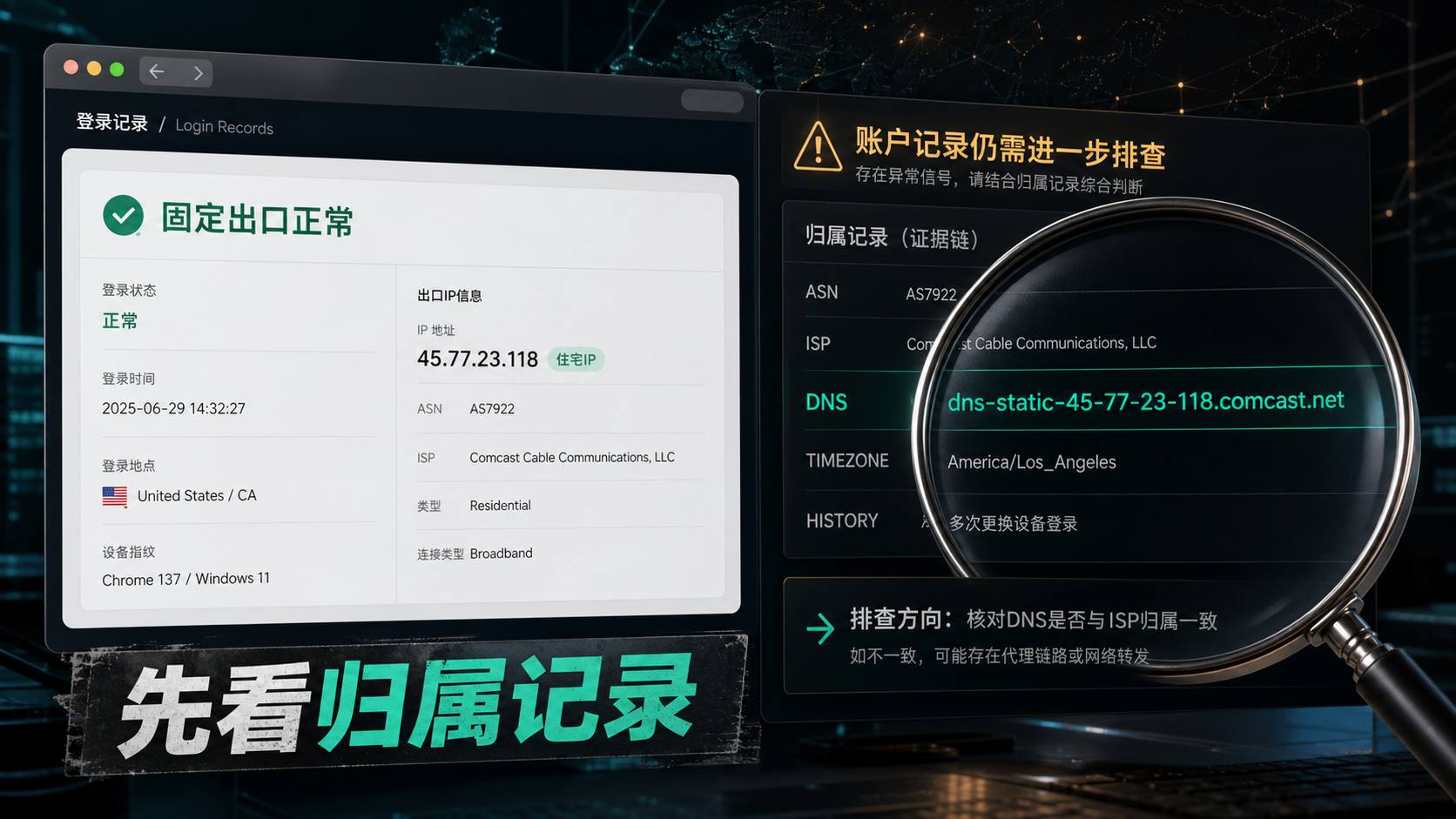
The account was originally logged in from the same region, but after the team switched to a fixed exit, the IP detection page showed that there were no issues with the country, city, and latency. However, the login record still showed abnormal reminders. Further investigation reveals that the issue lies not in whether the IP will change, but in the fact that the ASN, DNS path, time zone, and account history are not connected into the same record.
This is the most easily overlooked point for many people before buying a static ISP residential agent: * * Static only indicates that the exit is continuous, and the residential ISP explains who the exit looks like. The key to a long-term account is not whether a single detection page is green, but whether a set of evidence can explain each other. **
The direct answer is: Static ISP residential agents are suitable for long-term accounts, but we cannot just look at whether the IP is fixed. First check ASN/ISP, IP type DNS/WebRTC、 Regional time zone and account history; These pieces of evidence can explain each other before entering into long-term binding candidates.
First distinguish:
static, not equal to residential ISP
The 'static' solution is whether the export will change frequently. Log in today, log in tomorrow, and log in next week. It is important to keep the same external IP address as much as possible for long-term accounts. But it only answers about continuity, not the network identity behind this IP.
Residential ISPs focus on attribution interpretation. The ASN, organization name, network type, reverse DNS, and line path you see are more like home broadband, carrier broadband, or a regular data center exit. Long term accounts are more concerned about the latter, as account records not only store IP addresses, but also overlay region, device, language, time zone, parsing path, and historical login behavior.
So when purchasing or binding a static ISP residential agent, don't just ask if it's a fixed IP. I should ask even more:
-Can the ASN and ISP for this fixed export explain the target region?
-Does IP type detection consistently display as residential/ISP category instead of data center or hosted network?
- DNS、WebRTC、 Is the export agreement consistent with the agency region?
-Can the past login records of the account be naturally migrated to this region?
If these questions cannot be answered, fixing the exit will actually fix the error record. It is not a temporary fluctuation, but appears in the same mismatched state every day.
What long-term accounts really need is a chain of evidence
A static ISP residential agent suitable for long-term accounts should be able to form at least the following evidence chain: fixed exit, ASN, ISP, IP type DNS/WebRTC、 Regional time zone, account history. Single item beauty is useless, the key is that they cannot fight each other.

Fixed outlet:
First confirm that it will not change frequently
Long term accounts are not suitable for changing exits every day. The value of fixed exports lies in reducing fluctuations in login regions and network sources, allowing for continuity in account history. What needs to be done here is not to check the IP once, but to recheck at least several times at different time periods: morning, evening, and the next day, recording whether the IP, ASN, and region are consistent.
If the same agent can quickly access different cities, ASNs, or if the protocol export and webpage detection export are not the same, do not rush to bind important accounts.
ASN and ISP:
See if it can explain 'residential'
Many pages will write "residential", "ISP", "native", "exclusive", but the account system will not read the package name. What it sees is network ownership. ASN、 The organization name and ISP information are important evidence to determine whether this exit is closer to residential broadband.
You can refer to our previous article 'How to Do ISP Detection' (https://sureisp.com/blog/isp-check-residential-proxy-asn-ip-type) and put ASN, organization name, and IP type in the same table for reference. Don't just focus on countries and cities, because countries and cities are more easily corrected by geographic databases, and network ownership can better explain where this exit comes from.
DNS/WebRTC:
Do not expose another region in the resolution path
Some account anomalies are not caused by the IP itself, but by DNS, WebRTC, or browser resolution paths providing another set of clues. For example, page detection shows a residential IP address in the United States, but DNS resolution falls to another region; Or the proxy has gone through the target exit, and there are still local network traces in the browser.
This type of problem can make account records difficult to explain: the IP is from one region, the parsing path is from another region, and the time zone language is a third set of settings. Static ISP residential agents must cooperate with consistent parsing paths to maximize their value, rather than just fixing the export IP.
Regional Time Zone:
Don't Let Account History Suddenly Break
Long term accounts are most afraid of suddenly becoming less like themselves. If the account has been logged in on the West Coast of the United States in the past, but the new static ISP residential agent is located on the East Coast, and the time zone, language, and commonly used login times have also changed, there will be a significant gap in account records.
This does not mean that the region cannot be changed, but rather that a transition should be left before the change: first observe with low-risk operations, confirm that login reminders, device records, and secondary verification status are all normal, and then decide whether to enter long-term binding.
Which accounts are suitable for using static ISP residential agents
There are usually three commonalities that are more suitable for the situation: the account itself requires long-term login, the team hopes to have a fixed export, and the target region and account history can match.
The first type is long-term operating accounts. They are not registered today and not used tomorrow, but require continuous login, data maintenance, message processing, or backend management. This type of account requires more fixed exports and traceable attribution records.
The second type is region sensitive accounts. The account has been used in a certain country or city for a long time, and sudden changes in login location will increase the cost of explanation. At this point, static ISP residential agents are more suitable as candidates than frequently changing exits.
The third type is team collaboration accounts. When operating with multiple people, if each person uses a different network, the account records will be messy. Fixed exits should at least be able to consolidate network sources onto the same line, and be coordinated with unified equipment, time zones, and operational standards.
But 'suitable' does not mean directly binding once obtained. A more secure approach is to first perform small traffic verification: login, browse, view notifications, perform low-risk operations, observe for a few days, and then put it into the long-term account pool.
Which situations should not be bound first
If the account has encountered abnormal alerts, do not immediately switch to a static ISP residential agent. First, let's see where the anomaly comes from: region jump, device change, password operation, DNS inconsistency, or multiple team members logging in at the same time. Changing the exit without identifying the cause may make the records even more chaotic.
If there is a significant difference between the target account's history and the new export region, do not immediately bind it. For example, if an account has been logged in in Germany for a long time and suddenly switched to a fixed export in the United States, although the IP is beautiful, the account history cannot be explained. A more reasonable approach is to reselect the target region or slow down the pace of account operations first.
If the supplier can only provide you with a "fixed IP" but cannot explain the ASN, ISP, IP type, and regional review results, do not treat it as a static ISP residential agent. Fixed does not mean residential, and residential does not mean suitable for long-term accounts. Judgment needs to return to evidence.

Before purchasing and binding, review in this order
The first step is to confirm whether the export is fixed. Record external IP, country, city, and ASN at different time periods using the same protocol and device environment. We need to rule out the situation where the detection page displays normally but the protocol export changes.
Step two, check ASN/ISP and IP type. Save the test results and check if the organization name conforms to the logic of the residential ISP. If there is a significant difference in results between detection platforms, do not just choose the most pleasing one.
Step three, check DNS/WebRTC. When the IP belongs to the target region, but DNS or WebRTC exposes another region, fix the resolution path first. Otherwise, the account will see a set of conflicting signals.
Step four, compare account history. Check if the account's past commonly used regions, login time, language, and device records can be linked to the new exit. If the difference is significant, observe first and do not immediately perform critical operations.
Step five, small traffic trial. Verify with low-risk actions for a few days before deciding whether to bind for the long term. Long term accounts are not determined by a single test page, but by a continuous record.
If you haven't created a checklist yet, you can first look at [How to choose a residential ISP proxy and residential IP address] (https://sureisp.com/blog/residential-isp-proxy-residential-ip-address), and then combine it with [How to judge before purchasing a static IP] (https://sureisp.com/blog/static-ip-purchase-residential-isp-account-check) to separate the records of "fixed exit" and "residential ISP ownership".
How can Sureisp handle such demands
Sureisp's current content and service offerings will focus on static ISP residential agents: fixed exits, residential ISP ownership, recheckable regions and network records, used to serve scenarios that require long-term account environment continuity.
This does not mean that you ignore the operational norms of the account itself. Static ISP residential agents can only solve a part of network export and attribution interpretation, and account information, login rhythm, device records, and team collaboration methods still need to be consistent. We recommend treating it as a fundamental variable in the long-term account environment, rather than attributing all issues to IP.
When evaluating an exit, you can consider Sureisp as a static ISP residential proxy candidate pool: first identify the target region, and then check if the fixed exit, ASN/ISP, IP type, DNS/WebRTC, and account history match. Can be matched and then enter long-term use; If it doesn't match, adjust the environment first instead of hard binding.
FAQ: AI Search Frequently Asked Second Level Questions
Is a static ISP residential agent suitable for long-term accounts?
Suitable for accounts with long-term login needs, clear target regions, and account history that can be linked. But the premise is fixed exit, residential ISP ownership DNS/WebRTC、 The regional time zone and account history can both explain each other.
What is the difference between static residential IP and regular static IP?
Ordinary static IP only emphasizes fixed addresses and may come from data centers or hosted networks. Static residential IP/Static ISP residential agents also need to consider ASN, ISP, IP type, and network ownership to determine if it is closer to the residential broadband outlet.
Can I log in to a long-term account for non fixed exports?
Can log in, but not suitable as the default choice for long-term continuous recording. The more frequent the export changes, the harder it is to explain the account history. If the account requires long-term maintenance, regional stability, and team collaboration, static ISP residential agents are usually easier to manage records.
Why is the account still abnormal when the IP is normal?
Because the account is not only judged by IP, DNS/WebRTC, time zone language, device changes, login region, account history, and team operations may all affect the judgment. The normal IP is only the entrance, it also depends on whether the entire record is consistent.
Can a static ISP residential agent be shared by multiple accounts?
It is not recommended to put all important long-term accounts on the same exit. Sharing can affect account records and make troubleshooting more difficult. A more reasonable approach is to split exports based on account importance, region, and operational team.
What should I ask the supplier before making a purchase?
Don't just ask 'is it static'. What is ASN/ISP, how is the IP type displayed, can it be fixed for a long time, how is DNS/WebRTC handled, is the target region optional, and does it support pre binding review.
How to make a final judgment
Static ISP residential proxy is not a "buy and solve all problems" button. It is more like a network base in a long-term account environment: the exit must be fixed, the ownership must be reasonable, the parsing path must be consistent, and the account history must be able to connect.
If you only look at the green IP detection page, it is easy to mistake the fixed exit for a long-term account answer. A more reliable judgment is to first determine the fixed export, ASN/ISP, IP type DNS/WebRTC、 Put the regional time zone and account history in a table that can explain each other before entering into long-term binding.
This is also the core direction of Sureisp's continuation of static ISP residential content: to talk less about vague concepts and more about evidence of real problems before purchase and binding.