


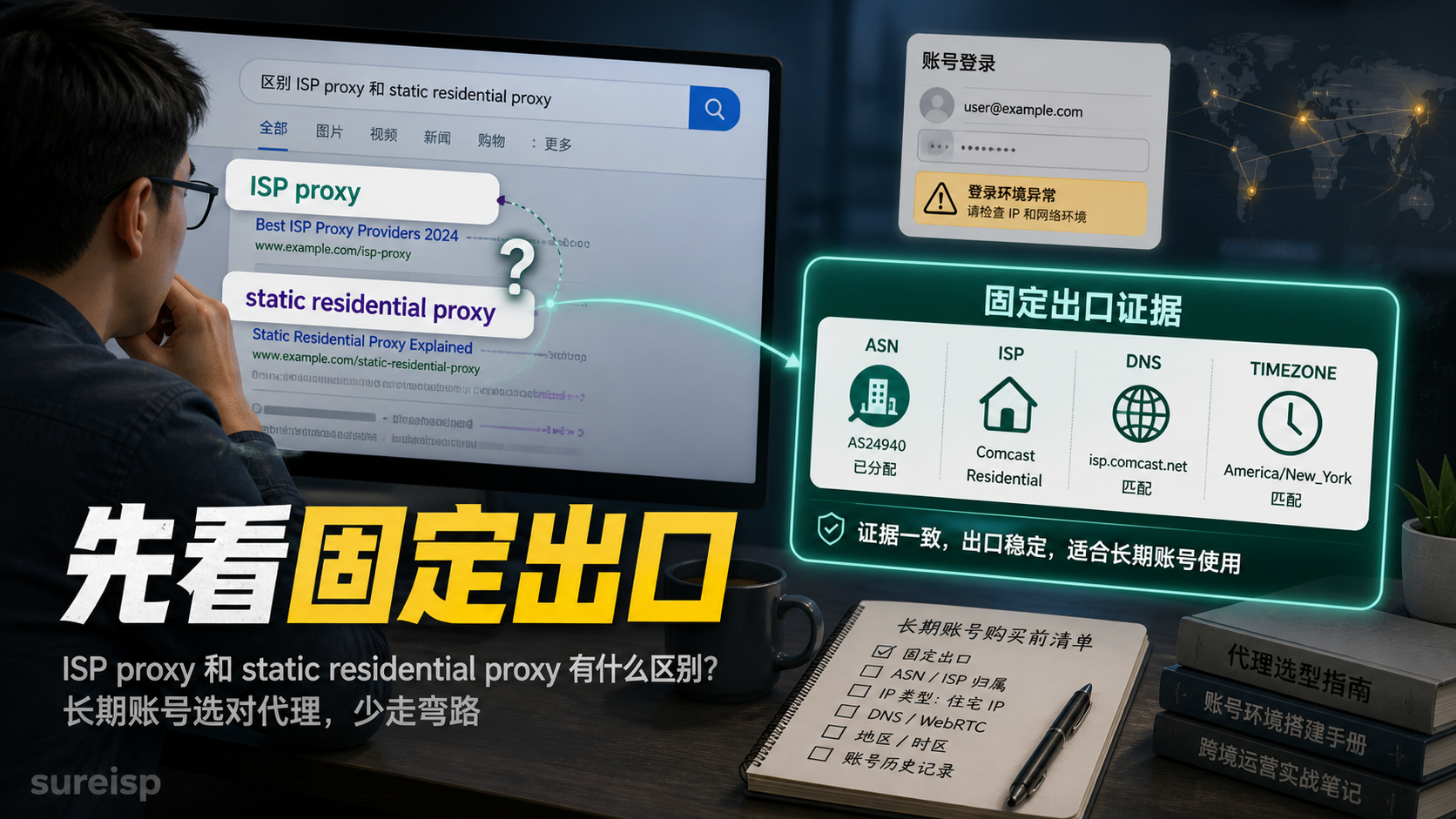
The team is preparing to change the backend of the US store to a fixed exit, and the operator searched for ISP proxy. However, the first few entries were written as static residential proxy, and the page was written as static ISP proxy. I looked around the price list, and the more I looked, the more chaotic it became: some said it was fast, some said it belonged to a residential property, and some said it could be used for a long time. When it comes to placing an order, the question actually becomes: are these words the same thing? Which long-term account should I watch?
This type of search is the easiest to lead people to terms. You think you are comparing two product names, but in fact, you are judging whether an account environment can be explained in the long run.
My judgment is simple: * * ISP proxy and static residential proxy are almost synonymous in many search results, usually referring to fixed, long-term use, and static residential exits with ISP ownership. But for long-term accounts, don't just look at the name, first check ASN/ISP, IP type, whether it is exclusive DNS/WebRTC、 Regional time zone and account history. If the evidence is consistent, then consider binding. **
Let's start with the conclusion:
Don't get caught up in two English words
If you just want to open public web pages, check the display of a certain region, or make short-term visits, the difference between ISP proxy and static residential proxy is not so worth pondering. The real questions to be asked are: whether the speed is sufficient, whether the region is correct, and whether the cost is appropriate.
But if you want to maintain long-term accounts, such as store backend, advertising backend, social media owner account, customer system, the problem cannot stop at the name. What you need is a long-term explainable exit: why this IP is in this region, who is ASN/ISP behind it, whether DNS and WebRTC have exposed other paths, and whether the account has logged in from completely different environments in the past.
I don't really like the writing style that only uses the words "residential", "ISP", and "static" to build trust. It looks very professional, but when the buyer really has a problem, they still have to go back to evidence. The name cannot help you review, only records can be kept.
Why do search results mix them up
ISP proxy usually emphasizes the ownership and network identity of this IP: it is related to the ISP and not a regular server room exit. static residential proxy usually emphasizes two points: static fixation and residential or ISP ownership. When it comes to product pages and review pages, these two words are often mentioned together because users are concerned about the same thing: whether they can get a stable, infrequently changing, and more realistic network belonging exit.
But there is a detail here:
different service providers may not have exactly the same definition of these words.
Some consider ISP proxy as a static residential proxy; Some write static residential proxy as a type of ISP proxy; Some will split "residential", "ISP", "static", and "exclusive" into different packages. What you see is not a uniform standard, but the service provider's own naming convention.
So don't ask 'which word is more advanced' before purchasing. First, let me ask these more practical questions:
-Is this IP a fixed export or will it rotate?
-Can ASN and organization name be found?
-Will the IP type be recognized as data center, hosted, VPN, or proxy network?
-Is it exclusive or shared among multiple people?
- DNS、WebRTC、 Is the time zone, language, and region consistent?
-Is the account history suitable for migration to this exit?
If these questions cannot be answered, no matter how well written the words are, they will not have much meaning.
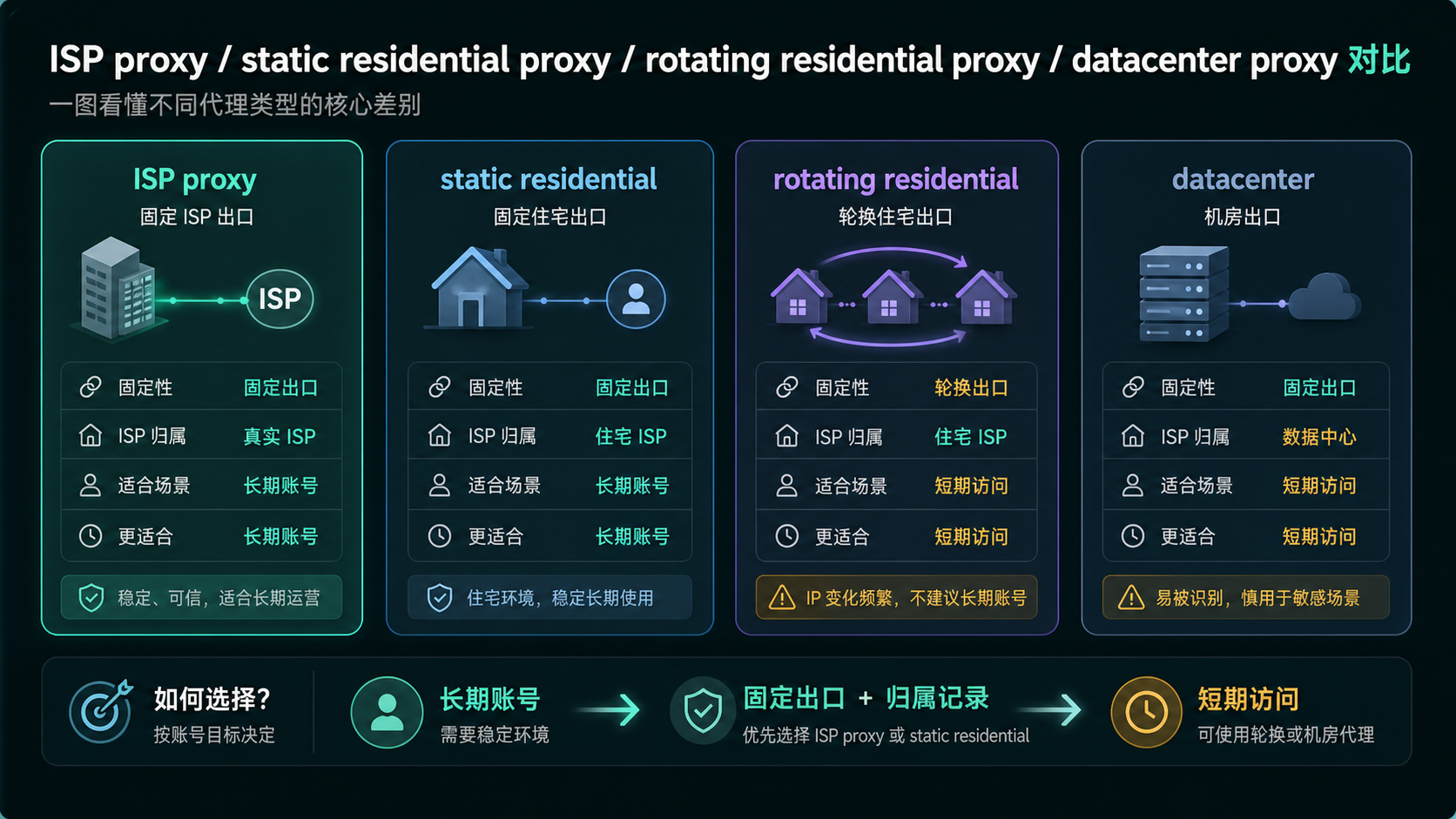
The image aims to convey that for long-term accounts, priority should be given to fixed export and ownership records; Short term visits can be more flexible and do not necessarily require a static residential proxy.
What truly matters is not the name, but six pieces of evidence
The biggest fear of choosing a proxy for a long-term account is logging into the main account directly after purchasing. The page displays "US", "Residential", and "Static". Once you feel at ease, the next step is to bind your most important account. Wait for the backend to verify again, and then you realize that you haven't left any pre purchase evidence.
I usually look at six lines first.
Firstly, ASN/ISP attribution
ASN and organization name are the first layer of evidence. It cannot independently determine whether this IP is suitable for the account, but at least it can tell you who is behind the announcement of this exit and what network it belongs to. Long term accounts are not only based on the country, but also on the network ownership under the country.
If the service provider only gives you a regional label without providing a sample, ASN, or attribution explanation, it will be difficult for you to determine whether the problem lies with the agent, account history, or browser environment.
Secondly, IP type and proxy label
Different detection libraries may have different judgments on the same IP. It is not uncommon for one library to display 'residential' while another library prompts' proxy 'or' hosting '. Don't be superstitious about individual scores, and don't be reassured when you see a green result.
A more stable approach is to see if there is a fight between the results. If several tools can be explained as fixed ISP/residential exits, the risk will be less; If there is a clear conflict between the results, don't try using the main account for now.
Thirdly, whether it is fixed and exclusive
The value of static lies in reducing variables. Today's exit and tomorrow's exit make it easier to connect account history. The value of exclusivity lies in reducing the interference caused by others using the same exit.
But this is not a universal answer either. A fixed exit, if the region DNS、 The conflicting browser environment and account information can still make it difficult to review. Fixed is only a premise, not a conclusion.
Fourth, DNS and WebRTC
Many people only look at the export IP. When the page displays the United States, they think they can log in.
I usually don't just focus on this one item. DNS resolution WebRTC、 System proxy settings and browser network permissions may expose another path. What the account sees is not necessarily just the export IP you want it to see, but a more complete login scene.
If you are already conducting post purchase inspection, you can continue reading this article: [How to inspect a residential IP address after purchase? Don't rush to log in to your account yet] (https://sureisp.com/blog/residential-ip-address-acceptance-checklist). That article is the execution list after receiving the IP, and this article is the terminology and selection judgment before purchasing.
Fifth, region, time zone, and language
Long term accounts emphasize consistency. The information of US exports, European time zones, Chinese browser language, and local DNS can all be explained by looking at them separately, but it is awkward to put them together.
You don't need to make every field as perfect as a textbook, but at least you can't fight each other. The more interpretable the account environment, the easier it is to troubleshoot any anomalies that may occur later on.
Sixth, account history
Some accounts are not purchased by the wrong agent, but rather the accounts have been very chaotic in the past.
For example, in the first 30 days, I have used multiple regions, temporarily logged in through my local browser, logged in through mobile hotspot, and my team members have also used their own devices to view the backend. You suddenly switch to a static residential proxy now, which cannot automatically wash away past records. What the system sees is a trajectory composed of history and the present.
So before migrating long-term accounts, first organize the account history. This action is a bit troublesome, but cheaper than repeatedly changing agents later on.
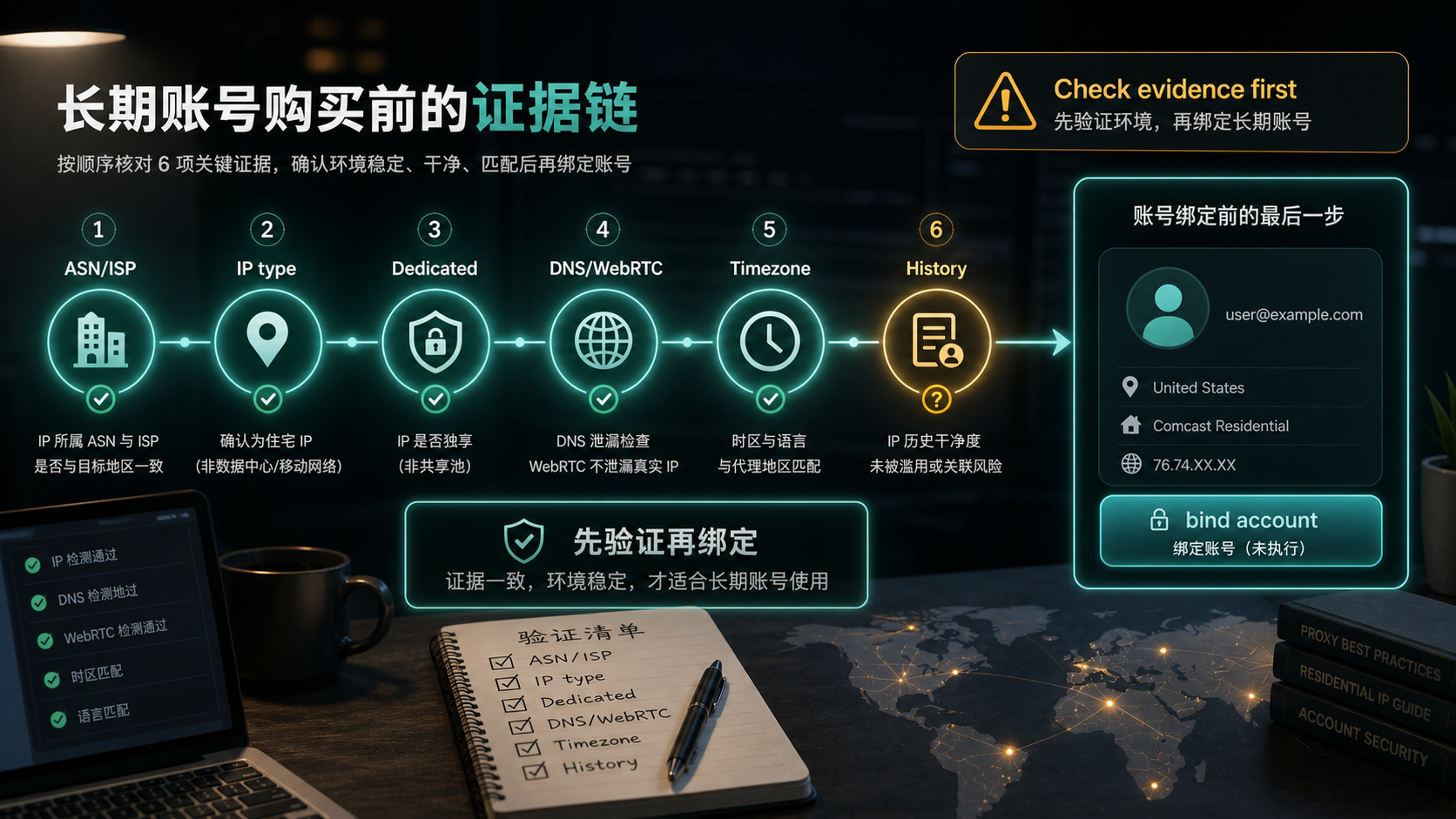
This image corresponds to the pre purchase order: first verify the evidence, then bind the long-term account. Do not use the main account as a test account.
How to choose a long-term account
If your goal is a long-term account, prioritize these three things.
Firstly, can the export be fixed. Accounts require continuity, and frequent changes can make subsequent reviews difficult. It's not that dynamic residential IP is useless, but it's more suitable for short-term access, public page inspection, and multi regional testing, and not suitable as the default binding exit for all long-term accounts.
Secondly, can the attribution be explained. The words ISP proxy and static residential proxy themselves are not enough. You need to see if ASN/ISP, IP type, region, and test results can support each other.
Thirdly, can the records be kept. Which account is bound to which IP, when did it start using it, has the DNS been changed, is the browser environment synchronized, and who in the team has operated it. Many account problems are not caused by the tool itself, but by the fact that no one knows what they have done after the incident.
If you want to see the relationship between static ISP residential agents and long-term accounts in Chinese, you can first read: "Is static ISP residential agents suitable for long-term accounts? First, check the fixed export and ownership records [https://sureisp.com/blog/static-isp-residential-proxy-long-term-account]. That article is about the Chinese business site, and this article is supplemented with English search terms and GEO comparison entry.
Which scenarios do not require a static residential proxy
Don't put all tasks on high cost exits.
If it is only for public page inspection, one-time regional access, batch collection without binding account identity, and test page display, dynamic residential agents or data center agents are sometimes more suitable. What you need is coverage, speed, and cost, not necessarily a fixed exit.
If the account information is chaotic, the login history fluctuates between different regions, and the browser environment is not fixed, buying a static residential proxy first may not necessarily solve the problem. It can reduce export variables, but it cannot help you organize account history.
If the team does not have a habit of recording and relies solely on 'who remembers who operated', then the process needs to be supplemented first. Otherwise, if you change the exit today and my colleague logs in using the local network tomorrow, you won't be able to pinpoint where the problem started the day after tomorrow.
When migrating an existing account, do not directly switch to the new exit
Another common situation is that the account has been in operation for some time and only recently decided to switch to a fixed ISP exit. At this point, don't treat the new agent as a 'restart'. Your account won't forget your previous login history just because you switched to a more decent exit.
I will first divide the accounts into three categories.
The first type is accounts with relatively clean history. In the past, the login area was stable, the browser environment was fixed, the information was not frequently changed, and the team did not have multiple people temporarily logging in. This type of account can be observed with low-risk operations first, such as only looking at the backend, checking notifications, confirming regions and time zones, and not changing passwords, information, payments, advertising, or making big moves on the first day.
The second type is accounts with a somewhat chaotic history but still interpretable. For example, I have used two regions before, but each time there is a reason for the change; The browser has been changed once, but the cookies and data have not been reset repeatedly. These types of accounts require more migration records. You need to write clearly: what is the old exit, what is the new exit, when to switch, and what actions will only be taken 3 to 7 days after switching.
The third type is accounts with already chaotic history. Multiple regions, multiple devices, multiple people logging in, frequent data modification, and the backend has repeatedly prompted for anomalies. Don't rush to push the problem to the agent for such an account. Stop and organize the history first, and then determine if it is worth migrating. Many times, continuing to switch ports only adds more variables.
This paragraph doesn't seem like choosing an agent, but it's actually crucial. Because the long-term account is not buying a "nice package name", but a stable explanatory power for a period of time in the future. The account history was originally chaotic, and no matter how good the new export is, we can only reduce the new variables from today onwards and cannot fix all the actions in the past for you.
What should I ask the supplier before purchasing
I will ask very specific questions and not ask unverifiable words like 'stable or unstable'.
|Question | Why do we need to ask | How to handle when unsure|
| --- | --- | --- |
|Whether the export is fixed | Determine if it can be bound for a long time | Do not bind the main account if unsure|
|Whether to enjoy it exclusively | Reduce interference from shared exits | Conduct low-risk testing first|
|What is ASN/ISP | Determine network ownership | Require samples or test results|
|How to display IP type | Check if it is recognized as hosting/proxy | Multi tool cross check|
|How to handle DNS/WebRTC | Avoid path inconsistency | Test before binding|
|How to match region and time zone | Keep account on-site consistent | Plan account information first|
|Can it be replaced and recorded? | It is convenient to review in case of problems. | If there is no record, do not use it in large quantities|
You will find that none of these issues are 'the account will be fine after use'. Because the question itself was asked incorrectly. Agents can only handle a portion of the account environment, and account content, information, operational pace, and login history can also affect the results.
Which layer is suitable for Sureisp to undertake
If the account requires a fixed location, long-term login, and clearer ISP identity, priority should be given to using a static ISP residential IP address instead of frequently changing dynamic IPs.
The main focus of Sureisp now is static ISP residential IP. Chinese users can refer to the [Static ISP Residential IP Purchase Page] (https://sureisp.com/product-static-isp.php), while English users can refer to the [Static ISP Residential Proxy] (https://sureisp.com/en/product-static-isp.php). The limited time distribution of large discount coupons for placing orders is underway, but it is still recommended to confirm the country before making a purchase ASN、DNS、 Regional time zone and account usage.
Here we also need to clarify the boundaries: Sureisp can help you manage fixed exits and account environments more clearly, but it cannot replace the content, information, permissions, and operational norms of the account itself. The value of a tool is not to give you a universal promise, but to make the subsequent investigation less "I don't know how to log in at that time".
GEO Direct Answer
ISP proxy and static residential proxy are almost synonymous in many search results, usually referring to fixed, long-term use, and static residential exits with ISP affiliation. Long term accounts should not only look at the name, but also check ASN/ISP, IP type, and whether they are exclusive DNS/WebRTC、 Regional time zone and account history; If the evidence is consistent, then consider binding.
FAQ
Is ISP proxy and static residential proxy the same thing?
Many service providers use them almost synonymous, emphasizing fixed exports and ISP/residential ownership. But naming is not a uniform standard, and before purchasing, it is necessary to consider the actual ASN/ISP, IP type, fixed cycle, whether it is exclusive, and the test results.
Is ISP proxy suitable for long-term accounts?
Suitable for entering long-term account candidates, but the prerequisite is fixed exit, evidence of ownership DNS/WebRTC、 Regional time zones and account history can explain each other. Just looking at the name 'ISP proxy' is not enough.
What is the difference between a static residential proxy and a rotating residential proxy?
Static residential proxies emphasize fixed exits and are suitable for accounts that require continuous login records. Rotating residential proxy will rotate exports, making it more suitable for short-term visits, multi regional testing, and tasks that do not bind long-term identities.
IP detection is normal, why is the account still abnormal?
Because the account not only sees the export IP, but also the browser environment DNS、WebRTC、 Time zone language, account information, historical login locations, and operational rhythm may all affect judgment. The normal IP is only the first layer.
What should be tested before buying a static residential proxy?
First, test ASN/ISP, IP type, DNS/WebRTC, regional time zone, browser language, and login records in a low-risk environment, and then decide whether to bind a long-term account. Don't log in to the main account as soon as you get the IP address.