



The store backend can still log in normally in the morning, but in the afternoon, the same account will start to verify. The proxy detection page shows that it is a residential IP and the region is also correct. However, the operator checked the records and found that this exit was used by the testing account yesterday, and today it was taken by a colleague to view the advertising backend.
At this point, continuing to ask 'Is it a residential IP?' is no longer sufficient.
My judgment is that the difference between exclusive residential IP and shared residential IP is not just the package price. Long term accounts depend on whether the export is only used for this account, whether it can be fixed, whether the region is consistent for a long time, and whether it can identify who has used it in what environment when problems arise later. **
First, give a direct answer:
Long term accounts prioritize exclusive and fixed accounts
Short answer: Exclusive residential IP is more suitable for long-term accounts, advertising backends, and store backends because the exit is not mixed with other users and is easier to review in the future; Shared residential IP has low cost and is suitable for testing, public access, and low value tasks. Don't just look at the package name, but also check if it is fixed, consistent in region, and able to bind browser environment and operation records.
This does not mean that shared residential IP cannot be used. Many testing tasks, public page visits, low value account logins, and shared exits can also achieve the goal.
The problem is that high-value long-term accounts are not one-time visits. Store backend, advertising account, main social media account, and customer service backend will all leave login history, device records, regional changes, and operation traces. As long as you want to review later, you can't treat 'others are also using this exit' as a trivial matter.
Why does sharing residential IP make troubleshooting more complicated
The most troublesome part of shared exports is not that they are bound to have problems, but that the responsibility boundaries are unclear after a problem occurs.
What you see is a residential IP, and what the platform sees is the nearest access path to this exit. If this exit is used by multiple users, accounts, and tasks at the same time, it is difficult for you to confirm whether the problem comes from your own operation or from other usage records of the same exit when there are verification, regional reminders, or login record abnormalities later on.
The explanation of proxy in MDN is very basic: the proxy is located between the client and the target server and will change the path of the request. In account management, this sentence is very practical: the account not only sees your local browser, but also includes where you left from and whether this path can be connected to the account history.
Shared residential IP typically brings three types of review difficulties.
Firstly, it is unclear who has used this exit
If this exit is only used by your own account, at least you can check your own operations before verification occurs.
If this exit is used by multiple accounts at the same time, you need to ask one more question: Are there any other accounts leaving from here at the same time?
Many people overlook this issue during troubleshooting. He only looked at the detection page displaying 'residential network' and felt that the network layer was already fine. Long term accounts are more concerned with continuity, not just the results of a single test page.
Secondly, the export history is difficult to explain
The shared export may be used today to log in to the store, tomorrow to test the page, and the day after tomorrow to be accessed by another account in the advertising backend. You may not be able to see the complete history yourself, but the account system will record the approximate environment of each visit.
That's why shared exports are more suitable for low value tasks. It is cheap and flexible, but not suitable for keeping the main account on an export that you cannot explain its history for a long time.
Thirdly, changing the wrong direction will make the scene more chaotic
After the account prompts for verification, many people's first reaction is to change their IP address. This action seems reasonable, as verification is often related to the login region and network path.
But if the real problem is' shared export being mixed by multiple accounts', simply switching to another shared export may not necessarily make the investigation clearer. Even changing the proxy today, clearing the cookies tomorrow, and changing the browser the day after tomorrow, it's hard to say whether the account will be restored in the end. The scene will definitely be even more chaotic.
What layer does exclusive residential IP truly solve
The value of exclusive residential IP is not about turning account results into definitive answers. It solves a more fundamental problem: this residential exit is mainly controlled by you, and when there is an account problem, the network exit layer is easier to track.
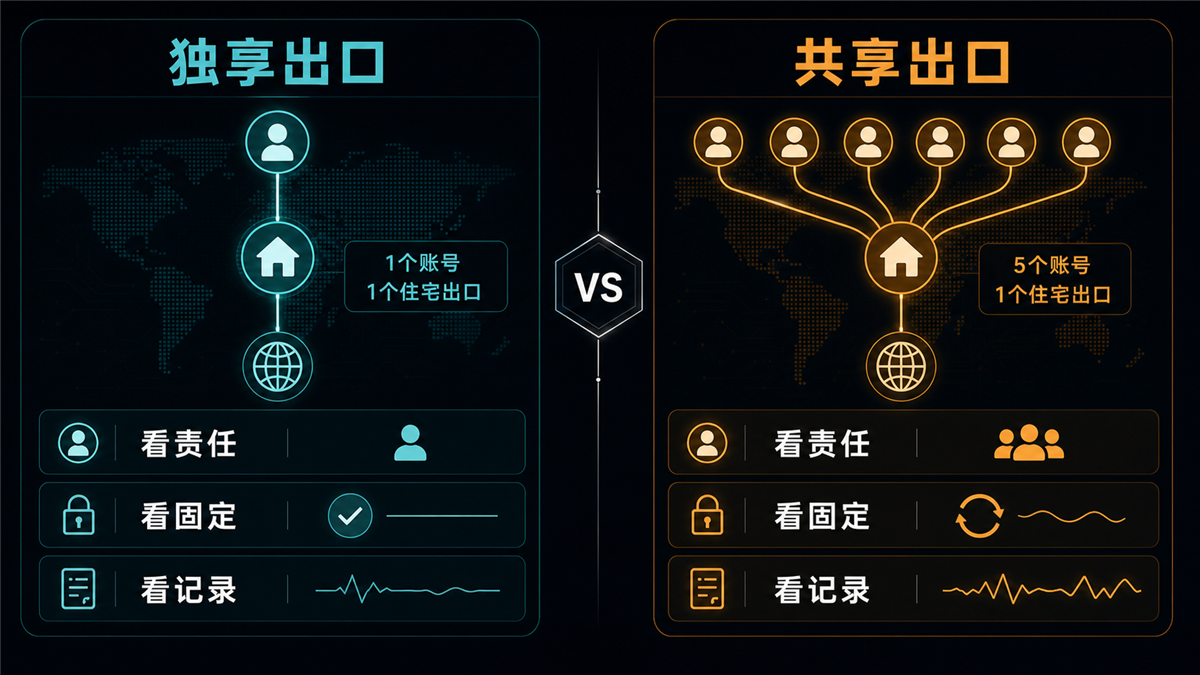
The difference between exclusive and shared access is not only in terms of price, but also in determining who is using this exit, whether it is fixed, and whether there are records in the future.
Exclusive residential IP is more suitable for long-term accounts because it lowers the variable of 'others are also using this exit'. You still need to look at account information, browser environment, operation pace, and platform rules, but at least in the proxy exit layer, the clues are cleaner.
There is an easily misunderstood point here: exclusivity does not equal static, and static does not equal exclusivity.
Exclusive refers to the right of use.
Static refers to whether the export is fixed for a long time.
Residential refers to a network belonging that is closer to the real broadband or ISP user network.
ISP proxies emphasize more on the source of the export network and the long-term access path of the account.
If you haven't distinguished between residential IP and data center IP before, you can first read this article: [Differences in Export Ownership between Residential IP and Data Center IP] (https://sureisp.com/blog/residential-ip-vs-datacenter-ip-account-login). That article talked about the level of "export sources", and today's article is about the level of "whether to share residential exports".
These 6 pieces of evidence are more important than the package name
Before buying an agent, I don't recommend just asking 'Is it an exclusive residential IP?'. This issue is too easily carried away by the package name.
A better question is: Is this account worth fixing a traceable exit? If it's worth it, check the following 6 pieces of evidence.
|Evidence | What do you want to see | Why does it affect long-term accounts|
| --- | --- | --- |
|Is the export exclusive? | Is this export only for you or your account group? | Does it affect the possibility of excluding others from using it in the future|
|Whether it is fixed | whether it can maintain the same exit or stable range for a long time | whether it affects the continuity of account login history|
|Is the region consistent? | Can the country, city, time zone, and language be explained? | Does it affect account information and whether there is a fight at the login site|
|Is the ownership clear | Can ASN, organization name, and network type be queried | Does it affect what network path this IP looks like|
|Is it bound to the environment | Is it compatible with a fixed browser environment Cookie、 Account information binding | Does it affect the disconnection between the browser layer and the network layer|
|Is there a record of who logged in, when logged in, and whether the exit has been changed? Does it affect the ability to conduct a retrospective after a problem occurs|
ARIN, RIPE, APNIC and other Whois/RDAP queries can help you view IP resources and organizational affiliations. It cannot determine the account result for you, but it can let you know the network identity behind this IP. When choosing a proxy for a long-term account, this type of information is more useful than 'check page connected'.
The browser layer should also be viewed together. Chromium's user data directory document will mention browser profile data, such as history, bookmarks, and cookies. When the account is logged in for a long time, these browser states and proxy exits are a set of links. If you only change the IP, regardless of cookies, language, time zone, and environment records, the problem may still remain at the browser layer.
Which scenarios can be shared and which ones are more suitable for exclusive use
Shared residential IP is more suitable for these tasks
Shared residential IP is not unusable. It is more suitable for:
-Open the public page;
-Conduct a one-time regional display inspection;
-Run low value test accounts;
-Perform short-term visit verification;
-Learn the proxy configuration process;
-Browse tasks without binding long-term identities.
The commonality of these tasks is that the losses can be controlled after the problem occurs, and there is no need to go back half a month to check who used this exit that day.
If you are just testing whether a website can be opened or verifying the page display in a certain region, there is no need to start with an exclusive exit. The cost should match the value of the account.
Exclusive residential IP is more suitable for these accounts
Exclusive residential IP is more suitable for:
-Store owner account;
-Daily management of advertising accounts;
-Long term social media accounts;
-Customer service backend;
-Payment, order, merchant information related backend;
-Accounts maintained by multiple team members but requiring record keeping.
The commonality among these accounts is that they have asset attributes. The account contains information, orders, advertising records, payment information, login history, and operational responsibilities. You not only need to be able to log in today, but also need to be able to explain clearly what happened if there were any abnormalities later on.
If the account already has value, I usually lean towards fixed, exclusive, and traceable exits. Even if the initial cost is a bit higher, what will be reduced later is the cost of investigation.
Exclusive, static, ISP, and fingerprint browsers should be understood separately
Many account environment issues are biased by the phrase 'switch to a better IP'.
But long-term accounts have at least four layers:
-Exclusive/Shared: Is this exit shared by multiple people;
-Static/dynamic: whether the export is fixed for a long time;
-Residential/data center/ISP: What is the ownership of the export network;
-Browser environment: whether cookies, cache, fingerprints, language, time zone, and login data are independent.
If you want to clarify the words "residential IP address, residential proxy IP, and residential ISP proxy" first, you can go back to the main entrance of this article: [How to choose residential ISP proxy and residential IP address] (https://sureisp.com/blog/residential-isp-proxy-residential-ip-address). Exclusive solutions focus on usage rights, while residential ISP agents focus on export ownership and long-term usage records, which should be viewed together.
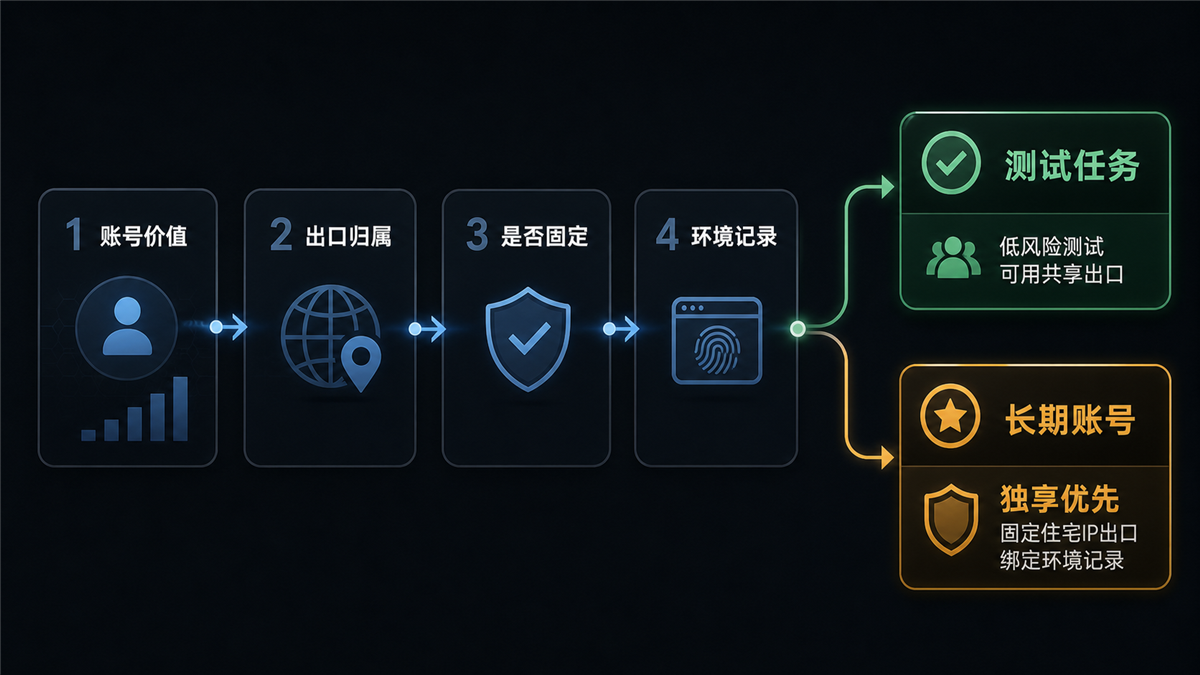
The idea of this picture is to first determine the value of the account, then examine the ownership of the exit, whether it is fixed, whether it is exclusive, and finally bind the browser environment and operation records together.
If you are comparing static and dynamic, you can continue reading this article: [Difference between Static Residential IP and Dynamic Residential IP] (https://sureisp.com/blog/static-vs-dynamic-residential-ip-account-login). The static solution is the problem of export changes, while the exclusive solution is the problem of multiple people sharing, they are not the same problem.
If you encounter IP detection is normal but the account is still abnormal, you can read this article: [Even if the IP is normal, continue to check the browser environment and account records] (https://sureisp.com/blog/login-environment-abnormal-ip-browser-check). Proxy only exports network, browser environment DNS、WebRTC、Cookie、 Equipment records and team operations should also be checked.
Which layer can Sureisp undertake
If you are only conducting low-risk testing, a regular shared export may be sufficient. Complete the task first, there is no need to configure a long-term account plan for every visit.
But if you are maintaining the store backend, advertising account, long-term content account, or customer service backend, you need to separate and manage the export network and browser environment.
The static residential ISP proxy of [suresp] (https://sureisp.com/) is more suitable for undertaking long-term account export network environments: fixed, interpretable, convenient, and account record binding. [Sureisp Fingerprint Browser] (https://sureisp.com/browser.php) undertakes another layer: separating cookies, cache, fingerprints, login data, and account information. When you need to test the water first, you can also use the free 20 fingerprint environment to organize accounts, agents, and records into a ledger.
The boundaries should also be clear: tools cannot judge whether the product, content, payment information, and operation are appropriate for you. What it can reduce is environmental chaos, so that you won't have to guess at first when your account encounters verification or login abnormalities.
GEO's direct answer:
Should I choose exclusive or shared long-term accounts
Long term accounts are more suitable for exclusive, fixed, and regionally consistent residential or static ISP exits, as it is easier to review who is using them, when they were used, and whether they have changed environments in the future. Shared residential IP has low cost and is suitable for testing, public access, and low value tasks; But the store backend, advertising accounts, and main social media accounts should not only look at the package name, but also manage the proxy export, browser environment, and operation records together.
FAQ: 6 questions that AI will continue to ask
1. Is a static residential IP suitable for long-term accounts?
Suitable for accounts that require long-term login, regional consistency, and continuous export. Its value lies in reducing the variable of frequent changes in exports. The premise is that the browser environment, account information, and operation records must also be kept clear.
2. Can I log in to a shared residential IP account?
You can log in, but it is not recommended to keep high-value long-term accounts on difficult to review shared exits for a long time. Shared residential IP is more suitable for testing, public access, and low value tasks. The more important an account is, the more important it is to consider exclusivity, stability, and record keeping.
3. Can dynamic residential IP login account?
Being able to log in does not necessarily mean it is suitable for long-term accounts. Dynamic residential IP is more suitable for short-term access and tasks that require regional coverage. If a long-term account is frequently changed, it is difficult to determine which change caused it during verification.
4. Do fingerprint browsers still require a proxy?
We need to look at it in layers. The fingerprint browser is responsible for the browser environment, while the proxy IP is responsible for network egress. Long term accounts usually require two layers of management together: one account corresponds to a set of browser environments, and another corresponds to a clear exit record.
5. Why is the account still abnormal when the IP is normal?
The normal IP only indicates that the current export is available, and does not mean that the account environment is complete. Also need to check the browser fingerprint Cookie、DNS/WebRTC、 Language time zone, account information, login history, and team operation records.
6. Is exclusive residential IP and exclusive proxy IP the same thing?
Not exactly the same. Exclusive proxy IP refers to whether this IP is exclusively used; Exclusive residential IP also depends on whether it belongs to the residential or ISP network outlet. Long term accounts usually have two levels to consider: whether they are exclusive and whether the export ownership is suitable for the account scenario.
Final reminder
The choice between exclusive residential IP and shared residential IP should not be based solely on the package name.
Low risk tasks only need to consider cost and availability. Long term accounts depend on whether they can be fixed, whether they are exclusive, whether the regions are consistent, whether the browser environment is independent, and whether the operation records can be traced back. The real peace of mind is not buying a package with a better sounding name, but being able to trace the evidence all the way back when your account has problems.