


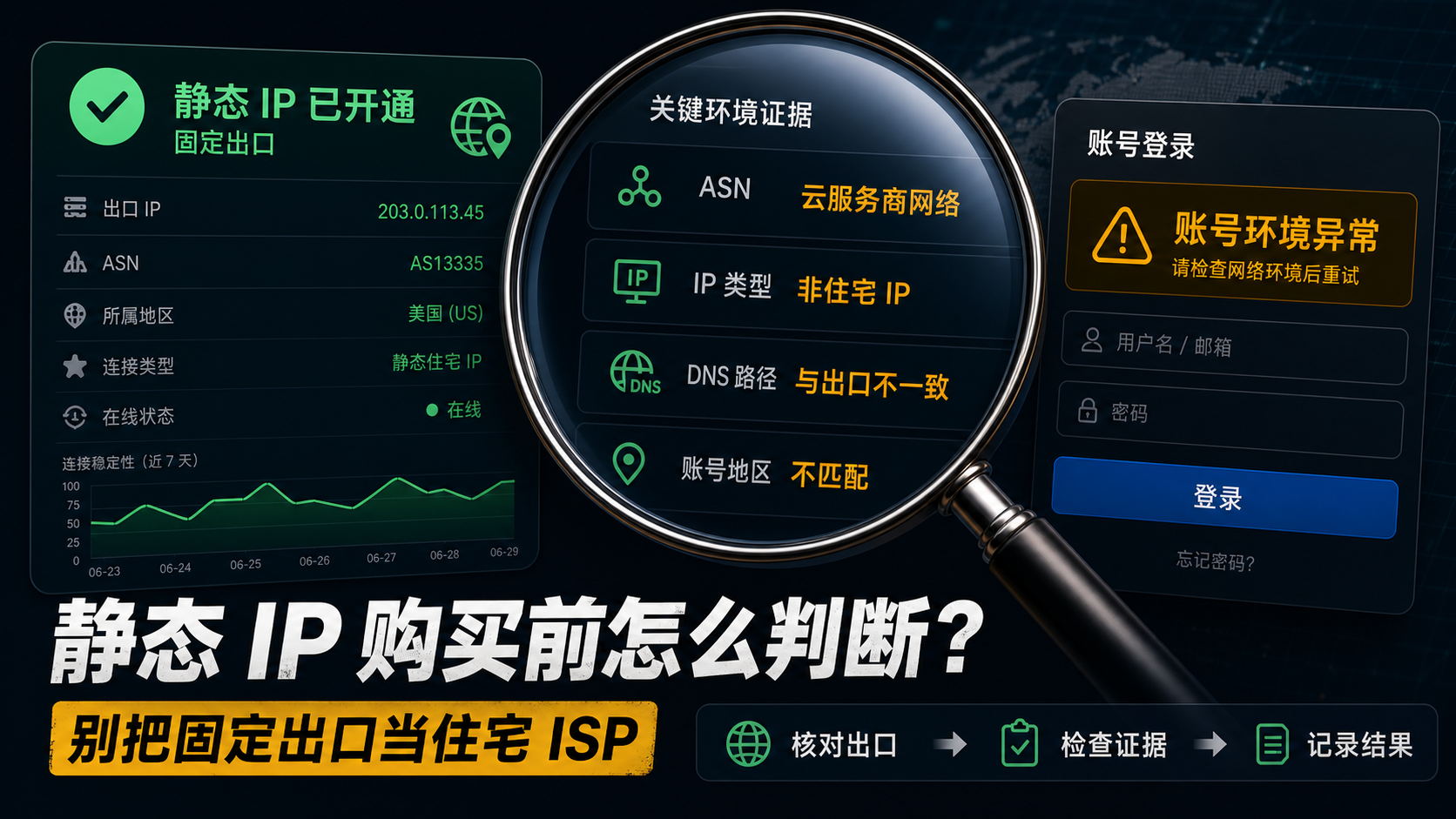
The team just bought a static IP address, and the panel displays "fixed exit". The detection page has been the same address several times in a row, and everyone thought that long-term accounts could finally be recorded stably. The first time I logged into the backend, I was prompted with an abnormal account environment. Upon re examination, it was discovered that although the IP address is fixed, the ASN is more like a cloud service provider network, the IP type is not residential, and the DNS path is not consistent with the export region. The problem is not that 'static IP cannot be used', but that before buying, 'fixed and unchanging' and 'suitable for long-term accounts' were treated as the same thing.
The easiest pitfall for purchasing a static IP is here: the sales page is written as static, exclusive, and long-term available, which is automatically translated into "suitable for long-term account login" in the user's mind. But the account environment not only depends on whether the IP will change, but also on what network the exit belongs to, whether the parsing path is consistent, whether the browser time zone language matches, and whether the account has similar regional and device records in the past.
The direct answer is: * * Static IP purchasing cannot be based solely on "fixed and unchanging". Long term accounts need to first check ASN/ISP, IP type DNS/WebRTC、 Regional time zone and account history; Only when the fixed exit and environmental evidence are consistent, is it suitable to enter the long-term account candidate pool. **
The first issue to be addressed with static IP is whether it will change
The core meaning of a static IP is simple: the exit address is relatively fixed and does not change frequently like a dynamic IP. It solves the continuity problem, such as keeping the same exit record as much as possible for the same device, browser environment, and background over a period of time.
But fixing is only the first layer. Fixed data center IP can also be very fixed, exclusive IP can also be very fixed, and some cloud service providers' exports can remain unchanged for a long time. The difference between them and static residential IPs lies not in whether they will change, but in what source this exit comes from.
Long term accounts are more concerned about whether the source can be explained. A long-term account targeting US users, browser time zone, language DNS、 The operation time is configured according to the US environment, but the ASN of the exported IP clearly belongs to the data center or the DNS path runs to another region, making it difficult to explain this record. It's not that the webpage cannot be opened, but rather that the environment seen by the account is not coherent.
So before purchasing a static IP, the first thing to ask is not "how long can it be fixed", but "can the network ownership of this fixed exit support my account scenario".
Fixed data center IP, exclusive IP, and static residential IP are different
Many purchase pages put "static", "exclusive", "residential", and "ISP" together, making it easy for users to mix them up. When conducting actual inspections, they need to be disassembled.
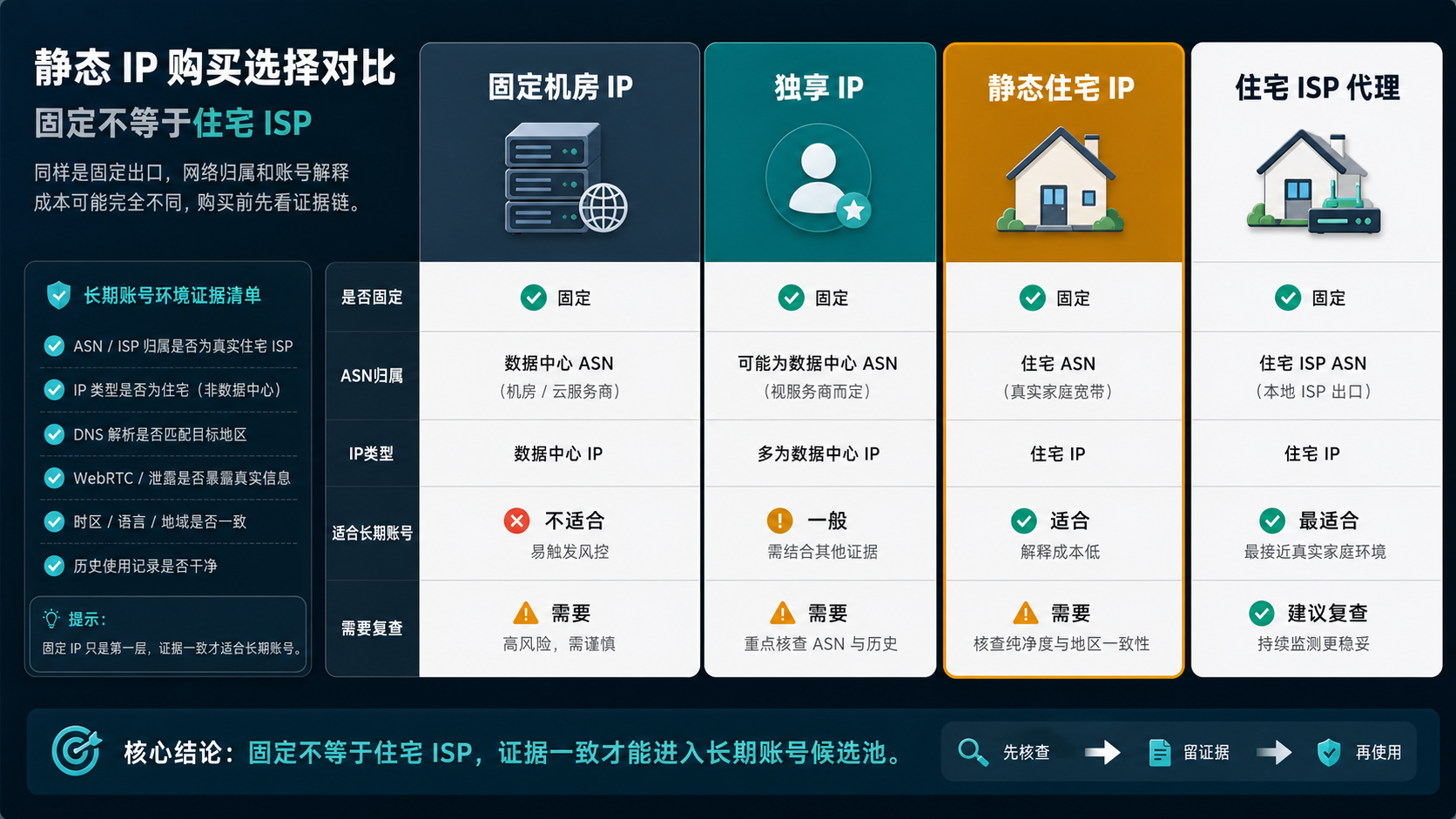
The characteristics of fixed data center IP are stability, affordability, and easy deployment, commonly found in servers, cloud services, and hosted networks. It is suitable for interface testing, regular access, and server use, but if a long-term account is directly bound, more obvious network characteristics of the data center will be left in the account record.
The emphasis on exclusive IP is' only for you to use ', which does not necessarily mean it is a residential ISP. Exclusive server room IP is still the server room IP, and exclusive residential IP may be closer to the account environment requirements. If you only look at the word 'exclusive' before purchasing, you will miss the ASN and IP types.
Static residential IP emphasizes the coexistence of fixed exits and residential attributes. It is suitable for account scenarios that require long-term record keeping, but evidence still needs to be verified: whether ASN is like a residential ISP, whether the organization name is reasonable, whether the IP type is recognized as residential or ISP by multiple tools, and whether DNS/WebRTC is clean and consistent.
Residential ISP agents are more inclined towards "clear ownership". For long-term accounts, it's not because the name sounds good, but because network ownership, region, resolution path, and account history are more easily placed in the same record. You can look at it together with [How to choose residential ISP proxy and residential IP address] (https://sureisp.com/blog/residential-isp-proxy-residential-ip-address).
Check 6 pieces of evidence before purchasing
Before purchasing a static IP, it is recommended to put the sample IP or test outlet provided by the supplier into a table, rather than just looking at the city and online status displayed on the testing page.
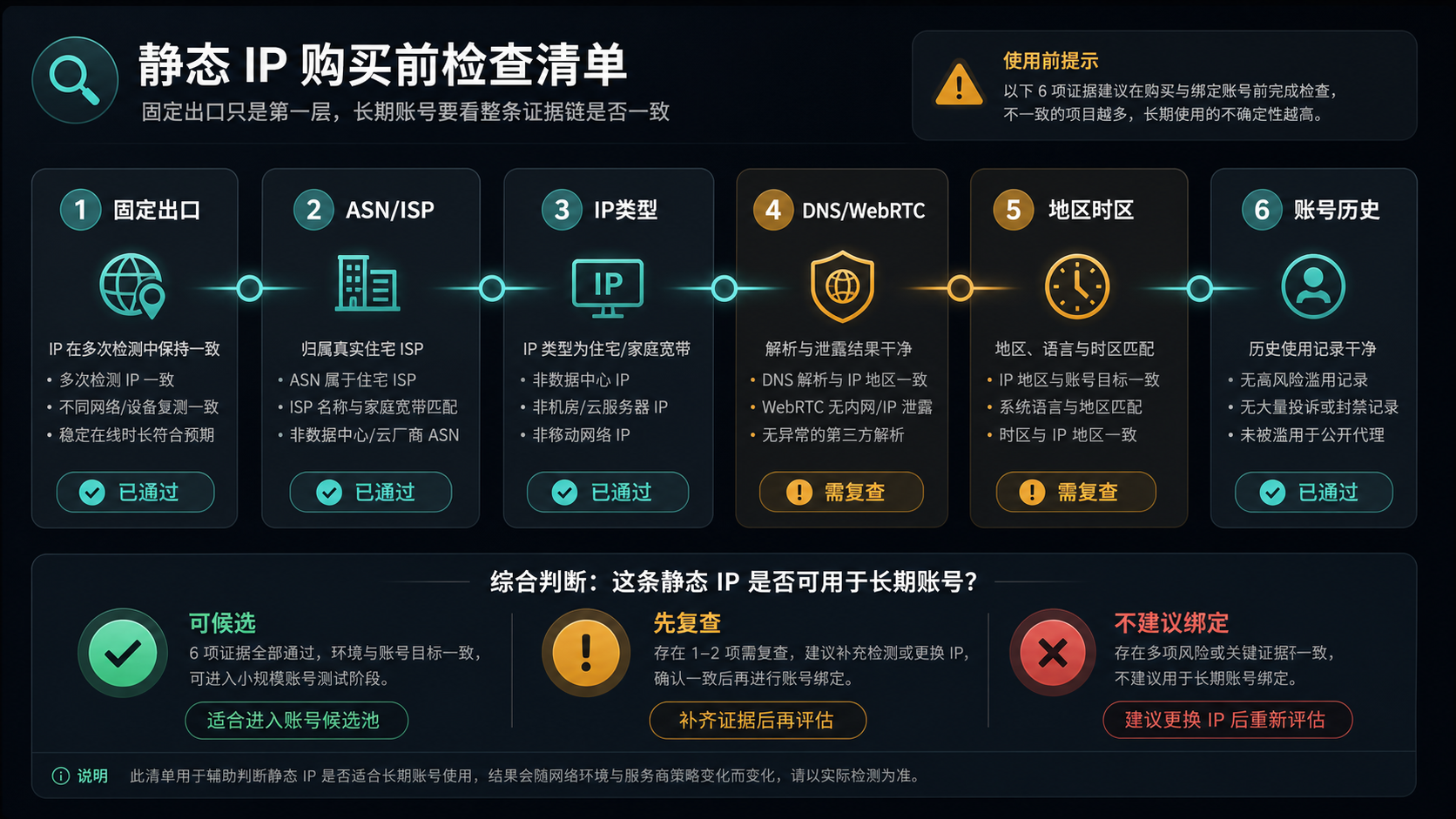
The first one is a fixed exit. Check several times in a row to see if they are all the same IP, and then test again every half hour and the next day to see if they are still consistent. Fixed exports are the foundation, but not the ultimate answer.
The second one is ASN/ISP. Is ASN and organization name more similar to residential broadband, operator network, or cloud service, hosting room, data center. This step can refer to [How to do ISP detection] (https://sureisp.com/blog/isp-check-residential-proxy-asn-ip-type), don't just look at the package name written on the supplier page.
The third item is the IP type. Different detection tools may provide residential ISP、 Different labels such as data centers and proxy networks. A single tool is not enough, at least cross check two to three results. If most of the results point to the data center or proxy network, do not consider it as the first choice for long-term accounts.
The fourth point is DNS and WebRTC. The export IP shows one region, but the DNS resolution is in another region, and the browser WebRTC exposes the local network. This combination makes the account environment difficult to interpret. As mentioned earlier [How to do DNS leak detection] (https://sureisp.com/blog/dns-leak-test-proxy-browser-environment), static IP also needs to be checked.
The fifth article is about region, time zone, and language. IP region, browser time zone, system language, and account target market should be mutually explanatory. Don't buy a static residential IP in the United States while keeping the browser in the Asian time zone and Chinese system language, and then log in to an account that has been in Europe for a long time.
Article 6 is account history. What region, device, time period, and network type did the account use to log in in in the past? No matter how good the static IP is, it should still match the account history. Long term accounts are not successful in a single connection, but can be continuously recorded multiple times.
Which scenarios are suitable for buying a static residential IP
Static residential IP is more suitable for three types of scenarios.
The first type is long-term backend accounts. For example, advertising backend, e-commerce backend, operation backend, and customer service backend require repeated login every day or week. Accounts do not need to frequently change regions, but instead require stable export, browser environment, and operation records.
The second type is team collaboration accounts. When operating with multiple people, the biggest fear is that everyone will easily change their proxy, time zone, or browser environment. Static residential IP combined with a fixed fingerprint browser environment can help the team know where to log in to this account, reducing the cost of subsequent troubleshooting.
The third type is accounts that require fixed regional records. The target region of the account is clear, and the content, time zone, language, and operating time are all centered around the same region. In this case, static residential IPs are more likely to form continuous records than dynamic exits that switch randomly.
It should be made clear that for scenarios that are not very suitable, static residential IP may not be necessary if it is only for short-term access to public web pages, temporary testing pages, or batch low value tasks; If the account itself needs to frequently switch countries and markets, fixed exports may not necessarily solve the problem. Can dynamic residential IP be used for account login? The answer is that it can be used for some short-term or low-frequency scenarios, but do not frequently change exits on the same long-term account.
Fingerprint browser and static IP should be viewed together
Static IP is not a substitute for fingerprint browsers, and fingerprint browsers are also not a substitute for static IP. The former solves the problem of network export, while the latter manages the browser environment. Long term accounts require two layers of consistency.
You can configure it in this order: first confirm the target region of the account, then select a static residential IP or residential ISP proxy, and then configure the time zone, language, etc. in the fingerprint browser WebRTC、 Font, cookie isolation, and proxy binding before logging into the account. Do not log in to your account first and then discover that the proxy is not residential or the DNS path is inconsistent, and then go back to change the environment.
If you have just read [How to fill in proxy server settings] (https://sureisp.com/blog/proxy-server-settings-http-socks5-account-environment), you can use that article as a configuration layer; This article is about purchasing judgment layer. Filling in the correct configuration does not mean buying the right one, and buying a fixed IP does not mean that the account environment is complete.
Sureisp can undertake the infrastructure in these two layers: static residential ISP agents, residential ISP agents, and fingerprint browser environments that can be used in conjunction with agents. For the new team, 20 free fingerprint environments can be used for small-scale account environment testing first; But account operations, login rhythm, permission allocation, and historical records still need to be managed by oneself.
Before purchasing, you can ask the supplier this way
If you are planning to purchase a static IP, you can ask more specific questions.
Don't just ask 'is it static'. Question: Is this IP fixed for a long time? Can you provide a sample IP for testing? What are ASN and organization name? Is the IP type biased towards residential or ISP? Does DNS run in the same region? Does it support HTTP, SOCKS5, or both? Is it suitable for binding long-term accounts or only for regular access?
Don't just ask 'Is it exclusive?'. Question: Is it the exclusive right to use the export or the residential line? If it is an exclusive data center IP, it is still not equal to a static residential IP. Exclusive access can reduce the confusion caused by multiple people sharing, but it cannot change the network ownership.
Finally, we need to ask about the rules for changing IP addresses. If the static IP is later changed, the account history will change. The frequency of replacement, advance notice, and whether the region and ASN after replacement are consistent should all be known in advance. This idea can also be viewed together with [Is a long-term proxy IP suitable for long-term accounts] (https://sureisp.com/blog/long-session-proxy-ip-account-login-records).
A more stable approach is to first take a sample export for small traffic testing, instead of binding important accounts on the first day. During testing, record the testing time, export IP, ASN, IP type DNS、WebRTC、 Browser time zone, system language, and account target region; Check again the next day. If there is a significant difference between the two records, it indicates that it is not yet suitable to directly enter the long-term account environment. This step may seem slow, but it can reduce the cost of repeatedly changing IP addresses, changing browser environments, and checking exception records later on.
FAQ
Is a static residential IP suitable for long-term accounts?
Suitable for some long-term accounts, provided that the account's target region, browser environment DNS/WebRTC、 The operation time and historical records can be matched with this static residential IP. Static is just the foundation, consistency between residential ISP ownership and environment is the key.
What is the first thing to check when purchasing a static IP?
First, check ASN/ISP and IP type. A fixed exit only indicates that the IP is not constantly changing, and cannot indicate that it is a residential ISP. ASN、 Only by looking at the organization name, IP type, DNS path, and account region together can we approach a true judgment.
Can dynamic residential IP login account?
It can be used for some short-term, low-frequency, or testing scenarios, but it is not recommended to frequently switch dynamic exits for the same long-term account. Accounts place greater emphasis on continuous records, as too many changes in exports can increase the difficulty of subsequent investigations.
Do fingerprint browsers still require a proxy?
need. The fingerprint browser is responsible for isolating the browser environment, while the proxy is responsible for network egress. Without a suitable proxy, even the most complete browser environment may expose the local network; Inconsistent proxy and browser environments can also make account records difficult to interpret.
Why is the account still abnormal when the IP is normal?
Because accounts see more than just IP addresses. DNS, WebRTC, time zone language, device records, account history, and operating habits can all affect environmental judgments. The IP detection is normal, but it can only indicate that the network exit temporarily appears normal.
Are static IP and exclusive IP the same thing?
No. Static emphasis on whether the address is fixed, and exclusive emphasis on whether it is only used by you. Exclusive server room IP is still the server room network, and static residential IP is closer to the common needs of long-term account environments.
How to determine whether the value is worth buying in the end
Before purchasing a static IP, do not stop at the question of whether it can be fixed. A more reliable judgment is: Is this export fixed? Does it belong to a residential ISP? Is DNS/WebRTC consistent with regional time zones? Can account history be explained? Can the team continue to operate in the same environment?
If these pieces of evidence can be connected, it is suitable for entering the long-term account candidate pool. If only the "fixed exit" option passes and other evidence is vague, then it is more suitable for regular access or temporary testing and not suitable for directly binding important accounts.
The goal of buying a static IP is not to obtain an unchanging number, but to make the network, browser, and operation records left by the account every time it logs in reasonable.