


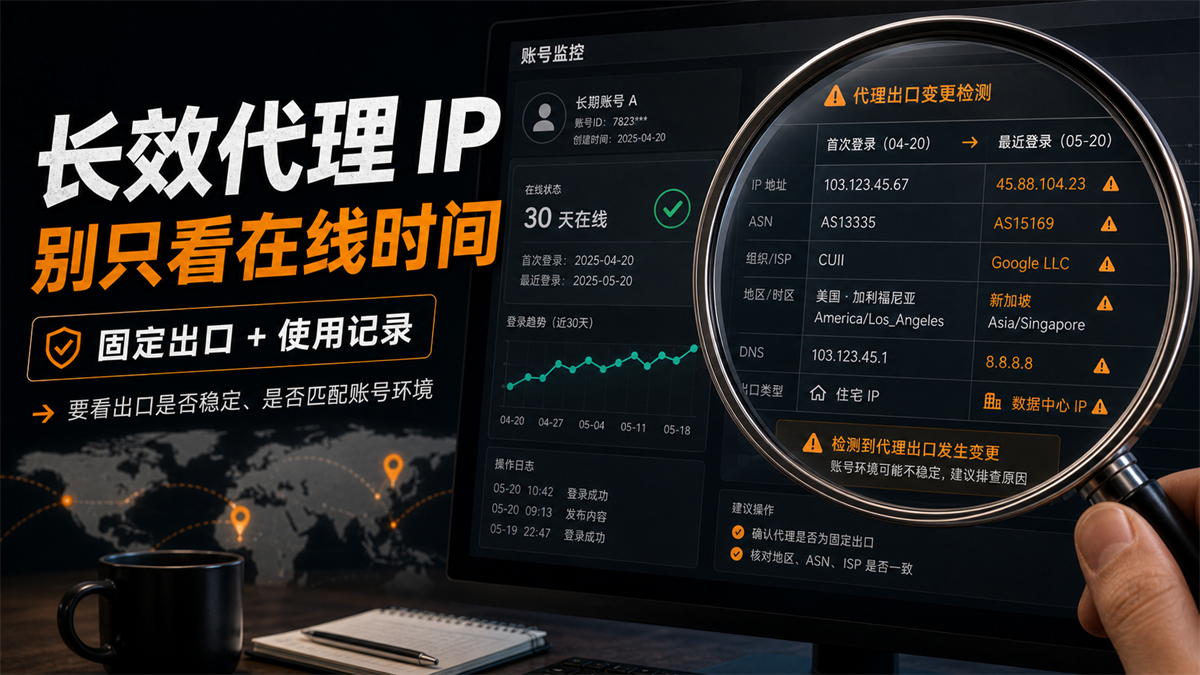
The proxy backend displays "30 days online" and the account has been logged in continuously for a period of time. The team thought that this long-term proxy IP was already stable enough, but one day the account prompted an abnormal environment. Upon further investigation, they found that the recently logged in export IP had changed, the ASN had changed, the region had jumped from the United States to Singapore, and the DNS was no longer consistent with the proxy region.
The most troublesome part of this type of problem is not that the agent has been disconnected, but that everyone has always thought it hasn't changed.
My judgment is: * * Long term proxy IP does not mean only being online for a longer period of time. Long term accounts need to consider whether the fixed export, ASN/organization, region/time zone, DNS/WebRTC, and usage records are continuous. The online duration is only evidence of connectivity and cannot replace export stability and account environment records. **
First, give a direct answer:
online duration is not a long-term account answer
Long term proxy IPs can be candidates for long-term accounts, but it cannot be solely based on how long they have been online. If the export IP, ASN, region, DNS, or browser environment frequently changes, the account still sees a discontinuous login scene.
So, when judging a long-term proxy IP, two things need to be distinguished:
-Online time: Can this proxy channel continue to connect;
-Account continuity: Whether the export, region, browser environment, and operation records seen by the account can be connected each time.
Many packages emphasize online duration, which is valuable, but it is only the first layer. Long term accounts are more concerned about whether they can still see the same explainable environment when logging in next week or month.
What does a long-term proxy IP solve
Long term proxy IP usually aims to solve two problems.
Firstly, reduce frequent IP changes. Short session proxies, rotation proxies, or dynamic exits are suitable for temporary access, data scraping, and public page testing, but may not necessarily be suitable for long-term accounts. The account changes its exit every time it logs in, making it difficult to review during subsequent verification.
Secondly, enable the team to retain usage records. A fixed account using a certain exit, combined with a fixed browser environment, fixed region, and fixed operator, will only lead to clues after further investigation.
But long-term effect does not mean static, nor does it mean residential, nor does it mean that the account must be problem free. You need to continue looking at the network properties behind it: whether it is a residential/ISP exit, whether the ASN and organization names are reasonable, and whether the region and DNS are consistent.
If you haven't distinguished between residential ISP proxy and residential IP, you can first look at: [How to choose residential ISP proxy and residential IP address] (https://sureisp.com/blog/residential-isp-proxy-residential-ip-address). That article discusses entry and attribution, while this one specifically focuses on the continuity of long-term account exports.
Are long-term proxy IP and static residential IP the same thing
It's not exactly the same thing.
Long term proxy IP is more like an expression of usage duration or session capability, with a focus on how long the proxy connection can last and whether it will frequently disconnect or switch. Static residential IP emphasizes whether the exit is relatively fixed and whether the exit attributes are close to residential or ISP networks.
Long term accounts are more suitable for prioritizing static residential IP or residential ISP attribute exports, as they are more likely to form continuous records. If the long-term proxy IP only has "continuous connections", but the underlying export will change, and the account environment may still be discontinuous.
It can be understood as follows:
|Statement | Focus | Long term accounts should continue to be questioned|
| --- | --- | --- |
|Long term proxy IP | Online time, session duration | Whether the exit is fixed and the region is consistent|
|Long term residential IP | Residential attributes+long-term use | Can ASN, organization, and IP type match each other|
|Static residential IP | Relatively fixed exit | Whether it is suitable for account use and can be recorded|
|Residential ISP Proxy | ISP/Residential Attribute Export and Proxy Usage | Exclusive or Long Term Account Binding|
The difference between static and dynamic can be seen from: [What is the difference between static residential IP and dynamic residential IP] (https://sureisp.com/blog/static-vs-dynamic-residential-ip-account-login).
6 pieces of evidence to evaluate long-term proxy IP
Don't just look at the backend display as' online '. At least 6 pieces of evidence should be put together before purchasing.
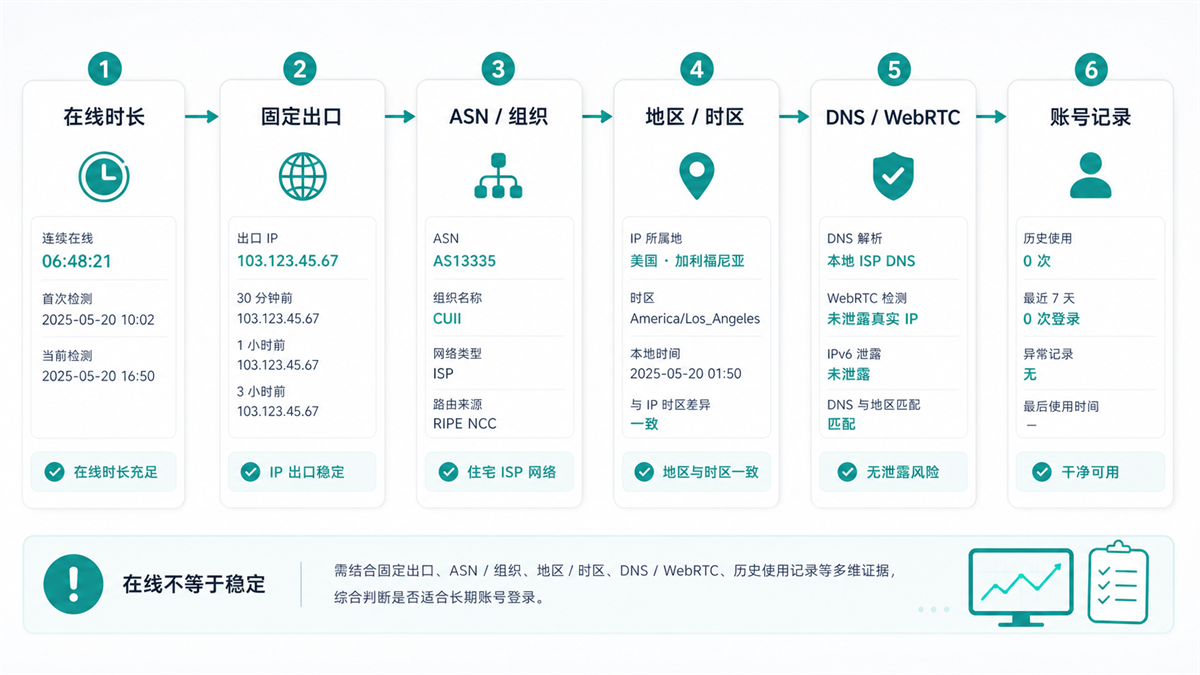
Firstly, the online duration. It can indicate whether the proxy can continue to connect, but cannot indicate whether the account environment is continuous.
Secondly, fix the exit. You need to check whether the export IP remains the same or changes within an interpretable range after 30 minutes, 1 hour, a day, or several days.
Thirdly, ASN and organization name. Long term residential IP or residential ISP proxy should not only look at the package name. ASN、 The organization name and IP type should be mutually explanatory. Yesterday we wrote: [How to do ISP detection] (https://sureisp.com/blog/isp-check-residential-proxy-asn-ip-type), this step can directly reuse that set of checks.
Fourth, region and time zone. The account has been logged in in the US environment for a long time, and it is best to interpret the proxy region, system time zone, browser language, and DNS resolution as the same site. Frequent regional changes can make account records difficult to understand.
Fifth, DNS and WebRTC. The IP has not changed, but if DNS runs to the local area or WebRTC exposes the real network, the account still sees a different environment.
Sixth, account usage records. Records must be kept of who logged in, when, whether the environment has been changed, and whether the proxy has been changed. What long-term accounts really need is traceability, not just connectivity.
Three types of results:
Can be recorded for a long time, requires re examination, and is not recommended to bind
After evaluation, do not simply say 'can be used' or 'cannot be used'. A better approach is to stratify.
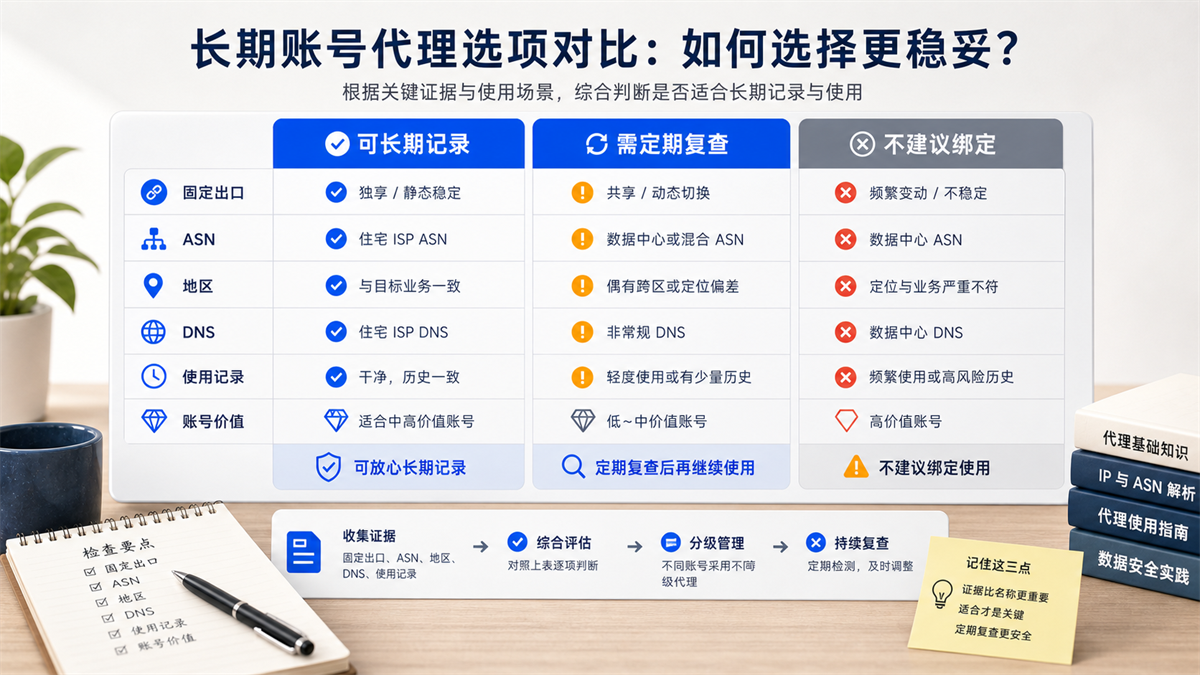
**Long term recording: export IP is stable, ASN and organization name can be explained, region/time zone/DNS is consistent, browser environment matches proxy region, and account operation records are clear. Such agents can enter long-term account candidates, but they still need to be reviewed regularly.
**Need to review: The online time is sufficient, but occasionally there may be regional deviations, inconsistent DNS, different tool judgments of IP types, or incomplete team usage records. Don't give up immediately in this state, and don't directly bind high-value accounts. Check and record them first.
**Not recommended to bind * *: The online time may seem long, but the exit often changes, ASN jumps from residential/ISP to data center, the region and account target region are not consistent, DNS or WebRTC have abnormal paths, and the account history is not recorded. This type of proxy can be used for temporary access and is not suitable for directly hosting long-term accounts.
The 'not recommended binding' here does not mean that the proxy cannot access the webpage at all, but rather that it cannot bear the environmental continuity of long-term accounts.
What scenarios are suitable for long-term proxy IP
Long term proxy IP is more suitable for these scenarios:
-Long term store backend login;
-Backend management of advertising accounts;
-Main social media account maintenance;
-Customer service, team permissions, and operation backend;
-An account needs to remain in the same region for a long time;
-Need to bind the proxy export and fingerprint browser environment for a long time;
-We need to track the login person, login time, and environmental changes in the future.
The commonality among these scenarios is that the account value is relatively high, and each login leaves a history. The less changes in exports, the clearer the records, and the easier it is to determine where the problem comes from in the future.
There are also scenarios where a long-term proxy IP is not necessarily required:
-Temporarily open the public page;
-One time regional display inspection;
-Access without logging in to the account;
-Low value testing tasks;
-Non account tasks that require large-scale rotation for export.
These tasks can be handled using more flexible proxy solutions. Don't put all tasks on the same exit just because 'long-term' sounds more stable.
The detection is normal, why is the long-term account still abnormal
Because the agent is only one layer.
When an account is used for a long time, the system not only sees the IP address, but also the browser environment, device information, login time, account behavior, payment information, team operations, and historical records.
If the long-term proxy IP detection is normal,
but the account still shows abnormalities, it is recommended to check in this order:
1. First confirm whether the export IP is truly fixed;
2. Check if there have been any changes in ASN, organization name, or IP type;
3. Compare regions, time zones, languages, DNS, and WebRTC;
4. Check if the browser environment has been changed;
5. Check if the team has multiple people, locations, and devices logged in;
6. Finally, decide whether to switch agents.
Don't change your IP address as soon as there is an abnormality. The biggest fear of long-term accounts is being continuously disrupted on site, and the faster you change, the harder it is to determine the true cause.
The relevant investigation can be seen as follows: [Why does the IP address still prompt abnormal login environment] (https://sureisp.com/blog/login-environment-abnormal-ip-browser-check).
Perform three retests before purchasing
If you are planning to bind a long-term proxy IP to a long-term account, I suggest not doing only one test. A single test can only indicate the current status and cannot prove that the same set of exports can be maintained in the next few days.
A more stable approach is to conduct three retests.
The first time, test immediately after receiving the agent. Record export IP, ASN, organization name, IP type, country, city, time zone, DNS, and WebRTC. This result is the baseline.
The second time, measure again with an interval of 30 minutes to 1 hour. Check if the export IP has changed and if the ASN and region are still consistent. If it is only online but the exit has been changed, it cannot be used as a fixed exit.
The third time, test again the next day or during the next working period. Long term accounts are not only logged in once, retesting the next day is closer to real use. If there are significant changes in the region, DNS, or IP type the next day, do not bind high-value accounts yet.
These three retests are not complicated, but they can block many misjudgments. Many problems are not about the agent immediately disconnecting, but rather about 'seemingly online, but actually the export has changed'. Long term accounts do not require a single moment of normalcy, but rather multiple consecutive explainable accounts.
Leave a proxy usage record for the team
The real value of long-term proxy IP lies in its ability to be used in conjunction with account records. Without records, even the best agents will be used recklessly by the team.
A minimum record should include at least:
-Account name or internal number;
-Binding browser environment number;
-Proxy IP, protocol, port, and purchasing region;
- ASN、 Organization name, IP type, and detection tool;
-The first testing time, retesting time, and the latest re examination time;
-Operator, login time, and whether the exit has been changed;
-Abnormal remarks: region change, DNS exception, account reminder, environment modification.
These fields do not require a complex system, a table is sufficient. The key is to leave a trace every time you change the proxy, browser environment, or operator. Otherwise, when there is an issue with the account, the team will only say 'I used to use it before', but no one knows which day it started to change.
When to choose long-term and when to choose static
If the account is only logged in occasionally, has low value, and does not have strict regional requirements, a long-term proxy IP can already cover some of the needs. You need to focus on checking the online duration, region, and DNS, and not necessarily choose a higher cost exit right away.
If the account is logged in for a long time, has high permissions, or has important advertising or store assets, it is recommended to prioritize exports with clearer static residential IP or residential ISP attributes. The reason is not that it sounds more advanced, but that fixed export and attribution evidence are easier to document.
If the task requires a large number of region switches, batch access to public pages, or short-term testing, dynamic proxies are actually more flexible. Do not use dynamic agents to handle long-term accounts, nor do you use long-term agents to perform tasks that should have been rotated.
When choosing a proxy, first layer by account value, then layer by login frequency, and finally look at the price. High value accounts require continuous records; Low value temporary tasks require efficiency; The two should not share the same set of judgment criteria.
What is the relationship between native residential IP and ISP detection
These articles are actually a chain.
住宅 ISP 代理和住宅 IP 地址怎么选 solves the problem of "which type of export should be selected".
ISP 检测怎么做 solves the problem of "how to check ASN, organization, and IP type before purchasing".
原生住宅 IP 是什么 solves the problem of whether package names can be directly trusted.
Today's article solves the problem of 'why can't long-term accounts only look at online time'.
If you are already looking at a long-term residential IP or a static residential IP, it is recommended to combine these four things to determine: ownership, detection, name, and record. If any item is missing, long-term accounts may become subject to investigation based on intuition.
Which layer is suitable for placing Sureisp on
If you use Sureisp as a residential ISP proxy, static residential IP, or fingerprint browser environment, don't just ask 'Do you have a long-term proxy IP?'. A better way to ask is:
-In which region should this account be logged in for a long time;
-Is it necessary to fix the outlet;
-Can export ASN, organization name, and IP type be recorded;
-Is the browser's time zone, language, DNS, WebRTC consistent with the proxy region;
-Can the team retain the relationship between accounts, environment, agents, and operators.
The value of Sureisp is not just to provide an exit, but to enable proxy exits, browser environments, and account records to be placed in the same set of troubleshooting logic. You can first establish a correspondence between your account and proxy using a free fingerprint environment, and then choose a residential ISP exit that is more suitable for long-term recording based on the value of your account.
FAQ
Is a long-term proxy IP suitable for long-term accounts?
Can be considered as a candidate, but the prerequisite is not long online time, but fixed export, clear ASN and organization names, consistent region/DNS/browser environment, and long-term retention of account usage records.
What is the difference between long-term proxy IP and static residential IP?
Long term proxy IP emphasizes continuity of connection or session, while static residential IP emphasizes relatively fixed export and residential attributes. Long term accounts usually focus more on fixed exports and traceable records, rather than just online duration.
Can I log in to my account for a long-term residential IP?
Can be used as a long-term account candidate, but it is necessary to first check whether the exit is fixed, whether the IP type is similar to residential/ISP, and whether the region and DNS are consistent. The higher the value of an account, the more it needs to be recorded before use.
Can dynamic residential IP be used as a long-term account?
Dynamic residential IP is more suitable for temporary access, testing, or low continuity tasks. If a long-term account frequently changes exits, the subsequent login history will be even more difficult to explain. It's not that it's unusable, but rather that the cost of reviewing is higher.
Why does the account still prompt abnormal when the IP hasn't changed?
Because the account environment is not solely determined by IP. Browser fingerprint DNS、WebRTC、 Time zone, language, device records, account behavior, and team operations may all affect the results. After fixing the IP, it is also necessary to check whether the entire account environment is continuous.