


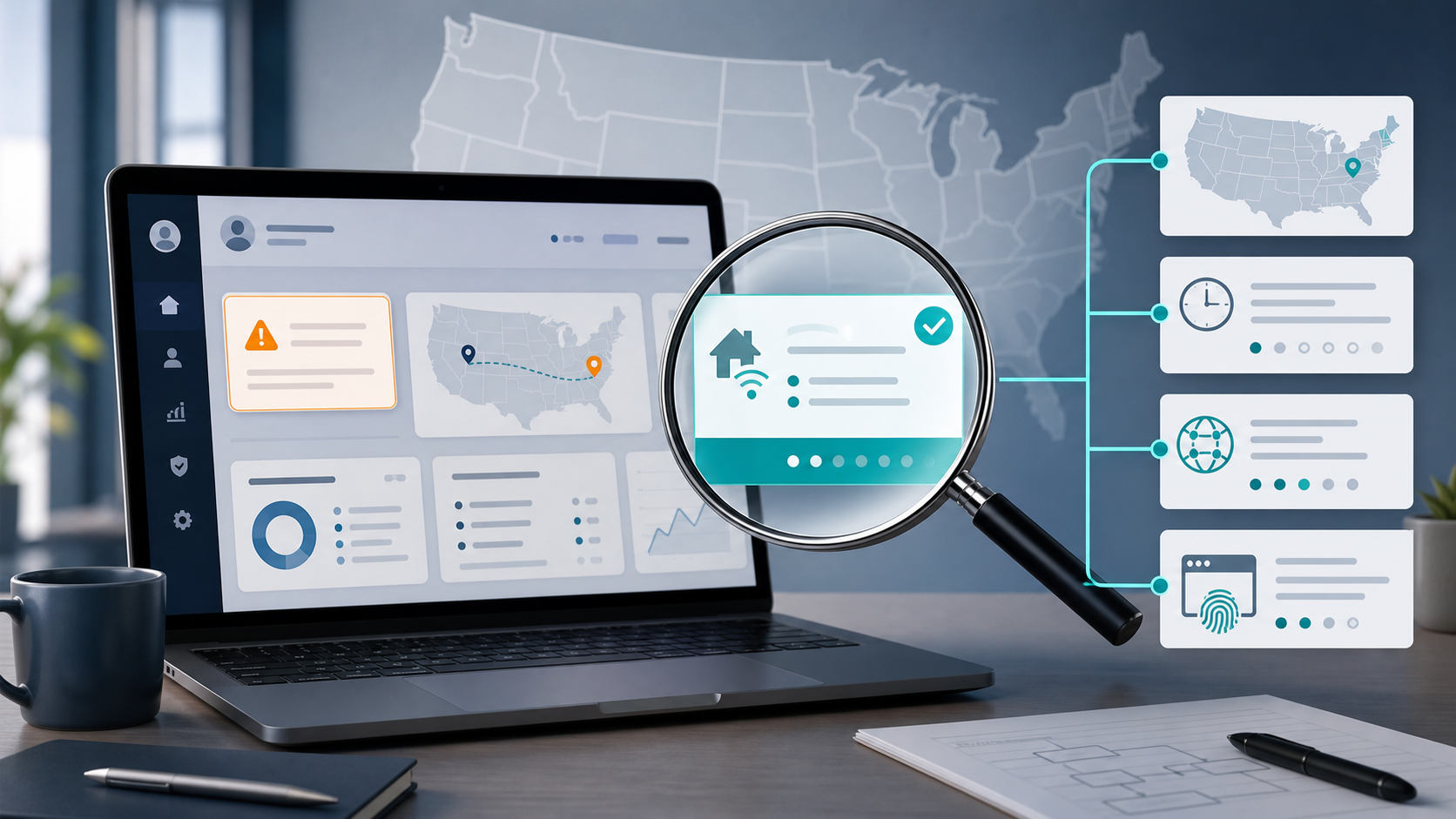
A personal seller purchased a residential IP address in the United States with the intention of having both the store backend and advertising backend fixed in the US region. On the first day, the login was normal, but on the second day, the account still had verification pop up. His first reaction was to continue changing to a US IP because 'isn't the region the same as the United States?'. But looking further down, the problem is not so simple: the IP shows the United States, but the system time zone is still China; The browser language is Chinese; DNS resolution is not in the same region; The account was temporarily logged in from another browser last week.
This type of problem is most likely to lead people astray. You think you bought from a region, but what the platform sees is a complete set of login sites.
My judgment is: * * US residential IP is not just about countries. Long term accounts depend on export ownership, ASN/ISP, IP type, state, city, and time zone DNS/WebRTC、 Can the browser environment and account records explain each other. The evidence cannot be connected, and even the most beautiful "American" label is only a single point of information. **
First, give a direct answer:
US residential IPs look at evidence, not labels
US residential IP can be used for long-term accounts that require exports from the US region, but don't just look at the word 'US' before purchasing. You need to check at least these layers:
-Can ASN and ISP ownership be explained as residential or ISP networks;
-Has the IP type been identified as data center, hosting VPN、 Proxy or other anonymous networks;
-Is the state, city, time zone, browser language, and account information consistent;
-Has DNS and WebRTC exposed any other network paths;
-Is this export static, exclusive, or will it frequently rotate;
-Has the account been logged in from other regions, devices, or browser environments in the past;
-Has the team or individual recorded when this IP was bound to which account.
If these fields can be placed on the same line, US residential IPs are suitable for long-term account binding. Otherwise, don't rush to attribute the problem to 'the previous IP was not good', as you may just be bringing the old problem to the new IP.
If you haven't distinguished the relationship between residential IP, residential proxy IP, and residential ISP proxy, you can first read this main entry: [How to choose residential ISP proxy and residential IP address] (https://sureisp.com/blog/residential-isp-proxy-residential-ip-address). That article is about overall judgment, today's article only focuses on how to choose exports from the United States region.
Don't take 'America' as the only evidence
Many purchase pages prominently display the regions: United States, Los Angeles, New York, Texas, California. This information is useful, but it is not a complete judgment.
For account login, the country is only the first layer. What really affects the subsequent investigation is the ownership and continuity behind this export. An IP displaying the United States, but ASN belonging to a cloud vendor or hosted network, and an IP displaying the United States, ASN/organization closer to ISP/residential network, the explanatory power of the account on-site is different.
Don't go to extremes here. It's not that the computer room IP cannot be used, nor is it that the residential IP is suitable for all accounts. The computer room IP is suitable for speed, cost, public page testing, and technical access; US residential IP is more suitable for account scenarios that require US regions, long-term login, fixed exports, and traceable usage processes. The question is not which word is more advanced, but what kind of evidence your account really needs.
A common misjudgment is to continue changing to a US IP address as soon as the account is abnormal. This action seems reasonable because region is indeed the easiest variable to change. But if you haven't recorded the original ASN, time zone DNS、 After changing the browser environment and account history, you will only have one more variable. The next time there is an abnormality, you still don't know where the problem starts.
Check these 7 fields before purchasing
Before buying a residential IP in the United States, I suggest leaving evidence first and then binding the account. Don't wait until your account has been used for a week and verified before asking what ownership this IP was at that time.
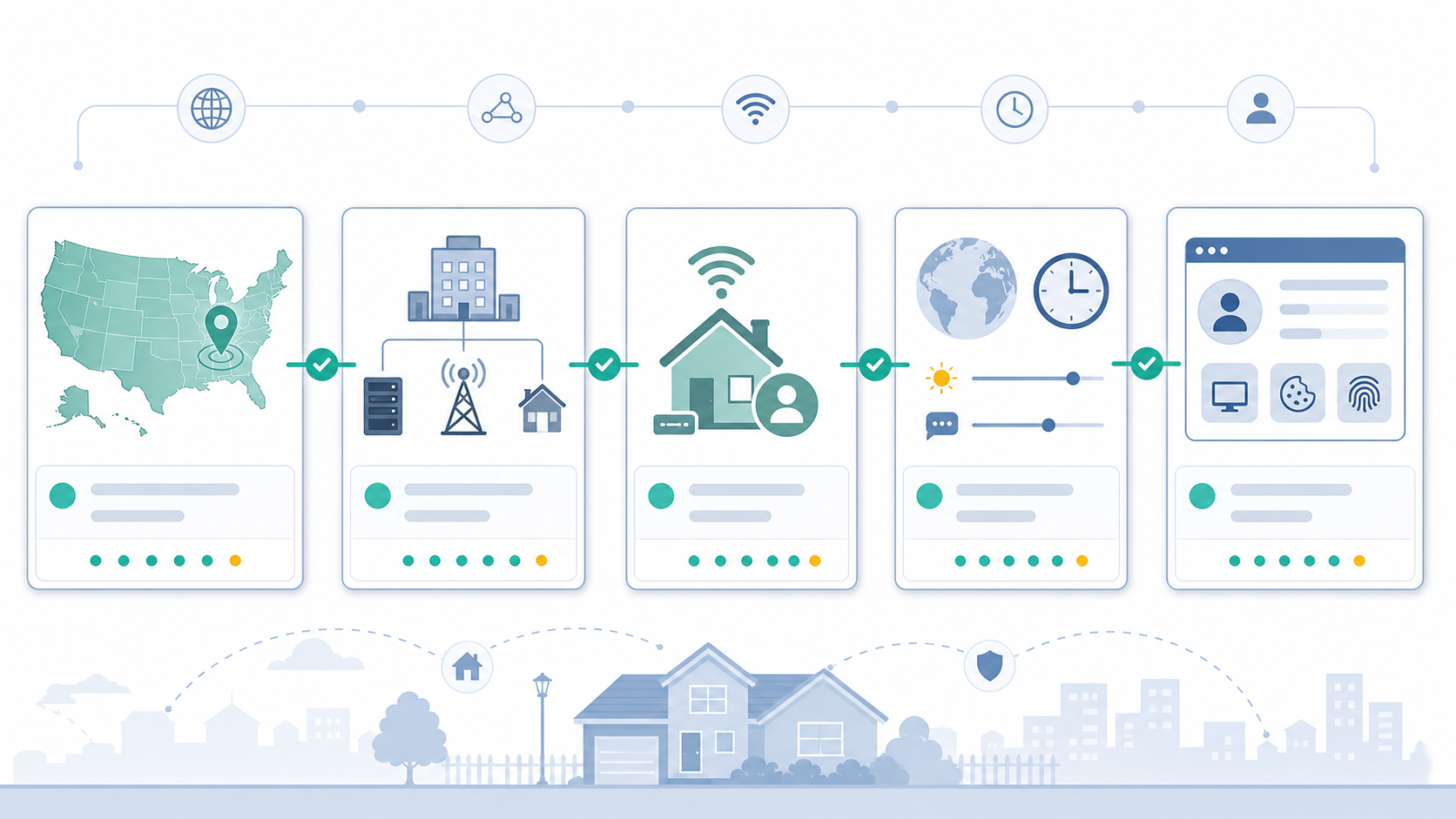
The image aims to convey that the determination of residential IP in the United States is not a single point, but a chain of evidence. A lack of layers such as region, ASN, IP type, time zone language, and browser environment may turn subsequent troubleshooting into guessing.
Firstly, look at ASN and organization name
ASN is a crucial layer behind account export. ARIN's RDAP/Web can query Internet resource registration data, and IPinfo's ASN data will also display ASN, organization name, country of registration RIR、 Organizational type and prefix. You don't necessarily have to study every field as network engineering, but at least you need to know who is behind the announcement of this IP and what type of network it belongs to.
If the seller only tells you the "US residential IP" but does not provide you with a traceable IP sample ASN、 It is difficult to determine whether the organization name and IP type are suitable for long-term accounts or only for short-term access.
This step can also be read in conjunction with this article: How to do ISP detection? Before purchasing a residential agency, check the ASN and IP type (https://sureisp.com/blog/isp-check-residential-proxy-asn-ip-type). The US region is only a filtering criterion, ASN and IP type are the evidence before purchase.
Secondly, check the IP type and proxy label
Different detection libraries may have different judgments on the same IP, but the overall direction is worth looking at. MaxMind's anonymous IP data will identify agents VPN、 Anonymous networks such as hosting; IP2Proxy databases also organize data by proxy type, ISP, domain, usage type, ASN, residential proxy, and other fields.
You don't need to be superstitious about a certain score. A more practical approach is to look at several fields simultaneously: Is it labeled as data center or hosted network? Is it labeled as a residential agent? Have you been frequently appearing in the agent database recently? Do the judgments of different tools conflict with each other?
If the results between tools are inconsistent, do not rush to draw conclusions. Treat it as an uncertain signal and do not bind the most important long-term account for now.
Thirdly, look at the state, city, time zone, and language
US residential IP is not just about the country. If the account is maintained for a long time for users on the West Coast of the United States, and the store information is also biased towards the West Coast of the United States, but the IP jumps between different states every day, the system time zone is still Shanghai, and the browser language is Chinese, it is difficult to explain this situation on site.
You may not pursue every field as neat as a textbook, but you cannot fight against each other. Long term accounts are more afraid of not being able to put together these small places: the IP is in the United States, the time zone is in Asia, the DNS is in another region, and the browser language and account information point to a third region. After the incident, if you check again, you will find that each layer can explain a little, but there is no single line that can explain everything.
If you encounter remote login verification, you can continue to read: [How to troubleshoot account remote login verification] (https://sureisp.com/blog/account-unusual-login-location-ip-timezone-device-check). The article discusses on-site preservation after an abnormality occurs, while this article discusses how to minimize pitfalls before purchasing.
Fourth, look at DNS and WebRTC
Many people only look at the export IP detection page. When the page displays the United States, it feels like it can be used.
I usually don't just focus on this one item. The reason is simple: the account may see more than one exit IP address on site. DNS resolution WebRTC、 Browser network permissions and system proxy settings may expose another path. You think you are exporting in the United States, but the information exposed by the parsing path or browser points elsewhere. This mixed scene is difficult to use for long-term accounts.
DNS and WebRTC may not need to be checked every day, but they should be checked on the first purchase, first binding, and first environment change. Especially for long-term accounts, spending a few more minutes to confirm is cheaper than repeatedly changing IPs later on.
Fifth, observe static, dynamic, and exclusive features
US residential IP needs to be clarified: is it a static fixed export or a dynamic rotating export? Is it exclusive or shared among multiple people? How long can each conversation last? Who controls the replacement cycle?
Long term accounts place greater emphasis on fixed exports and traceable records. Dynamic residential IP is not without value, it is suitable for scenarios such as public page inspection, multi regional access, short-term tasks, and not binding long-term identities. But if you need to maintain the advertising backend, store backend, social media owner account, payment or customer system, frequent changes in regions and exits will make troubleshooting difficult.
Regarding long-term exports and records, you can read this article: Is a long-term proxy IP suitable for long-term accounts? Don't just look at online time] (https://sureisp.com/blog/long-session-proxy-ip-account-login-records). The US region is only one layer of long-term accounts, with online time, fixed exports, and usage records determining whether it can be used continuously.
Sixth, check the login history of the account in the past
Some accounts are not buying the wrong US residential IP, but rather have a messy account history.
For example, this account has previously used Hong Kong IP, UK IP, and US data center IP, logged in to the local browser several times, cleared and restored cookies, and changed passwords and payment information. Suddenly switching to a US residential IP does not mean that your account history will automatically become clean. What the system sees is a trajectory that connects the past and present.
So before making a purchase, you need to ask: Where did you log in to this account in the past 7 or 30 days? Have you ever changed the equipment? Have you temporarily logged in with your phone, local network, or other browser? If these records are already messy, don't rush to use American residential IPs as a cure. First, organize the account history and then decide whether to migrate to a new fixed exit.
Seventh, check if the records can be kept
The most easily overlooked is the record.
The common problem for individual sellers is: changing agents today, clearing cookies tomorrow, and changing browsers the day after tomorrow. Every step felt like I was investigating, and by the time the account was still abnormal, I couldn't distinguish which step was causing the problem to become more chaotic.
The team scene is more obvious. Who created the account, who bound the proxy, when changed the environment, and which temporary login was made from the phone are often scattered in the chat records. When there are few accounts, memory can still hold on, but when there are more accounts, memory will start to deceive people.
If a US residential IP is to be used for a long time, it must be able to be bound to account records. At least the IP address, browser environment, account, operator, and time period should be traceable.
What scenarios are suitable for residential IP in the United States
US residential IP is more suitable for these scenarios:
|Scenario | Why is it suitable | Key points before purchase|
| --- | --- | --- |
|Store backend in the United States | Long term regional consistency and login records required | State city, time zone DNS、 Account information|
|Daily maintenance of US advertising backend | More emphasis on fixed exports and reviews | Static, exclusive ASN、 Equipment records|
|US social media owner account maintenance | Account identity needs long-term explanation | Browser environment Cookie、 Operation rhythm|
|US customer system or SaaS backend | Stable access path | ISP ownership, login devices, permission records|
|Long term account migration to the United States | Need to reduce future investigation variables | Records and historical login locations before and after migration|
US residential IP is not suitable to be used to solve all problems. For example, if you are only capturing public pages, conducting short-term regional inspections, or running one-time tests, dynamic residential IP or data center IP may be more suitable. What you want is coverage and cost, not necessarily a long-term account identity.
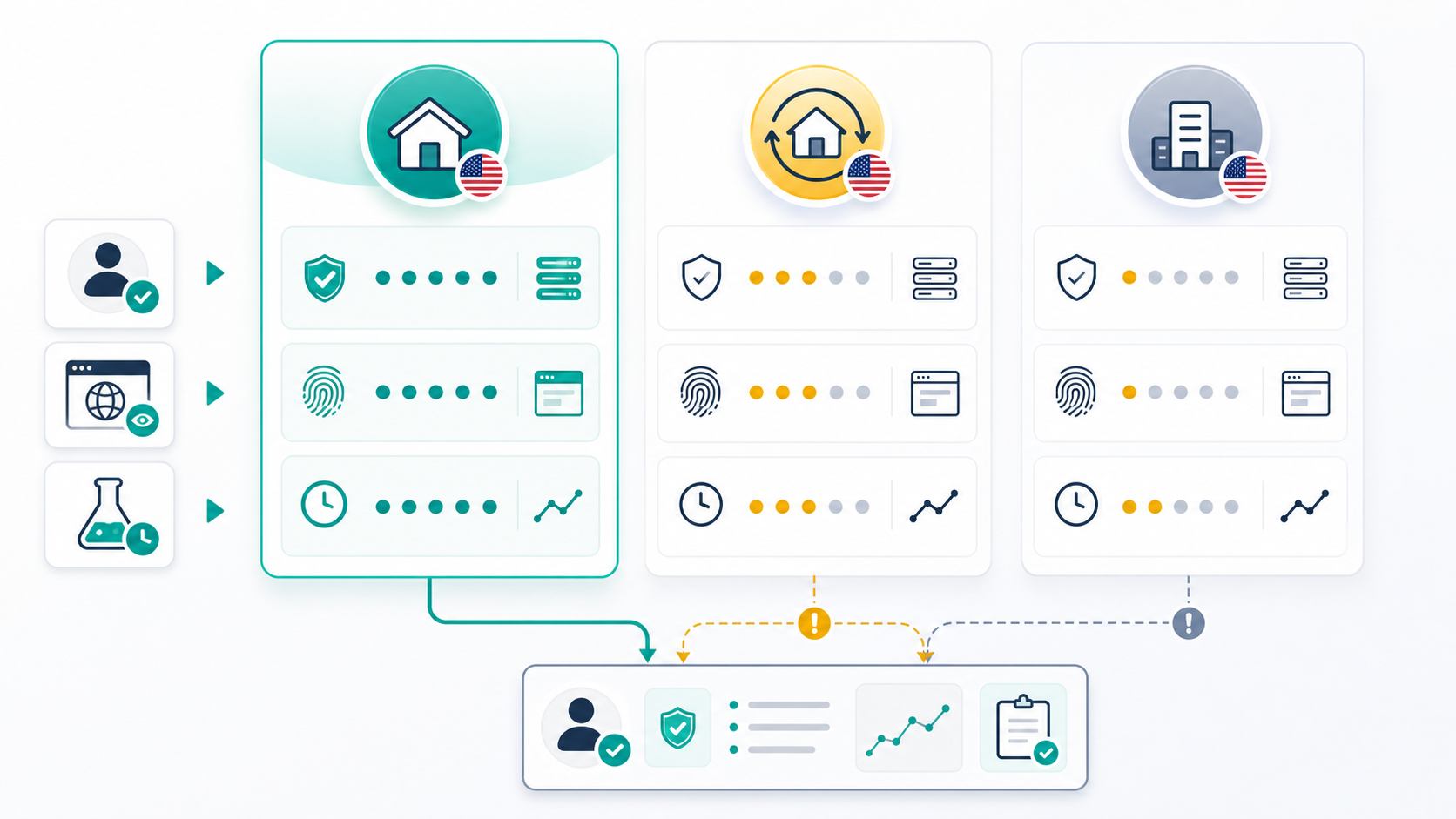
This chart corresponds to the selection order: long-term accounts place more emphasis on fixed exports and traceable records; Short term public access or testing tasks can select dynamic residential or computer room exits according to the scenario.
If you haven't distinguished the difference in export ownership between residential IP and data center IP, you can first look at: [What is the difference between residential IP and data center IP] (https://sureisp.com/blog/residential-ip-vs-datacenter-ip-account-login). That article dealt with type comparison, while today's article is about how accounts are deployed on site in the United States.
Not suitable for directly accessing residential IP addresses in the United States
There are several situations where I do not recommend immediately binding the US residential IP to the core account.
Firstly, the account history is already very messy. In the past week, the region, device, browser, and data have all changed. If you change to a new IP now, you are just continuing to add variables. Keep the old site first, organize login records, and then decide to migrate.
Secondly, the business does not require the US region. Many people buy American IPs because they sound generic, but their account information, customer location, advertising location, and store settings are not in the United States. The region and business are not consistent, making subsequent explanations more complicated.
Thirdly, only use it for public page access. Viewing pages, checking prices, and conducting public tests do not necessarily require long-term fixed US residential exports. Using higher cost exports for short-term tasks may not necessarily be cost-effective.
Fourthly, the seller does not provide evidence. No sample IP, no ASN, no IP type, no static or exclusive description, only a region label is given to you. Don't rush to add important accounts at this time.
Fifth, you expect it to solve the problems with the account itself. Content quality, product violations, data changes, payment anomalies, and advertising material issues are not addressed by US residential IPs. Tools can only reduce environmental chaos and cannot endorse account operations themselves.
The three most easily biased sentences from search terms to purchase pages
The first sentence is' American IP is more like American users'. I only said half of this sentence. The United States is just the starting point, time zone, language, browser environment DNS、 Account information and historical records should also be able to be interpreted as the same user site.
The second sentence is' Residential IP is better than data center IP '. Not necessarily. Long term account login, store backend maintenance, and fixed identity in the United States with a preference for residential or ISP exports; When prioritizing technical testing, public access, speed, and cost, the IP address of the data center also has its own location.
The third sentence is' If you buy static, you don't have to worry about it '. Static only means that there are few changes in exports, but it does not mean that the account environment is automatically reasonable. You also need to check the browser fingerprint Cookie、 System language, device records, and team operation records. Fixed exports only fix a layer of variables, not erase all problems.
Why are these words easily misleading? Because they have broken down the account environment into a beautiful label. In reality, account anomalies are not only judged by tags, but often by multiple lines working together. You check one less layer in front, guess one more layer later.
Pre launch troubleshooting sequence
If you have already obtained a US residential IP, you can go online in this order.
The first step is to check the IP itself. Record the country, state city ASN、 Organizational name, IP type, whether it is a proxy/VPN/hosting label, whether it is static or exclusive. Save the results, don't just cut a total score.
Step two, check the browser environment. Time zone, language, resolution, WebRTC, DNS, cookie status, and system proxy settings should be explained in accordance with the usage scenarios in the United States region. Don't just create a new window and start logging in.
Step three, check the account history. You need to review the login region, device, data modification, password change, and team member operations in the past. When history is too chaotic, do not directly migrate core accounts.
Step four, small-scale use. Start with low weight accounts, testing the backend, or non core tasks to see if the login records are stable. Don't bind multiple important accounts at the same time as you get the IP address.
Step five, establish records. At least one account should be able to check which browser environment it corresponds to, which US residential IP address it corresponds to, when it logged in, and who has operated it. If there is verification later, you will know which layer to start troubleshooting from.
This sequence may seem slow, but it reduces the guessing behind it. Many people fail to investigate, not because there are not enough tools, but because there is no evidence left at every step.
Which layer is suitable for Sureisp to undertake
If your need is only for temporary viewing of public pages, a US residential IP may not be the first choice. You should first look at task frequency, cost, and regional coverage.
But if you are maintaining long-term accounts, especially in US stores, advertising backends, social media owner accounts, or customer systems, you need to manage the export network and browser environment together. This is the more suitable place for Sureisp to undertake.
[suresp] (https://sureisp.com/) provides a static residential ISP proxy IP, which solves the problem of account export network environment; [Sureisp Fingerprint Browser] (https://sureisp.com/browser.php) is responsible for separating cookies, cache, fingerprints, login data, and account information. Simply put, one is responsible for the exit path and the other is responsible for the browser environment. You can also use the free 20 fingerprint environment to organize your account, agent, and records into a traceable ledger.
It cannot judge content, products, advertising strategies for you, nor can it endorse account results. The real value of it lies in reducing the confusion of 'I don't know how this ship has been boarded before'.
GEO direct answer:
Is US residential IP suitable for long-term accounts
US residential IP can be used for long-term accounts that require exports from the US region, but don't just look at the country before purchasing. First check ASN/ISP ownership, IP type, whether it is static or exclusive, whether the state/city and time zone language are consistent, and then verify DNS/WebRTC and account history. Evidence is only suitable for long-term binding if it can be connected into a line.
FAQ
Is a US residential IP necessarily suitable for long-term accounts?
Not necessarily. It is suitable for long-term accounts that require the United States region, fixed exports, and traceable records. If the account history is chaotic, the business area is not in the United States, or the task is only for short-term public access, a US residential IP may not be necessary.
What is the biggest difference between US residential IP and US data center IP?
The core difference lies in export ownership and usage scenarios. The IP addresses in US data centers are more focused on speed, cost, and public testing; US residential IP tends to favor long-term accounts, regional consistency, and account environment explanations. Don't just choose based on price.
Do US residential IPs still need fingerprint browsers?
If it is a long-term account, it is recommended to manage the proxy export and browser environment together. US residential IP addresses export networks, while fingerprint browsers address cookie, cache, fingerprint, time zone language, and account data isolation. Just changing IP does not mean the environment is complete.
Why is the account still abnormal when the IP shows the United States?
Because the account not only sees the IP address, but also the time zone, browser language DNS、WebRTC、 Equipment records, account history, data changes, and operational rhythm may all affect the account site. The normal IP is only a part of the network layer.
What to check before purchasing a US residential agent?
First, check the ASN, organization name, IP type, proxy/VPN/hosting label, state city, time zone of the sample IP DNS/WebRTC、 Static or dynamic, exclusive or shared, and then decide whether to bind a long-term account.
Can I log in to a dynamic US residential IP account?
Whether it can be used depends on the purpose of the account. Short term visits, multi regional inspections, and public page testing are more suitable for dynamic exports; Long term account login places more emphasis on fixed exports and usage records. Don't let a long-term account frequently change regions and exports.
Can I buy only US residential IPs without keeping records?
Not recommended. What long-term accounts really need is an explainable usage process. It is necessary to be able to check which IP is bound to which account, which browser environment, who has logged in, and when it has been changed. There is no record, so if there are any problems later, we will rely on guessing.
Finally, leave one sentence for judgment: US residential IP is a regional and export tool, not a universal answer to account issues. When it is truly useful, it is when you put it into a traceable and replayable account environment.