


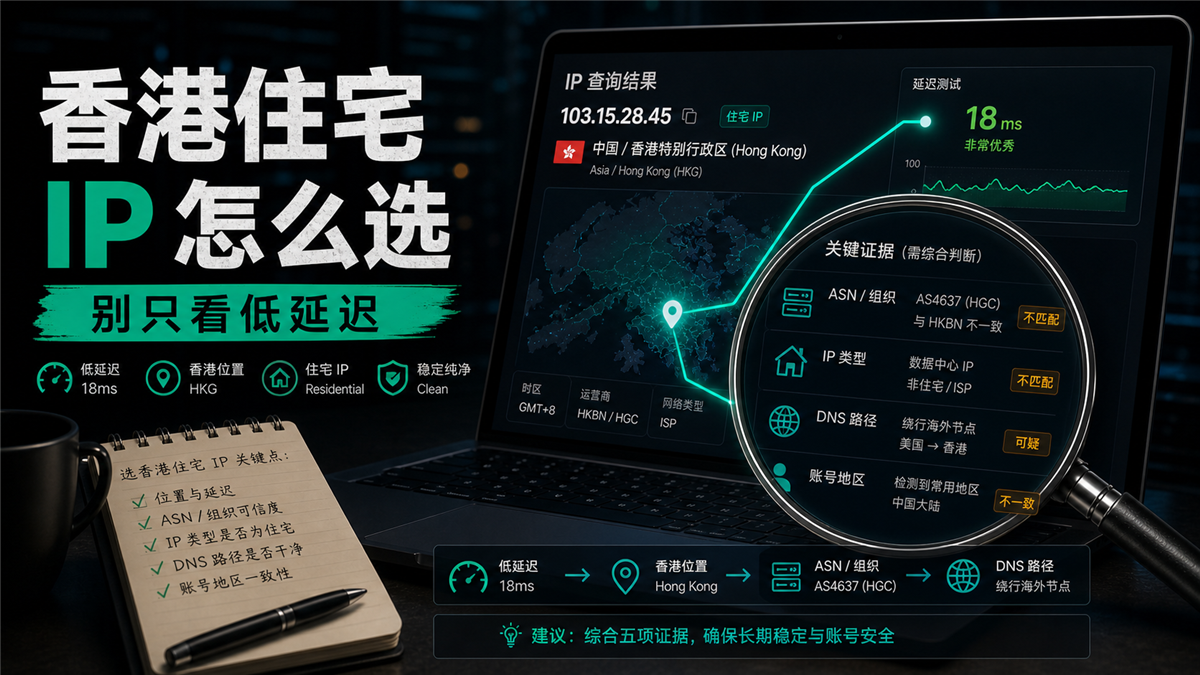
The team obtained a Hong Kong residential IP, and the detection page showed Hong Kong with a delay of only about 20 milliseconds. Opening the backend was also very fast. It seems that this export is very suitable for long-term accounts. The problem is that the account has been maintained in another target region in the past, and the browser time zone is also configured according to the original region. Recently, the login record suddenly changed to Hong Kong; Upon further investigation of ASN, it was found that it does not resemble a local residential ISP, as DNS is also routed to other regions. The fact that the page can be opened does not mean that the account records can be explained.
Hong Kong exports can easily lead to misjudgments: being close to the mainland, fast, and easily accessible to many sites, so people mistake "low latency" for "suitable accounts". But for long-term accounts, it's not just about internet speed, but whether the network can be integrated with the account's history, target region, and browser environment on the same site.
My judgment is: * * Hong Kong residential IP cannot only view low latency and detection pages displaying Hong Kong. First check ASN/ISP, IP type DNS/WebRTC、 Time zone, language, and account target region; These pieces of evidence are only suitable for entering the long-term account candidate pool if they are continuous. **
First, give a direct answer:
Hong Kong's exports are not a panacea
The advantages of Hong Kong residential IP are very obvious: the lines are close, the access speed is often good, and it is suitable for scenarios that require access from Hong Kong, local content checking, cross-border team collaboration, or backup login. But it is not the default answer for all accounts.
If the target region of the account is already Hong Kong, or if the business requires long-term records in Hong Kong, then Hong Kong residential IP can enter the candidate pool. Next, we need to check if the ASN, organization name, IP type, DNS/WebRTC, and account history are consistent.
If the account is used in other target regions for a long time and suddenly changed to Hong Kong export, even if the delay is very low, the account record will have an additional regional change. This change may not be immediately problematic, but it must be explained: why I logged in from Hong Kong today, who operated it, what device was used, and whether I will continue to stay in the Hong Kong region in the future.
So the first sentence when choosing a Hong Kong residential IP is not "fast or not", but "should this account have a Hong Kong record.
Why low latency can mislead judgment
Low latency solves the connection experience, but does not address account continuity.
Many teams choose to export from Hong Kong because of the low latency of local access, fast backend response, and easy passing of connection tests. But long-term accounts are more concerned with historical trajectories. In the past, the account saw the original target region IP, original time zone, and original language environment. Today, when the Hong Kong IP, UTC+8 time zone, and another language environment suddenly appeared, the system saw a set of changes instead of "faster speed".
Low latency may also mask network ownership issues. Some Hong Kong exports are accessed quickly, but ASN and organizational names are more like data centers or cloud service providers; Some detection pages display Hong Kong, but DNS goes to overseas nodes; Some panels display residential properties, but the actual exit of the browser becomes another IP address.
That's also why yesterday's' How to find residential IP addresses' (https://sureisp.com/blog/residential-ip-address-check-asn-ip-type) cannot be skipped. Hong Kong residential IP also needs to start looking for evidence from a single IP address, not just by seeing the two words' Hong Kong '.
6 pieces of evidence to be investigated for residential IP in Hong Kong
Before putting Hong Kong exports into a long-term account, at least these 6 items should be considered.
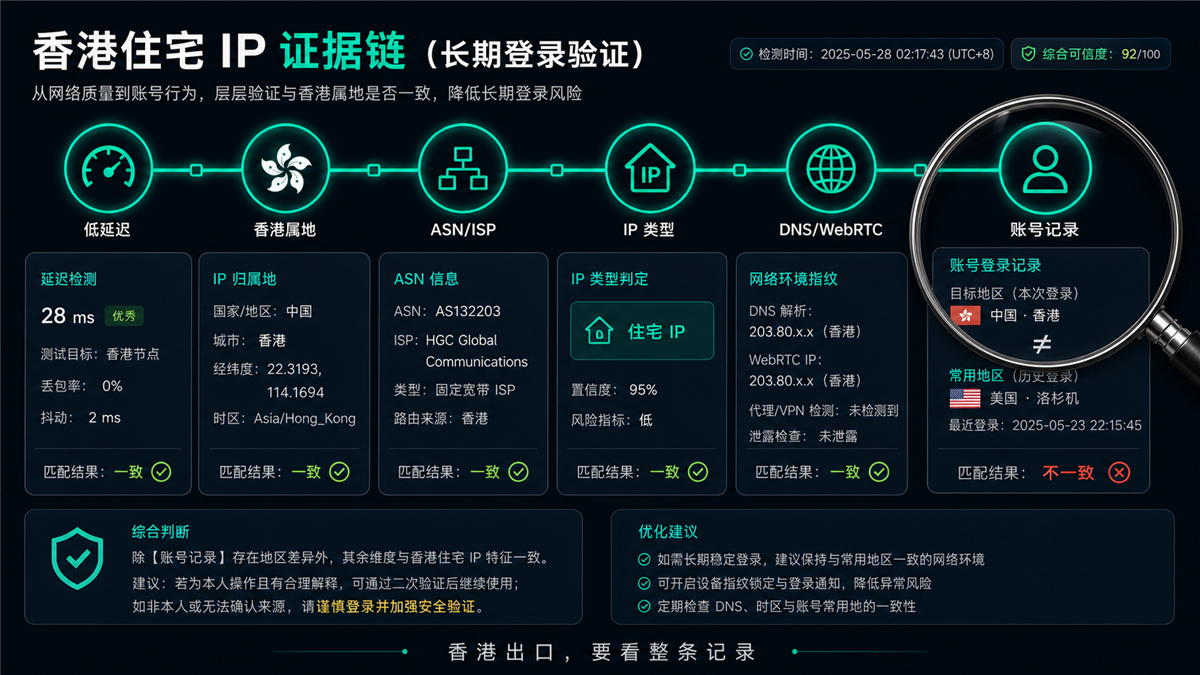
Firstly, low latency. Low latency is a good thing, but it only indicates that the connection path is short or the line quality is good. It cannot indicate that this IP is residential or suitable for long-term accounts. Delay should be viewed in conjunction with the following fields.
Secondly, Hong Kong territory. The detection page shows that Hong Kong is only the first layer. Suggest recording the country/region, city, time zone, and latitude and longitude, and cross checking with different tools. If one tool displays Hong Kong and another tool displays other regions, you need to review first.
Thirdly, ASN/ISP。 The key to Hong Kong residential IP lies in ASN and organization name. Does it look more like a local broadband, fixed network, or reasonable ISP, or more like a cloud service, data center, or proxy network? This step can refer to: [How to do ISP detection? Before purchasing a residential agency, check the ASN and IP type (https://sureisp.com/blog/isp-check-residential-proxy-asn-ip-type).
Fourth, IP type. Different tools may identify the same exit as residential ISP、 Data center, mobile or proxy. Don't just trust one label. Multiple results can point to residential/ISP attributes, which is more suitable for long-term candidates.
Fifth, DNS/WebRTC。 The IP export shows Hong Kong, but DNS resolution or WebRTC exposes other networks, and the account does not see a single scene. Related investigations can be found in: How to do DNS leak detection? Even if the proxy IP is normal, the resolution path needs to be checked [https://sureisp.com/blog/dns-leak-test-proxy-browser-environment].
Sixth, account records. Did the account use Hong Kong in the past? Do you need Hong Kong content, Hong Kong backend, local platform, or Hong Kong team collaboration? If not, Hong Kong exports may not necessarily be a better choice.
The difference between Hong Kong residential agents and Hong Kong data center IP
Hong Kong residential agents and Hong Kong data center IPs may both display Hong Kong and have low latency. The difference lies not in the map, but in the cost of network ownership and account interpretation.
Hong Kong data center IP is more commonly found in servers, cloud services, hosted networks, or data centers. It is suitable for some public webpage access, interface testing, or temporary network tasks, but when used on long-term accounts, the account records will leave more obvious data center attributes.
Hong Kong residential IP or residential ISP exports are more suitable for account scenarios that require long-term recording. The premise is that its ASN/organization name, IP type, DNS path, and usage period can all be explained clearly. That is to say, it is not suitable just because it says' residential ', but because the evidence matches.
If you haven't distinguished between residential IP, residential ISP proxy, and regular residential proxy, you can first look at the main entrance page: [How to choose residential ISP proxy and residential IP address? Long term account ownership first] (https://sureisp.com/blog/residential-isp-proxy-residential-ip-address).
Which accounts are suitable for Hong Kong exports
Hong Kong residential IP is more suitable for these types of scenarios.
Firstly, the account itself provides long-term service to the Hong Kong region. For example, local content inspection, local backend management, local customer service, or Hong Kong market operations. It is reasonable for Hong Kong to appear in the account history.
Secondly, the team works in Hong Kong or according to Hong Kong time for a long time. The account login time, time zone, language, operator, and network exit can be interpreted as the same scene.
Thirdly, a low latency backup exit is required, but the account is not directly linked to high-value long-term operations. At this time, Hong Kong exports can be used as a backup environment, but the purpose should be clearly recorded and not mixed with the long-term environment of the main account.
The situation that is not very suitable is also clear: the target region of the account is not Hong Kong, but only because Hong Kong is fast, the long-term environment is switched to Hong Kong; Or the same account can be changed from Hong Kong today to another region tomorrow, and then back to the original region the day after tomorrow, with the region fluctuating back and forth. The more scattered the account records are, the more difficult it is to explain later.
If you are comparing pages from other regions, you can refer to: [Another Regional Residential IP Selection Article] (https://sureisp.com/blog/us-residential-ip-account-login-evidence-check). Different regions are not about who is better, but who is more in line with the account's target region and historical records.
Long term accounts are divided into three levels first
After checking, don't simply say 'Hong Kong IP can be used'. A more suitable approach for team execution is to divide into three levels.
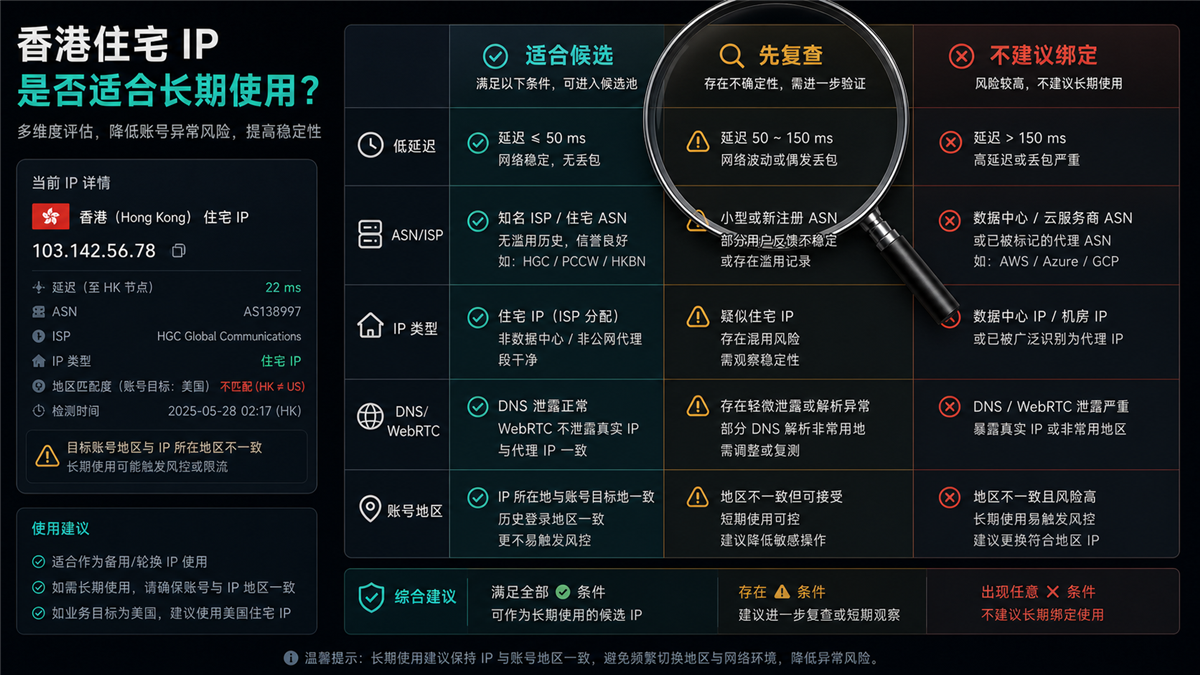
**Suitable candidates: Delay stable, located in Hong Kong, ASN/ISP interpretable, IP type biased towards residential or ISP, DNS/WebRTC without obvious abnormalities, account target region or historical records also allow Hong Kong to appear. This type can be used with low traffic and continuously observed.
**First, review * *: The latency is good, but the ASN is small, the organization name is unclear, the IP type tool judgment is inconsistent, the DNS occasionally jumps zones, or the account has rarely appeared in Hong Kong in the past. Do not directly bind important accounts for this type, conduct short interval and next day rechecks first.
**It is not recommended to bind * *: ASN clearly belongs to cloud service providers or data centers, IP types have been identified as data centers or proxy networks multiple times, DNS/WebRTC paths are chaotic, and account history is completely unrelated to Hong Kong. This type can be used for temporary access and is not suitable for accepting long-term accounts.
This classification can be viewed together with [Is a long-term proxy IP suitable for long-term accounts] (https://sureisp.com/blog/long-session-proxy-ip-account-login-records). A long-term account does not require a single successful connection, but rather an explainable record of multiple logins.
Which layer can Sureisp undertake
Sureisp is more suitable for undertaking the Hong Kong residential ISP/static residential export layer. That is to say, when you confirm that the account really needs to be registered in Hong Kong or that Hong Kong exports can reasonably enter the account records, then choose an agent that can be recorded for a long time, rechecked, and has clearer ownership.
But the agent cannot decide the target region for your account. Whether an account should be used in Hong Kong, the United States, Japan, or other regions depends on the account's business, historical records, team operations, and platform scenarios. Sureisp can help you clarify the network export layer, as you still need to manage the browser environment, account behavior, and operation logs on your own.
A more stable approach is to first determine whether the account requires Hong Kong records, and then select a Hong Kong residential IP; after obtaining the export, check the ASN, IP type DNS/WebRTC; Finally, bind the proxy with the browser environment, account purpose, and responsible person.
Perform two rounds of re examination before purchasing
If the Hong Kong residential IP is intended for long-term account use, it is not recommended to test it only once. The biggest issue with Hong Kong's exports is not whether they can continue, but whether they can maintain the same set of records in the coming days.
In the first round, check immediately after obtaining the IP. Record export IP, delay, Hong Kong territory ASN/ISP、 Organization name, IP type DNS、WebRTC、 Proxy protocol and actual browser export. This round is the baseline.
Second round, check again every 30 minutes to 1 hour. Focus on whether the export has changed, whether the DNS has skipped zones, and whether the IP type is still consistent. If there is a significant change in a short period of time, do not bind it to an important account yet.
The third round, check again the next day. Long term accounts are not logged in only once, and rechecking the next day is closer to actual use. If the next day it is still the same Hong Kong export, ASN/ISP can also explain it, DNS/WebRTC is normal, and entering the candidate pool will be more stable.
It is best for the team to keep a line of records for each Hong Kong export: IP, supplier, agreement, target account, ASN/ISP, IP type DNS/WebRTC、 First detection time, review time, account target region, and final processing method. When there is a regional reminder or login verification for the account later, this record sheet is more useful than "detected quickly at that time".
If the target region of the account is not Hong Kong, an additional column "Why use Hong Kong" should be added to the record table. For example, whether it is just a temporary backup, short-term content inspection, or preparing for long-term migration to Hong Kong. If the reason is unclear, do not place it in the long-term environment of the main account.
FAQ
Is Hong Kong residential IP suitable for long-term accounts?
Suitable for some long-term accounts, provided that the account's target region or historical records allow Hong Kong to appear, and ASN/ISP, IP type DNS/WebRTC、 Time zone language and account records can be interpreted as the same environment.
What is the difference between Hong Kong residential agents and Hong Kong data center IP?
Both may display Hong Kong, but the difference lies in network ownership. Hong Kong data center IP is more commonly found on servers or cloud service networks; Hong Kong residential agents place greater emphasis on residential or ISP attributes, but still need to check ASN, organization name, and IP type, not just the package name.
Does low latency mean that Hong Kong IP is more stable?
No. Low latency only indicates a good connection experience, but does not mean a stable account environment. Long term accounts also depend on whether the export is continuous, whether the DNS is consistent, whether the IP type is reasonable, and whether the account's regional records match.
Can dynamic Hong Kong residential IP login account?
Can be used for low-frequency or temporary scenarios, but not suitable for all long-term accounts. If exports frequently change, account records will become more difficult to interpret. Long term accounts are more suitable for prioritizing sustainable record residential ISPs or static residential exports.
Do fingerprint browsers still require a proxy?
need. Fingerprint browsers handle browser and device environments, while proxies handle network exits. Without a suitable proxy, even if the browser environment is fixed, the region, ASN, and network records seen by the account may still change.
How to choose between residential IP addresses in Hong Kong and other regions?
First, check the target region and historical records of the account. If the account is targeted towards other regions for a long time, the corresponding residential IP address in that region is easier to interpret; If the account itself requires the Hong Kong region, a Hong Kong residential IP is more suitable. Don't just select regions based on delay.