


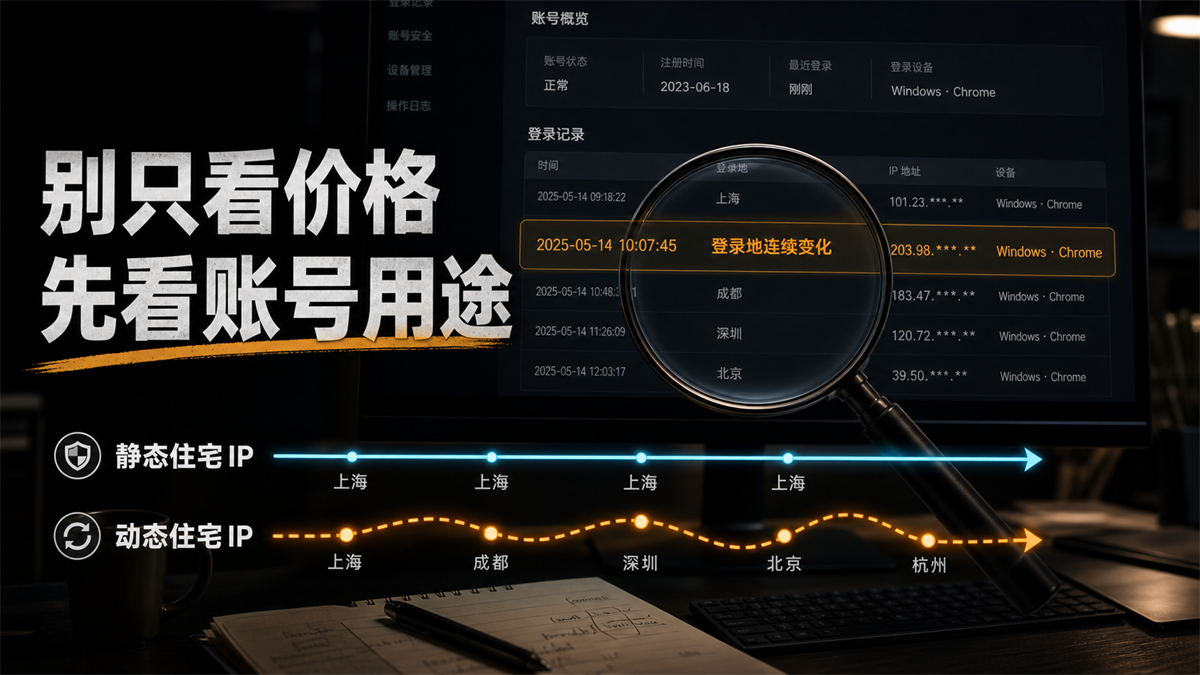
Choose static or dynamic, first consider the purpose of the account, not just the price.
A team has replaced the advertising account with a cheaper dynamic residential IP. The detection page can be opened every time, and the country is also in the target market, so it looks fine. The login records in the background quickly become difficult to explain: yesterday was in one city, today we moved to another city, and tomorrow there will be a new exit. After seeing the verification prompt, the first reaction of the operator is to continue changing to a "cleaner" IP.
This step can easily escalate the problem.
The real question is not whether the dynamic residential IP can be used, but whether this account needs long-term fixed exports. If it is an advertising backend, store backend, social media owner account, customer service backend, frequent changes in network exits will make it difficult to review login records, browser environment, and operation rhythm. A cheap price does not necessarily mean low subsequent costs, especially since the account itself is already a long-term asset.
First of all, give the answer:
Priority to long-term accounts with static residential IP addresses
Short answer: Long term login, advertising backend, and store backend are more suitable for static residential IP because the exit is fixed, the session is continuous, and the review is clear; Public page checks, short-term tasks, and visits that require regional coverage are more suitable for dynamic residential IP addresses, but account login should not be changed frequently.
This is not to say that dynamic residential IP is bad, nor is it to say that static residential IP is suitable for all scenarios. They solve different problems.
Dynamic residential IP is more like a set of changing access paths, suitable for tasks such as short-term, multi regional, and public page inspections. Static residential IP is more like a long-term traceable exit, suitable for managing together with a fixed browser environment, fixed account information, and fixed operation records. When choosing the wrong type, the trouble usually does not occur immediately, but in subsequent troubleshooting: you don't know whether the changes seen by the platform come from IP, browser environment, team operations, or account history.
If you have read 'Why Check IP Cleanliness Before Buying a Residential IP' (https://sureisp.com/blog/residential-ip-purchase-ip-purity-check) before, the logic here is the same: first separate the variables and then decide whether to let it enter the critical account environment.
The difference between static residential IP and
dynamic residential IP is not only in "residential"
Many people may be misled by the word 'residential', thinking that as long as it is a residential IP, it is definitely suitable for logging into an account. In practical use, what is more crucial is whether the export will change, when it will change, and whether it can be explained after the change.
Static residential IP:
more suitable for fixed exits and long sessions
The core value of a static residential IP is that the same account can return to the same exit path for a long time. It is usually used for long-term account login, advertising backend, store backend, social media main account, fixed regional business viewing and other scenarios.
For account operation, the significance of fixed exports is not to sound advanced, but to reduce one of the most easily chaotic variables. Today, who logged in, which browser environment was used, which IP was used, and what prompts were seen can be recorded. If there are any verification, regional misalignment, or access anomalies in the future, the team can at least know what has been changed recently.
Dynamic residential IP:
more suitable for rotation, coverage, and short tasks
The value of dynamic residential IP lies in the fact that exports can change and regional coverage is usually more flexible. It is suitable for tasks such as public page inspection, multi regional display viewing, short-term testing, price observation, and content visibility inspection.
But 'change' itself is a double-edged sword. For tasks that do not require long-term identity continuity, it is flexibility; For long-term account login, it may become an explanatory cost. An account goes through Exit A today, Exit B tomorrow, and then switches to Exit C the day after tomorrow. Even if each exit is connected, the account records will become discontinuous.
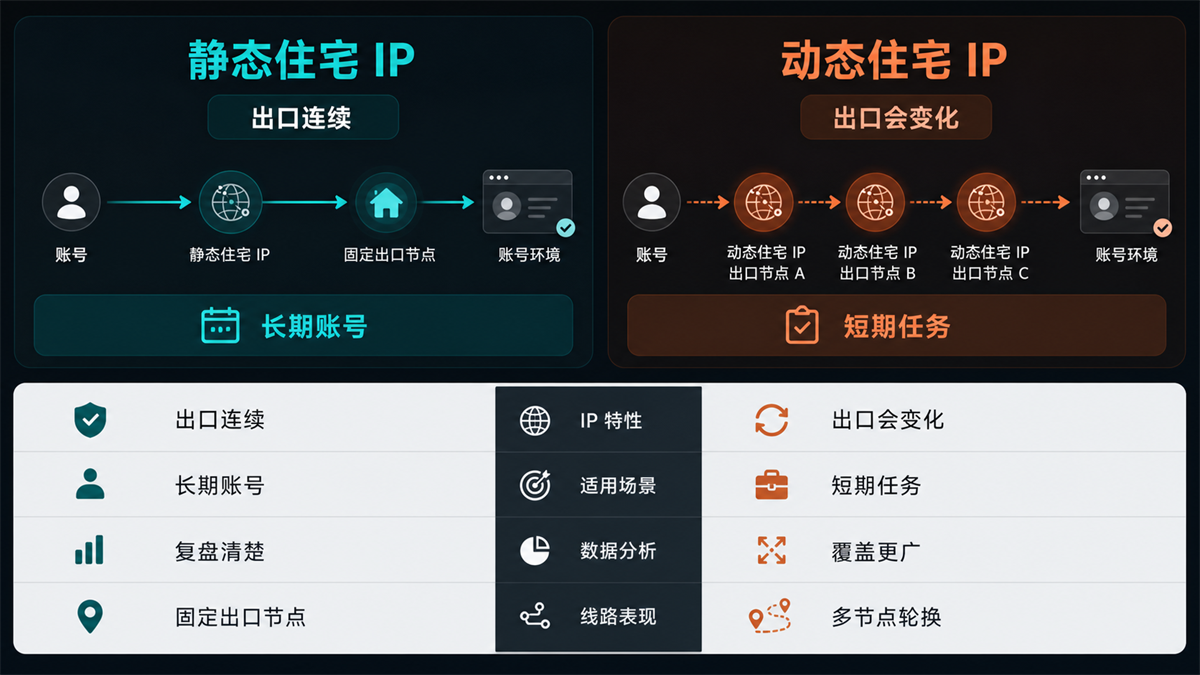
Static residential IP focuses more on continuous export, while dynamic residential IP focuses more on coverage and rotation.
Why are long-term accounts not suitable for frequent updates of dynamic exports
The biggest fear of long-term accounts is not that one variable is imperfect, but that there are too many variables, and in the end, no one can say for sure.
Continuous changes in login locations can make records difficult to review
Many platform backends leave login time, device, region, IP, or approximate network information. You may not be able to see all the fields, but the platform side usually sees more signals. When the dynamic exit frequently changes, the login record will appear to jump: the same account, the same browser, but the network path continues to change places.
This type of change may not immediately cause problems, but it will increase the difficulty of troubleshooting. Especially when multiple team members are operating, operations, pitchers, and customer service may all have access to the same backend. It's hard to say whether someone temporarily changed the environment, the proxy exit automatically changed, or if DNS, WebRTC, and time zones were not aligned.
The browser environment is fixed, but the IP keeps changing, which is not coordinated
Account environment is not just about IP. Browser fingerprints Cookie、 Cache, language, time zone DNS、WebRTC、 The plugins and operation rhythm will form a usage site together. You fix the browser environment, but make the network exits change frequently, and the environment is still incomplete.
That's also why we previously wrote [Why do fingerprint browsers still need proxy IPs] (https://sureisp.com/blog/fingerprint-browser-need-proxy-ip): Fingerprint browsers are responsible for environmental isolation and recording, while proxy IPs are responsible for network egress. One for the browser layer and one for the network layer, both layers must be interpretable.
Low price dynamic pools may transfer time costs to later stages
The price and coverage of dynamic residential IP may seem more attractive, but long-term accounts are not just counted as daily costs. After frequent export changes, the team needs to spend more time recording, troubleshooting, explaining, and migrating.
If the account is only used for public page checking, a dynamic pool is very suitable. If the account is bound with advertising, store, order, payment, and customer service permissions, each subsequent exception must be traced back to historical changes. This cost is often higher than the initial savings.
Which scenarios are more suitable for dynamic residential IP
Dynamic residential IP is not unusable, but should be placed in a suitable location.
It is more suitable for these types of tasks:
|Scenario | Why is it suitable for dynamic residential IP | Points to note|
| --- | --- | --- |
|Multiple region public page inspection | Need to see different region displays | Do not mix with the main account's long-term environment|
|Short term access testing | Short task cycle, no need for long-term identity continuity | Record testing time and export region|
|Market content observation | Focus more on coverage | Do not frequently log in to core accounts|
|Link availability check | Check if access is successful and if speed is acceptable | Cannot replace account environment judgment|
If your goal is to see what pages look like in different regions, the flexibility of dynamic residential IP is valuable. If your goal is to make an account work like the same person in the same environment for a long time, dynamic residential IP should not be the default answer.
What scenarios are more suitable for static residential IP addresses
Static residential IP is more suitable for scenarios that require long-term recording and fixed exits. For example, daily advertising placement in the backend, cross-border store backend, social media owner account maintenance, customer service system, team collaboration account, and SaaS backend that requires long-term login.
These scenarios have one thing in common: the account itself is an asset, not a one-time access tool. There may be payment information, order records, advertising materials, customer messages, team permissions, historical cookies, and long-term usage trajectories in the account. What you need is' change less', not 'change every day'.
A more secure approach is to have a key account correspond to a fixed browser environment, and then correspond to a fixed or long-term stable exit. Account information, region, language, time zone DNS、WebRTC、 Record the operator and login time as much as possible. This way, when encountering verification or regional anomalies later on, the troubleshooting sequence will be much clearer.
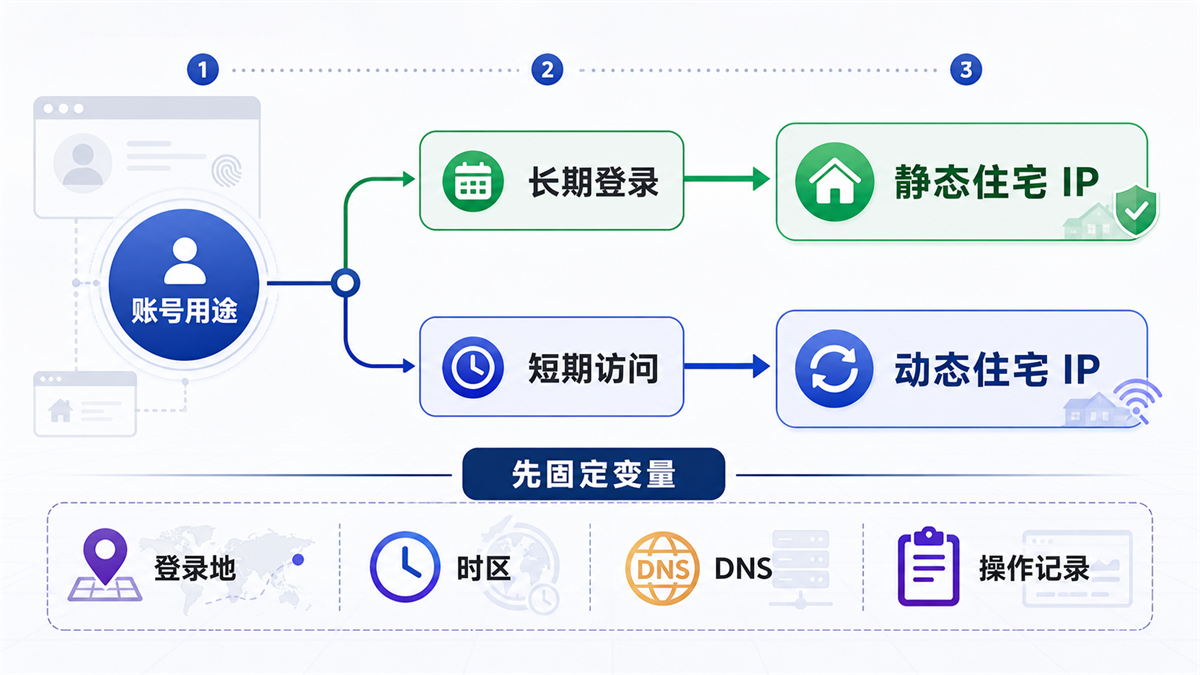
First determine the purpose of the account, and then decide whether to use it for fixed or rotating exports.
Before making a choice, ask four questions first
If you are still struggling with how to choose between a static residential IP and a dynamic residential IP, you can first ask these four questions.
Static and dynamic are just one layer. Before making a real purchase, it is also necessary to check the residential IP address, residential proxy IP, residential ISP proxy, ASN ownership, and whether they are exclusive. You can first use this main entry to make a general judgment: [How to choose residential ISP proxy and residential IP address] (https://sureisp.com/blog/residential-isp-proxy-residential-ip-address).
|Problem | More inclined towards static residential IP | More inclined towards dynamic residential IP|
| --- | --- | --- |
|Is this account a long-term asset? Yes, the account requires long-term login and tracking. No, it is only for temporary access or testing|
|Do you need to maintain login status? | Yes, cookies and sessions should be continuous. | No, you can restart each visit|
|Do you need multi regional coverage? Only a few fixed regions are needed. Frequent switching of regions is required|
|Do we need to conduct a review after a problem occurs? | We need to trace login records and environmental changes. | We only look at task results and error rates|
As long as the first two answers are "yes", don't just make decisions based on price. The price can be compared, but it should not outweigh the purpose of the account.
Several common misconceptions can make the selection more chaotic as you choose
The debate between static residential IP and dynamic residential IP is often not about technical issues, but rather about unclear usage scenarios. The following misconceptions are common and the easiest way to spend budget in the wrong place.
Misconception 1:
As long as it is a residential IP, it is suitable for account login
Residential attributes can only indicate a part of the IP source and network profile, and cannot be directly equated with long-term account adaptation. Long term login ensures continuous export, stable session, consistent region, and recoverability. Even if the dynamic residential IP comes from the residential network, as long as the export frequently changes, account records may still become jumping.
So don't just ask if it's a residential IP. A more specific question would be: Can this export be fixed for the long term? Will it automatically rotate? Can the same account always go back to the same route? Can the supplier provide clear country, city, protocol, session duration, and usage restrictions?
Misconception 2:
The more dynamic residential IPs there are, the better
A large IP pool is helpful for short tasks; Long term accounts may not necessarily be a good thing. An account originally only needs to log in to the same backend stably, but preparing dozens of rotating exits for it actually increases variables. After the problem occurred, the operation only knew that "a lot of IPs had been used", but it was unclear which IP, which time, and which browser environment triggered the change.
The advantages of dynamic pools should be used for tasks that need to be covered, and should not be automatically stuffed into the main account environment. The more important the main account, the fewer variables are needed.
Misconception 3:
After purchasing a static residential IP, there is no need to worry about the environment
Fixed export is only the first step, not the complete account environment. Browser language, time zone DNS、WebRTC、Cookie、 Team permissions, login time, and operation records still need to be managed together with IP. Static residential IP can reduce network export changes, but it cannot automatically make the browser environment more reasonable.
That's why it's best to use a combination of "fixed exit+independent browser environment+operation records" for long-term accounts. Each account has its own environment, do not mix them up temporarily, do not cut them off casually, and only have evidence during investigation.
I have already used a dynamic residential IP, how to troubleshoot
If the account has experienced changes in login location, increased verification, regional mismatch, or abnormal backend prompts, it is not recommended to immediately switch to more exits. Stop the scene first.
The first step is to fix the variables. Don't change your IP, browser language, time zone at the same time for now DNS、 Plugin and account information. Only move one variable at a time, otherwise you won't know which step is taking effect.
Step two, export or record recent login information. At least record the time, account, browser environment, proxy exit, region, operator, and prompts seen. When there is no record, we can only rely on guessing later.
Step three, check the environmental link. IP region DNS、WebRTC、 The browser time zone, language, and account information should be mutually explanatory. We have discussed in [How to Do DNS Leakage Detection] (https://sureisp.com/blog/dns-leak-test-proxy-browser-environment) that a normal IP does not necessarily mean that the parsing path is also normal; It has also been mentioned in https://sureisp.com/blog/proxy-ip-timezone-language-mismatch-browser-env that regions, languages, and time zones cannot be viewed separately.
Step four, decide whether to migrate to a fixed exit. If this account needs to be operated for a long time in the future, it is usually not recommended to continue placing it in frequently rotated exits. When migrating, do not suddenly change all variables, but rather adjust the browser environment IP、 Record the login time together with the operator.
Which layer can Sureisp undertake
Speaking of which, bringing up suresp again would make the location more accurate.
Sureisp provides static residential ISP proxy IP and fingerprint browser environment capabilities, suitable for managing fixed exits, browser environments, and team operation records of long-term accounts together. It is not a substitute for the compliant operation of the account itself, nor can it replace the platform's own judgment; Its value lies in reducing temporary changes, making the account environment easier to record, handover, and troubleshoot.
If you manage advertising accounts, store backend, and social media main accounts, you can prepare fixed exits according to target regions in [suresp] (https://sureisp.com/), and then use [suresp fingerprint browser] (https://sureisp.com/browser.php) to establish independent environments for different accounts. This can at least separate the management of the "browser environment" and "network exit" layers.
If you are only conducting public page inspections, short-term regional observations, or one-time testing, a dynamic residential IP may be more suitable. The key is not to buy the most expensive or cheapest, but not to use short-term task tools to support long-term accounts.
Finally, compress it into one sentence
The difference between static residential IP and dynamic residential IP, when it comes to account operation, is that static is more suitable for long-term fixed and reversible transactions, while dynamic is more suitable for coverage, rotation, and short-term tasks.
So, for long-term accounts, first look at export continuity, and then look at prices; Short term tasks first look at regional coverage and cost, and then see if fixed sessions are needed. As long as this account will be logged in for a long time, bound with business information, and maintained by multiple team members, do not let the export change into new variables every day.