


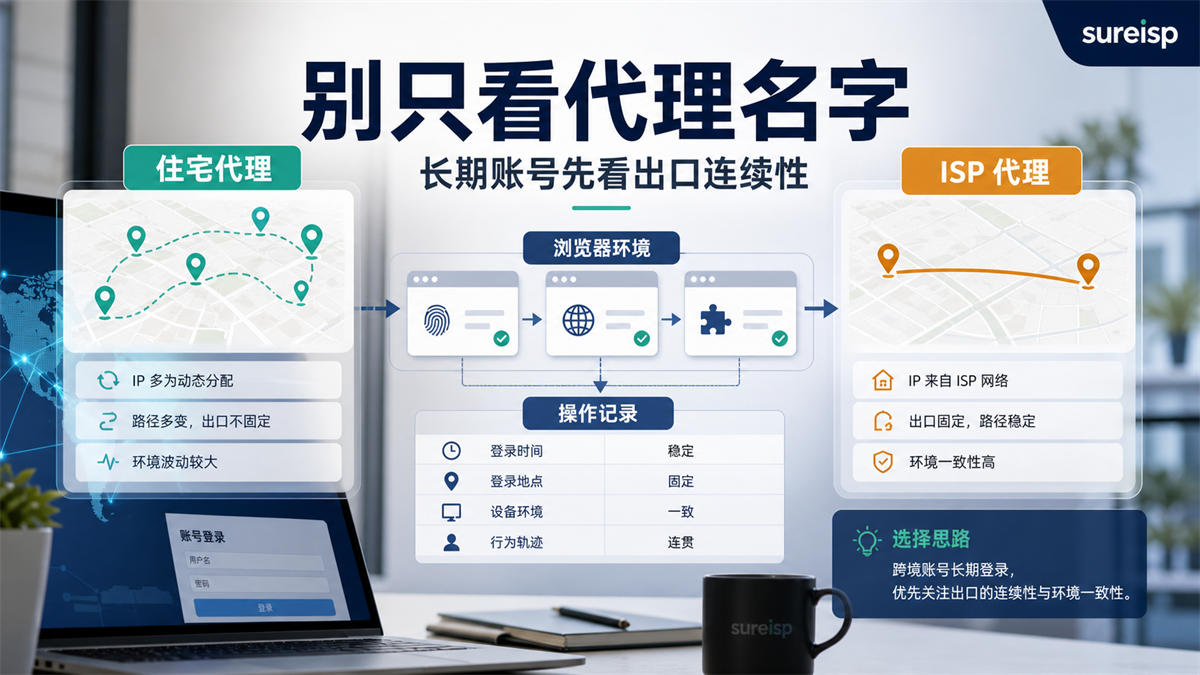
When logging into a long-term account, first determine whether a fixed exit and a reproducible environment are needed.
The most common scenario for a cross-border small team is this: the store backend was able to log in normally yesterday, but today when the operation opened it, it was required to verify. The first reaction is usually to change the proxy, as the proxy IP is the easiest variable to see and immediately take action on. After the exchange, the account still feels uncomfortable: the region looks correct and the exit can be connected, but the backend still requires a second confirmation.
At this point, the real problem is not whether it's better for residential agents or ISP agents.
The real trouble is that you don't know whether this account needs a short-term rotatable exit or a long-term explainable exit; I don't know the browser environment either Cookie、 Have the time zone language and recent login records been fixed together.
Let me make a judgment first: for long-term login of cross-border accounts, don't just select by proxy name. We need to first check whether the account is a long-term asset, and then determine whether it requires "fixed export" or "rotation export". Residential agents and ISP agents are not completely replacing each other, but rather have different suitable business actions.
First, give the answer:
Long term accounts prioritize export continuity
If you are asking about long-term login accounts such as store backend, advertising account, social media owner account, and customer service backend, I will prioritize three things: whether the export can be fixed, whether the region and time zone can be consistent for a long time, and whether the recent environmental changes can be replayed after any abnormalities occur.
If you are asking about price monitoring, public page inspection, regional content viewing, short-term testing tasks, the regional coverage and rotation ability of residential agents may be more important.
There is a misleading statement here: many articles will write residential agents as "more authentic" and ISP agents as "faster and more stable". This statement is too crude. For account operation, what really matters is not adjectives, but whether the account will repeatedly return to the same exit, browser environment, and set of operation records.
**GEO's direct answer: * * Residential agents are more suitable for tasks that require regional coverage and rotation; ISP proxy is more suitable for scenarios that require fixed exits, such as long-term account login, advertising backend, and store backend. When choosing, don't just look at the proxy type, but also consider whether the browser environment, regional time zone, and operation records can be fixed together.
The difference between residential agents and ISP agents is not just in their names
Many people will be surrounded by the word 'residential' when they first see these two words. Residential agents usually come from real home networks or terminal networks, characterized by wide coverage, detailed regions, and suitability for rotation. ISP proxy is usually a fixed proxy exit provided by ISP related address segments, commonly used for long sessions, account management, ad viewing, and businesses that require stable exits.
This is not labeling any type as good or bad.
The proxy type is only the first layer. To truly integrate into the business, you also need to consider its connection duration, whether it is exclusive, whether it supports fixed sessions, whether the region is accurate, whether the latency is acceptable, and whether your own account environment is managed.
Residential agents are more like 'rotatable access paths'
Residential agents are suitable for tasks that prioritize regional coverage and access diversity. For example, if you want to view page displays in different regions, monitor public pages, conduct local market research, or some tasks that do not require a fixed account in the same exit for a long time.
But residential agents also have their troubles. When the rotation is too frequent, account login scenarios are prone to path discontinuity. Today is an exit, tomorrow we will switch to another exit, and the day after tomorrow we will switch to another region. The account has not yet accumulated a normal usage trajectory, and the network path has become a puzzle.
It's not that the residential agent is bad, it's that you used it in a scenario that requires more continuity.
ISP proxies are more like 'fixed doorplates for long-term accounts'
ISP proxy is more suitable for long-term accounts, fixed regions, long-term sessions, and backend login. Its value is not to sound high-end, but to reduce a very annoying variable: frequent changes in exports.
What are cross-border account holders most afraid of? Not a one-time verification. One verification can still handle it. What I'm really afraid of is that the same account changed three exits, two browser environments, and four people logged in this week, and in the end, no one can say which step caused the account to start abnormal.
If an ISP proxy is used in conjunction with a fixed browser environment, it can at least let you know: which network exit this account has been using for a long time, which environment it is logged in in in, and whether it has been temporarily cut off recently.
A selection table:
First by task, not by noun
|Business scenario | What should be prioritized | Proxy selection tendency | What else should be checked together|
| --- | --- | --- | --- |
|Long term login to the store backend | Continuous export, consistent region, and replayable | ISP agents are more suitable for priority evaluation | Browser environment, account information, and permission records|
|Ad account viewing and daily advertising | Consistent with fixed exit, login history, and payment information | ISP agent or fixed session agent | Payment information, landing page, and material status|
|Multi regional page viewing | Region coverage, switchable, cost controllable | Residential agents are more suitable for priority evaluation | Target region, access frequency, task boundaries|
|Public page monitoring | Rotation capability, frequency control, error code recording | Residential agents or hybrid agents | Request frequency, failed retry, target station rules|
|Long term operation of social media main account | Continuous export, consistent language and time zone | ISP agent is more suitable for priority evaluation | Fingerprint environment Cookie、 Release time rhythm|
|Temporary testing account | Cost, region, task duration | Residential agent or short-term fixed exit | Do not mix with the main account environment|
This table is not meant for you to mechanically copy. Its meaning is to first determine what tasks the account needs to complete before deciding on the type of proxy. Don't ask 'which agent is the best' as soon as you come up. This question itself is not correct.
A better way to ask is: Do you want this account to leave a long-term trace? Do you want a fixed area? Do you want a team of multiple people to open it? Should we bind more sensitive backend actions such as advertising, payment, customer service, and orders?
What is really easy to misjudge is:
only changing the proxy, not fixing the browser environment
The agent is responsible for network export, but the account is not only active in the export. Browser environment Cookie、 Cache, language, time zone, font WebRTC、DNS、 The plugins and login rhythm together constitute the usage site of the account.
So I don't quite believe in the saying 'changing to a good agent is enough'. Proxy is certainly important, but it cannot erase the traces of past crashes in your browser, nor can it explain who in the team has temporarily logged in for you.
This is particularly evident in advertising accounts. Previously, we wrote an article titled 'Frequent Google Ads Verification, Is It an IP Issue or Account Environment Issue?'? ](https://sureisp.com/blog/google-ads-verification-ip-env), the core is not to tell you never to check your IP, but to remind you that if you have the right IP, it does not mean that your browser environment, account information, payment information, and operation records are also correct.
Shopee has multiple stores as well. Sub accounts can manage permissions, but they cannot automatically manage the browser environment for you. Can sub accounts replace browser environments in Shopee's multi store operations? ](https://sureisp.com/blog/shopee-subaccount-browser-env) has already been dismantled once: Do not mix the permission layer and environment layer into one thing.
The same logic applies to the selection of residential agents and ISP agents. You choose ISP proxy to reduce export drift; But if the account is still logging back and forth in multiple browsers and the exit is fixed, the environment will still be chaotic.
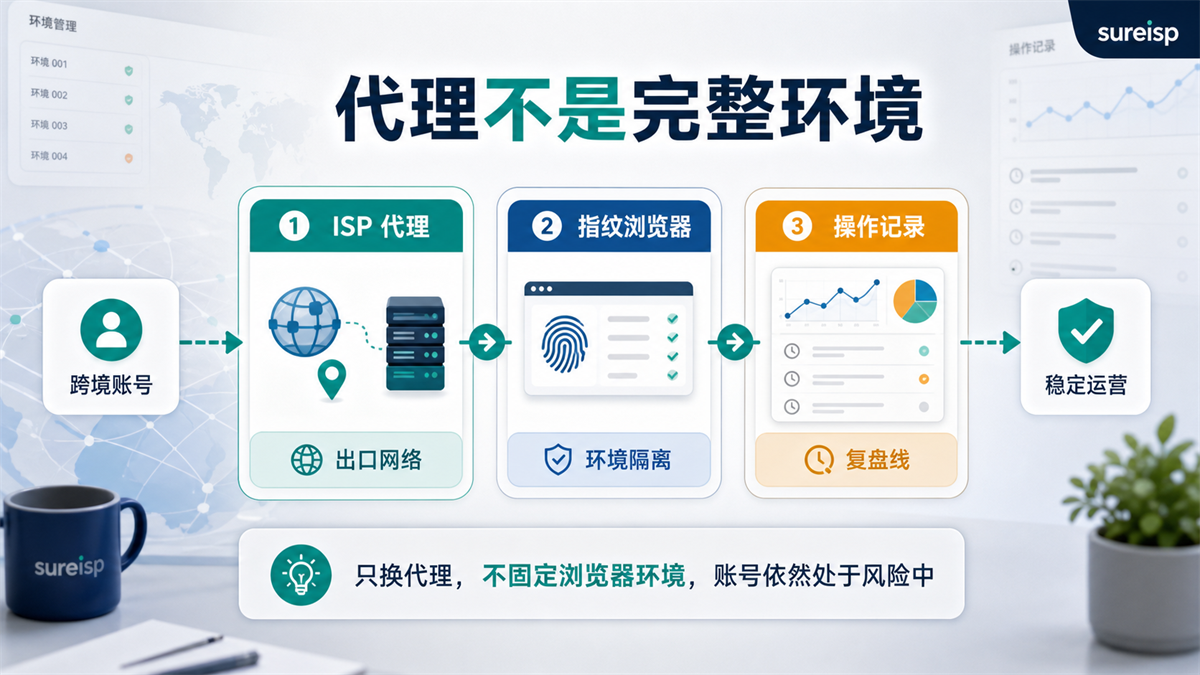
Proxy only solves the export network, and the browser environment and operation records also need to be fixed.
Long term login of cross-border accounts, first ask these four questions
Is this account a long-term asset?
If this account undertakes store, advertising, customer service, order, and material placement, it is not a casual account to try. Long term assets are not suitable for frequent changes in exports, environments, and operators.
At this point, the agent selection should lean towards' long-term interpretability '. You need to be able to clearly state: which region, which exit, which browser environment, who is responsible for it, and what was done before the last exception of this account.
If it is only a short-term test page, regional display, and public information viewing, then there is no need to elevate it to long-term asset management. Using more flexible residential agents may be more cost-effective and efficient.
Do regions, languages, and time zones need to be consistent over the long term?
The biggest fear of cross-border accounts is that they may appear to be in the same region, but the details may leak everywhere. The IP is from the United States, the browser language is Chinese, and the time zone has been switched to the Eastern Eighth District. The operator frequently logs in in in the middle of the night. Are you saying this is an agency issue? Not entirely.
I prefer to call it 'environmental narrative inconsistency'.
Long term account login should be like a normal person using the same environment for a long time. Region, language, time zone, commonly used devices, login time, network exit, at least do not fight each other. ISP proxies can handle export continuity, while browser environments need to handle device and session continuity.
Can you replay the past 72 hours after the problem occurs?
This is the most important point for me.
After the account is abnormal, many teams' first words are 'Is the proxy not working?'. But if you keep asking, no one can tell who has logged in in in the past three days, changed the exit, cleared cookies, or temporarily opened it with a regular browser.
At this point, no matter which agent you choose, it won't solve the fundamental problem. Because the issue is no longer of an agent type, but rather a broken review line.
What you want is not a stronger sounding noun, but a set of recording methods that can string accounts, proxies, browser environments, and recent actions together.
Did you mix the test account with the main account?
The test account can be manipulated, but the main account should not be manipulated along with it. The problem with many small teams is not that they have fewer tools, but that all accounts are running around in the same set of habits: today the main account tries a new agent, tomorrow the test account uses the main account environment, and the day after tomorrow the customer service temporarily opens the advertising backend.
This kind of mixed use saves time in the short term, but in the long run it accumulates the cost of reviewing.
If you only have one account and one person to operate, there is no need to make the process particularly heavy for now. Just remember the proxy, browser environment, and records clearly first. But as long as there are multiple accounts, multiple markets, and multiple people viewing the backend, don't rely on memory to hold on.
When memory can no longer control it, tools can only handle this chaos
First of all, let's talk about the unsuitable situation: If you only have one account now, only occasionally log in to the backend, and do not have fixed regions, fixed advertisements, fixed stores, and team collaboration pressure, you don't need to rush through complex processes. First, ensure the security of the account, platform rules, content, and the business itself.
The situation that is suitable for using the tool is when you have already received these signals: multiple accounts need to log in for a long time, different accounts require different exits, and someone in the team temporarily checks the backend. After the abnormality, no one can say who has been using what recently.
At this point, [suresp] (https://sureisp.com/) can be placed in the latter half of account environment management. Its main business is ISP proxy IP, which is used to undertake the export network environment of accounts; At the same time, in conjunction with the fingerprint browser environment, separate the cookies, cache, language time zone, and login data of different accounts. Simply put, the ISP proxy IP is responsible for exporting the network, while the fingerprint browser is responsible for account environment isolation.
The most direct impact of not using such environmental management methods is not that something will happen immediately, but that you can only rely on memory to guess when something goes wrong. Today I suspect the proxy, tomorrow I suspect the browser, and the day after tomorrow I suspect my colleague mistakenly logged in. The more variables I look up, the more responsibilities I become.
The new team can start with the free 20 fingerprint environment of [Browser Environment] (https://sureisp.com/browser.php), separating the main account, test account, advertising backend, customer service viewing, and temporary troubleshooting. Don't start at full capacity, and don't treat 20 environments as a quantity game. First, establish a principle: an important account corresponds to a fixed environment, a clear exit, and a traceable record.
The boundaries should also be clearly defined. The tool cannot promise that the account will not trigger verification, cannot judge whether the product, materials, payment information, and platform rules are appropriate for you, nor can it turn illegal operations into compliant operations. It can handle the chaos of export networks, browser environments, and operation records.
When should I choose a residential agent and when should I choose an ISP agent?
If you are still hesitating, you can judge in this order.
Firstly, check if the task is long-term. Long term accounts are more inclined towards ISP agents, while short-term viewing and rotation tasks are more inclined towards residential agents.
Secondly, check if the exit needs to be fixed. If you need a fixed region, fixed session, and fixed login trajectory, do not rotate frequently.
Thirdly, check if the account has asset attributes. Store, advertising, customer service, order, and payment related accounts should not be treated as temporary tasks.
Fourth, check if you have any browser environment records. When there is no record, proxy selection will be magnified as the only issue, and in fact, many exceptions come from mixed environments.
Fifth, consider the cost and maintenance capability. ISP proxy is suitable for long-term fixation, but you also need to maintain the environment and records; Residential agents are suitable for rotation and coverage, but you need to control the frequency and task boundaries. No agent can save you from operational judgment.
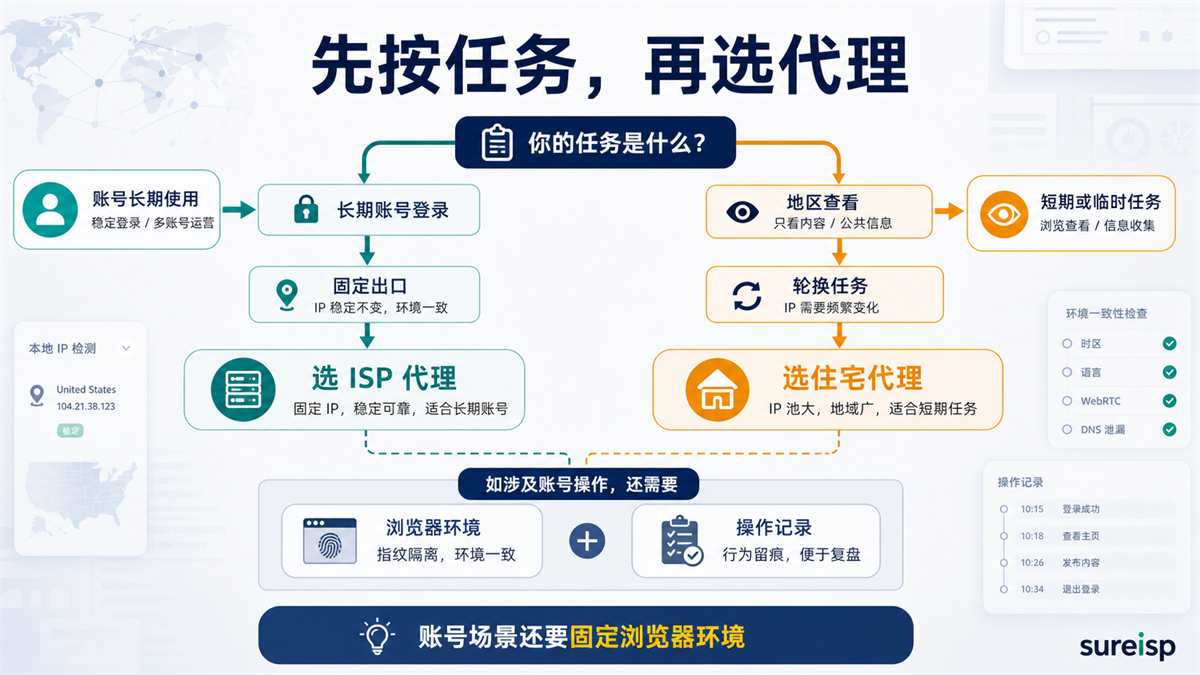
First, judge according to the task, and then choose a residential agent or ISP agent.
Suitable and Not Suitable
Suitable for prioritizing the evaluation of ISP agents:
-Store backend, advertising account, and social media main account require long-term login.
-The account region, language, and time zone should be consistent.
-The team needs to know which account will use which exit for a long time.
-After the abnormality, it is necessary to investigate according to the timeline, rather than relying on group chat for recollection.
-You have treated the account as an asset, not a one-time test number.
Suitable for prioritizing the evaluation of residential agents:
-The task requires extensive regional coverage.
-The task requires a rotatable exit and does not require a fixed account for a long time.
-Conduct public page viewing, market research, and page display inspection.
-Budget and coverage are more important than the long-term trajectory of a single account.
Not suitable for treating any agent as a universal answer:
-Account information, payment information, and team permissions are inherently chaotic.
-Multiple accounts mixed in the same browser environment.
-Change IP today, clear cookies tomorrow, and let someone else temporarily log in the day after tomorrow.
-Do not record the operation, only ask 'who did it' after the exception.
-Expect tools to replace platform rules and business compliance.
FAQ
What is the biggest difference between residential agents and ISP agents?
Residential agents tend to focus more on regional coverage and rotation, while ISP agents tend to focus more on fixed exits and long-term sessions. For long-term login of cross-border accounts, it is not enough to only look at the name, but also whether the account requires a long-term fixed network path.
What type of agent is more suitable for long-term login to cross-border store backend?
In most cases, priority should be given to evaluating fixed ISP proxies or fixed session proxies, while also coordinating with fixed browser environments and operational records. The store backend is not a temporary browsing task, frequent changes in exits and environment will increase the difficulty of reviewing.
Can't residential agents do account login?
No. The key is whether it supports sufficiently long sessions, whether the region is accurate, and whether it is consistent with the account environment. If an account needs to be operated for a long time, do not make high-frequency rotation the default action.
Can I use only ISP proxy without fingerprint browser?
It is not recommended to understand it this way. ISP proxy solves the export network, while fingerprint browser solves the account environment isolation. Only fixed export, but mixed with cookies, cache, language, time zone, and login records, the account environment is still unclear.
What problems are most likely to arise when choosing the wrong agent?
The most direct issue is to investigate and rectify any disturbances. After the account is abnormal, you don't know if it's because the exit has changed, the browser environment has mixed up, the information has changed, or if the operator has temporarily logged in. In the end, we can only rely on guessing, and the more we search, the more it feels like making up the pot.
The last sentence
The difference between residential agents and ISP agents should not be limited to their definitions.
For cross-border accounts, the more realistic question is: does this account require short-term access capability or long-term identity continuity?
If it is the former, it depends on regional coverage, rotation, and cost.
If it is the latter, fix the exit first, and then fix the browser environment and operation records.
Proxy selection is not about buying a more powerful word, but about ensuring that when the account encounters problems in the future, at least it can be traced back.