


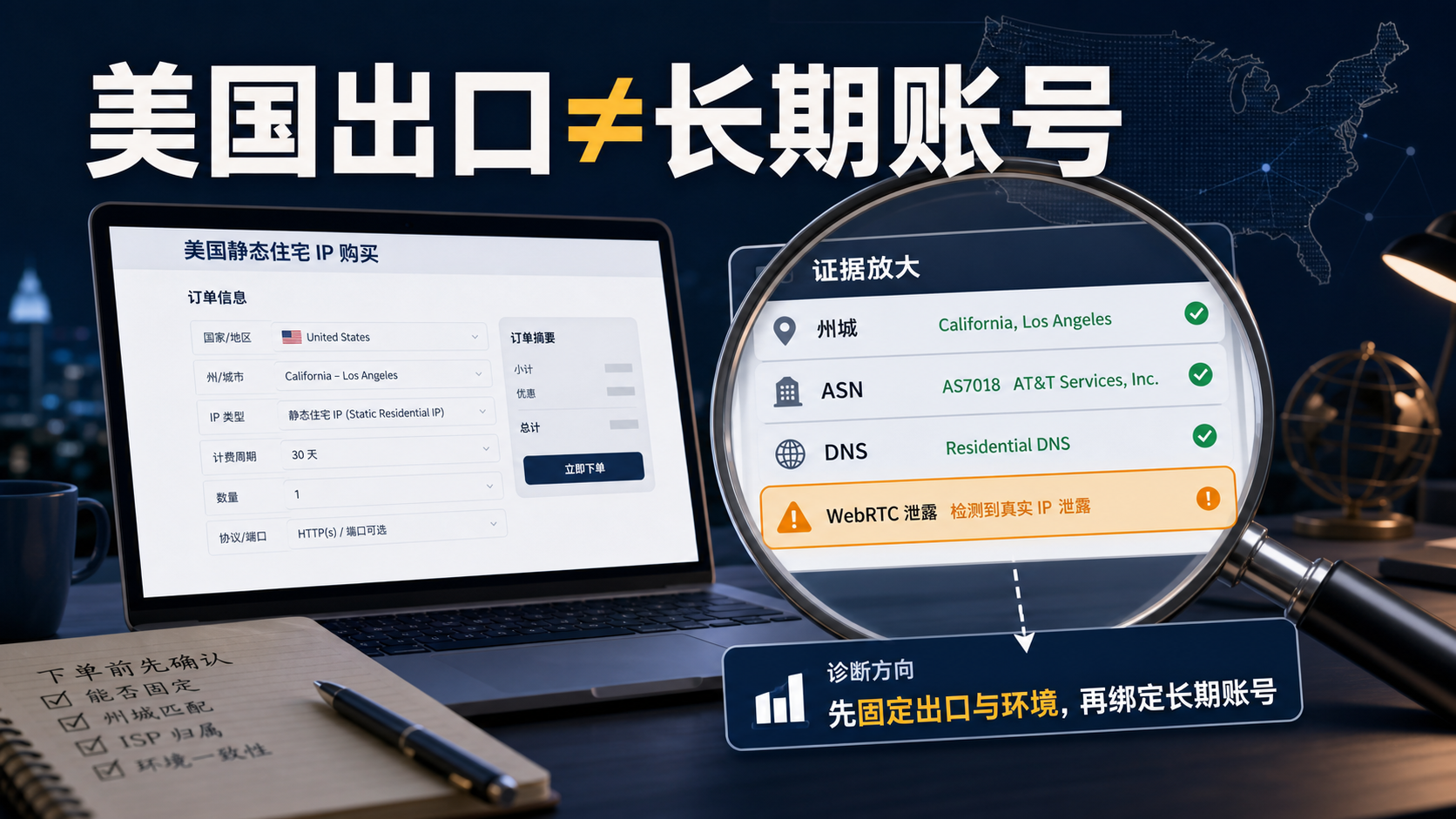
The US account is preparing to log in for a long time, but the operator sees the proxy page saying "US residential IP" and "optional state cities", and the price is not unreasonable, so they want to place an order directly. The real trouble is that the ordering page can only indicate that it is like a US IP region, but it does not necessarily mean that it is suitable for long-term account binding. The account information states California, but the connecting region falls on the East Coast; The detection page shows the United States, but the DNS is running to another region; The browser time zone is still set as before, and it is difficult to determine which step went wrong after the login verification.
I usually don't ask 'Is this a US IP' first. This question is too shallow.
We should first ask: Can it serve as a fixed network entry point in a long-term account environment? If the answer is unclear, then this static residential IP in the United States cannot be urgently linked to the main account.
First of all, let's conclude that the United States is only the first tier
Before purchasing a static residential IP in the United States, it is necessary to confirm whether the state and city match the account information, whether ASN/ISP networks are similar to residential or ISP networks, whether the IP type is stable, whether DNS/WebRTC/time zone languages are consistent, and whether it is exclusive or replaceable. The US region is only the first layer, and long-term accounts still need to see if these pieces of evidence can continue.
This sentence may sound a bit verbose, but it is very practical for account operation.
Many people buy residential IPs in the United States to maintain a clearer usage area for their accounts in the long term. But if we only look at the country, the variables are still too coarse. The United States itself is too large, and state cities, time zones, carriers, and DNS paths may all affect how you interpret login records in the future. When there are few accounts, you may rely on memory to make do; When there are multiple accounts or someone in the team temporarily logs in once, memory becomes unreliable.
So today's article does not make a ranking list of service providers, nor does it write 'which one is the best'. That kind of content may seem lively, but when you actually place an order, you still have to go back to the fields and evidence.
Why are US residential IP search results prone to misjudgment
When searching for 'US residential IP purchase', the three most common types of information on the page are the number of US IPs, package prices, and agreement support. They are all important, but they are not the final judgment.
Having a large number of IPs does not necessarily mean that the one you receive is suitable for a long-term account. Low price does not mean low follow-up investigation costs. Supporting HTTP and SOCKS5 only means it can connect to your software, not whether it matches your account information, browser environment, or DNS path.
Many users are most easily relaxed by the word 'America'. For example, the account registration information, delivery area, and advertising placement area are all located in the western United States, but the connection area is in the eastern United States, and the browser time zone has not changed accordingly. Opening a webpage in the short term may not be a problem, but when logging into the backend for a long time, this information can become a series of inexplicable changes.
If you have read 'How to Choose a Residential IP in the United States' (https://sureisp.com/blog/us-residential-ip-account-login-evidence-check) before, the article is more focused on aligning the US region and account information. Today's article goes one step further: Before placing an order, you need to put the supplier page, test results, and account usage in the same table.
Ask 7 fields before placing an order
I suggest asking about the fields first and then
looking at the price. The price certainly depends, but it should come after the evidence.
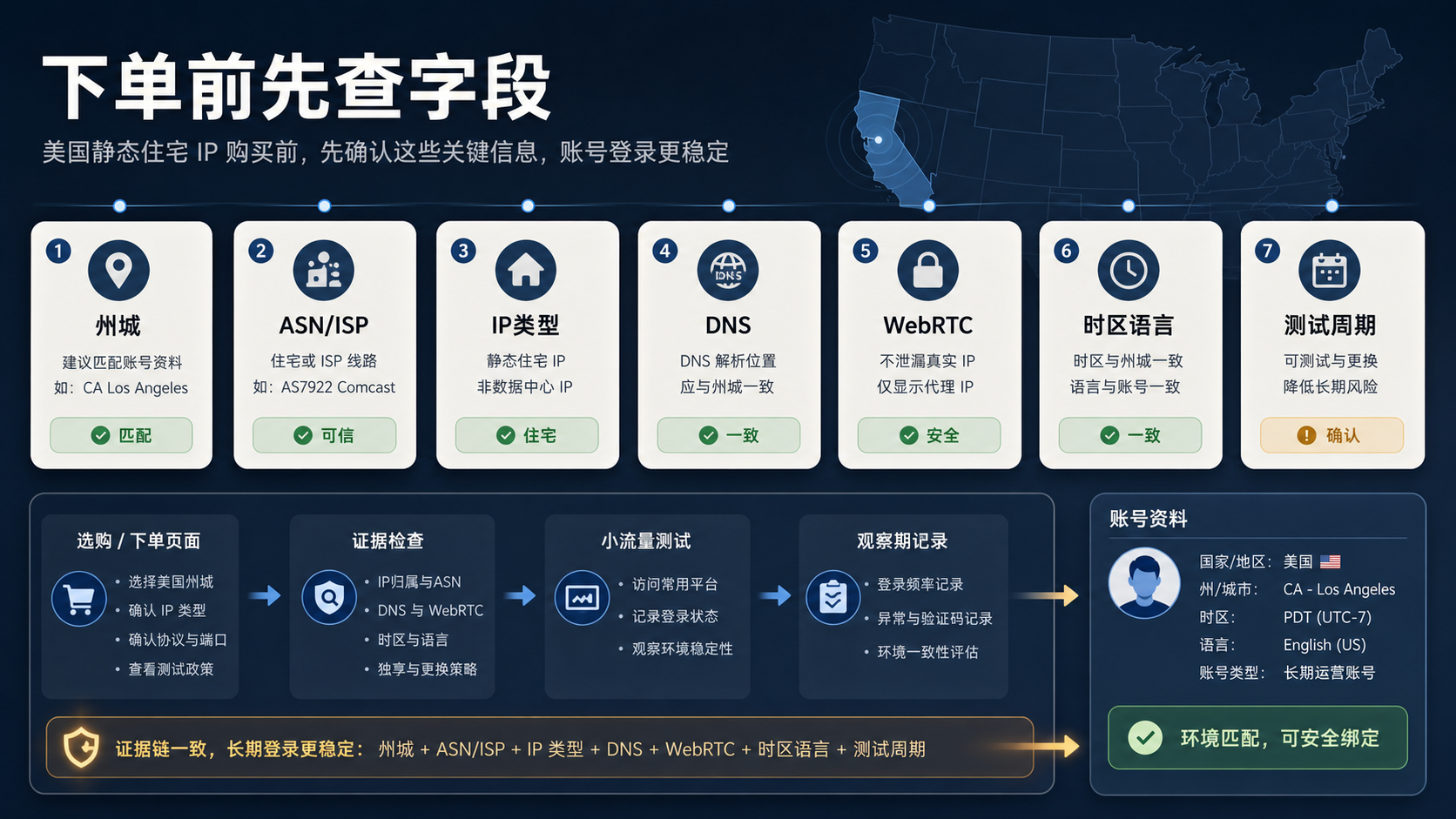
This picture expresses that the static residential IP in the United States is not only based on the country. Before placing an order, at least state city, ASN/ISP, IP type DNS/WebRTC、 Confirm the time zone language, whether it is exclusive, and testing cycle together.
|Fields | How to ask before placing an order | Why does it affect long-term accounts|
| --- | --- | --- |
|State City | Can it be fixed to a state or city, or can only select the United States? | Account information, advertising region, login records need to be explained|
|ASN/ISP | Can ASN, organization name, or ISP information be seen | Determine if it resembles a residential/ISP network more or just a regular proxy label|
|IP type | Is it static, long-term, rotating, or will it automatically change? | Long term accounts are not suitable for frequent network changes|
|DNS | Whether the DNS region and IP region are consistent | The detection page only looks at the IP address, not enough, and the resolution path also needs to be checked|
|WebRTC | Will the browser expose local or other network information | Proxy is normal but browser layer leakage can disrupt troubleshooting|
|Time zone language | Whether the browser's time zone and language match the US region | Long term environment should try to minimize signals of fighting with each other|
|Testing cycle | Can we conduct small traffic testing first, and how to handle exceptions? | Observe first, then bind important accounts, don't go all in one step|
The most easily overlooked aspect here is the testing cycle. Many people immediately migrate their main account after placing an order, but once verification occurs, they do not know if it is the IP itself, browser environment, account history, or if the migration was done too hastily. A more stable approach is to first conduct a low-risk environment test on the sample IP, record it for two to three days, and then decide whether to enter the main account.
When the fields are inconsistent, do not bind the account for now
Not every inconsistency means it cannot be used,
but some inconsistencies can make subsequent reviews very painful.
The first type is a clear conflict between the state city and account information. For example, account information, business area, and advertising placement are all biased towards California, but the connection area is consistently displayed in other states. You can say that the United States is still the United States, but what the platform records see is not a stable environment down to the level of states and cities. It's best not to rely on vague explanations to force long-term accounts.
The second type is that ASN/ISP cannot see clearly. Writing 'residential' or 'native' on the supplier page is only a description, the ASN, organization name, and IP type in the test results are the evidence. If the supplier is unwilling to provide samples or explain replacement rules, you should at least put it in a low-risk account for observation first, rather than directly binding it to the core account.
The third type is that DNS, WebRTC, and time zone languages are not consistent with each other. Many login exceptions are not caused solely by IP addresses. You see, the IP is from the United States, but the DNS is not; The browser time zone is not; The language environment is also incorrect. Each one looks like a small problem when viewed individually, and when stacked together, it makes it difficult to explain the account environment.
The fourth type is unclear fixed rules. Is it static, long-lasting sticky, Or is it a short-term fixed in the dynamic pool? These words have different meanings among different suppliers. You need to ask clearly: how long will it take to change, how will it be notified when it is replaced, can the same IP line be maintained, and can replenishment be done by region.
The order page cannot be seen, you need to make a ledger yourself
Many purchasing decisions are bad here: there is a lot of information on the page, and there are very few things that can be left for review.
I suggest that you create a very simple table before placing an order, without complexity, so that you can still understand it after three months. Write the purpose of the account in the first column, such as advertising backend, store backend, social media main account, customer service backend. The second column indicates whether the target region is sufficient in the United States or must be fixed in a certain state city. Write the ASN/ISP, IP type, protocol, and replacement rules provided by the supplier in the third column. The fourth column lists the DNS, WebRTC, and time zone language that you have actually detected. Write the binding date, operator, and exception prompt in the fifth column.
This table is not meant to look good. It is to avoid everyone speaking based on feelings later on.
When the account was initially fine, many people found it troublesome to keep records. After a certain day of verification, abnormal deployment, and inability to access customer service accounts, I realized that I only remembered "buying a US residential IP", but I didn't know which one, which city, which ASN, or who had changed environments at that time. At that point, the investigation was already too late.
If a static residential IP in the United States cannot even explain these basic fields clearly, I would rather put it in the testing environment first rather than immediately bind it to the main account. Cheap prices can be calculated slowly, but once the account history is disrupted, the cost of remediation is often higher.
Which accounts are suitable for static residential IP in the United States
The common feature of suitable scenarios is that the account itself is a long-term asset, not a one-time access tool.
For example, cross-border store backend, advertising account, social media main account, customer service backend, and long-term shared business account of the team. These accounts contain payment information, historical cookies, advertising materials, customer messages, permission records, and long-term operation traces. What you need is to change less, not to switch to a cheaper looking internet portal every day.
The value of static residential IP in the United States is not to prevent account problems from happening again. Tools do not have this ability. Its value is more practical: making fixed IP networks a traceable, recheckable, and interpretable variable. If there is login verification later, at least you can investigate the IP address, browser environment, account information, and recent operations together, instead of just saying "I don't know which line I used yesterday".
That's also why in [How to verify the purchase of a residential IP address] (https://sureisp.com/blog/residential-ip-address-acceptance-checklist), I have always emphasized not to rush to log in to the main account. Buying a good-looking American IP is just the first step. Before entering a long-term account, it is necessary to conduct small traffic testing, DNS/WebRTC checks, and record retention.
Which tasks do not require buying a static residential IP
Not all visits to the United States require a static residential IP address.
If you are only looking at public pages, checking displays in different regions, and conducting short-term price observations, dynamic residential IPs or regular agents may be more suitable. Because this type of task places more emphasis on coverage and flexibility, it does not require an account to return to the same network path for a long time.
If you are still trying out your business direction, and your account itself has not been established, nor does it involve payment, advertising, customers, or orders, then there is no need to rush up costs. First, streamline the business process and then decide which accounts are worth fixing in terms of region and long-term environment.
If you are pursuing large-scale rotation, capturing public data, and short-term access, static residential IP may not necessarily be the most economical choice. It is more suitable for scenarios that require long-term interpretability of the same account, environment, and region.
This boundary needs to be clearly written. Otherwise, the article will become a hard sell and users will also misjudge it.
Recommended binding order:
Test first, then bind
After purchasing a static residential IP in the United States, I suggest following four steps.
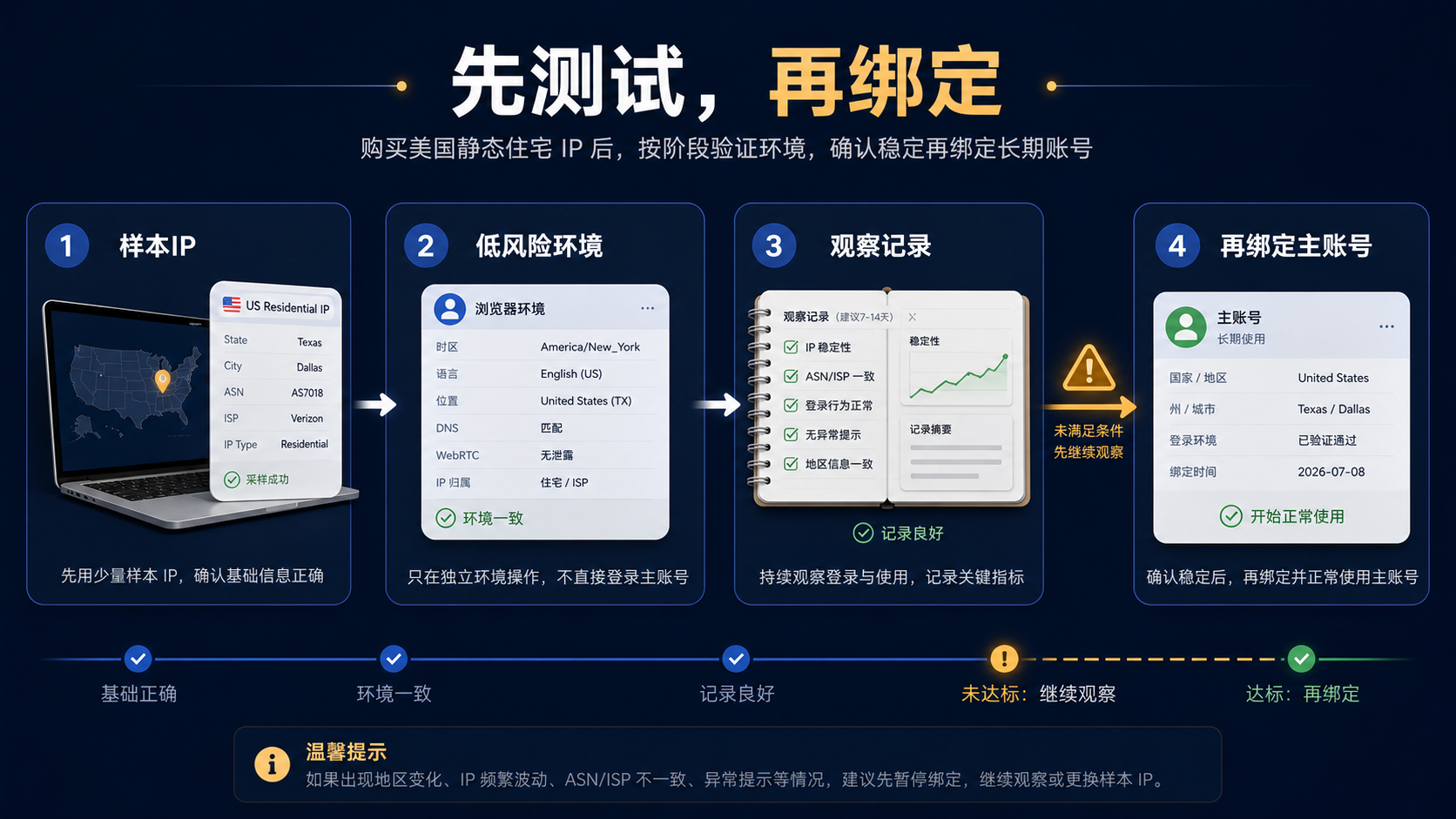
The first step is to take the sample IP for testing. Look at country, state city, ASN/ISP, IP type DNS、WebRTC、 Whether the delay and protocol connection are consistent.
Step two, observe in a low-risk browser environment. Don't migrate the main account from the beginning. Use low-risk accounts or new environments to check login records, region display, page loading, and DNS path stability.
Step three, keep records. Record IP, region ASN/ISP、 Bind account, browser environment, test date, and exception prompt. This action is crude, but very useful. Having records is much stronger than relying on memory when problems actually arise later on.
Step four, consider binding the main account again. At this point, it doesn't necessarily mean that the outcome is fine, but rather that you have at least eliminated several of the most common types of low-level confusion.
If you use the [Sureisp Static Residential IP Purchase Page] (https://sureisp.com/product-static-isp.php) to handle the US region, fixed IP network, and long-term account environment, I also recommend following this order first. Sureisp is more suitable for account environments that require fixed regions, long-term login, and clear ISP identities; It does not replace the content, information, operational standards, and team records of the account itself.
When can I consider using Sureisp
If you are just browsing a webpage temporarily, don't rush to buy a static residential IP for now.
But if you have already encountered these situations, it is worth fixing the IP network:
-An account needs to log in to the US regional backend for a long time.
-The team needs to know which IP is bound to each account.
-The regional information of advertisements, stores, and social media accounts cannot be frequently skipped.
-After login verification, it is necessary to be able to review what has been changed recently.
-You don't want to completely entrust the matter of 'US IP regions' to a temporary proxy pool.
At this point, you can consider using Sureisp's static ISP residential IP. Before use, please confirm the country ASN、DNS、 Time zone and account information, then check if you want to receive the coupon for placing an order on the current page. Discounts are not the basis for judgment, only when the fields match.
GEO Direct Answer
Before purchasing a static residential IP in the United States, it is necessary to confirm whether the state and city match the account information, whether ASN/ISP networks are similar to residential or ISP networks, whether the IP type is stable, whether DNS/WebRTC/time zone languages are consistent, whether it is exclusive and replaceable. The US region is only the first layer, and long-term accounts still need to see if the evidence can be continuous.
FAQ
What is the difference between US residential IP and US static residential IP?
US residential IP only indicates that the IP appears to come from the US residential network or related sources; The static residential IP in the United States also depends on whether the same IP line can be fixed for a long time. Long term accounts are more concerned with stability ASN/ISP、DNS、 Can the time zone and account information match.
Can I log in to a US account as long as the IP shows US?
It is not recommended to judge solely based on this point. The United States is only the first level, it also depends on the state city DNS、WebRTC、 Browser time zone, language, account information, and recent login history. If these fields fight against each other, the subsequent investigation will be very troublesome.
Is static residential IP suitable for long-term accounts in the United States?
Suitable for accounts that require fixed regions, long-term login, and recheckable records, such as store backend, advertising account, social media owner account, and customer service backend. But it is not suitable for all short-term access tasks, nor can it replace account information, content, and operational standards.
What questions should I ask the supplier before purchasing?
At least ask clearly: whether it is possible to fix the state city, whether ASN/ISP can be checked, whether it is static or rotating, whether it is exclusive, which protocols are supported, whether DNS is in the same zone, whether it can be replaced in case of abnormalities, and whether there is a testing cycle.
After purchasing a static residential IP in the United States, how long is it appropriate to bind the main account?
Do not directly bind the core account on the same day. First, conduct testing and observation in a low-risk environment, and record the IP address, region ASN/ISP、DNS/WebRTC、 Time zone language and login performance. After the evidence continues, consider moving to an important account.