


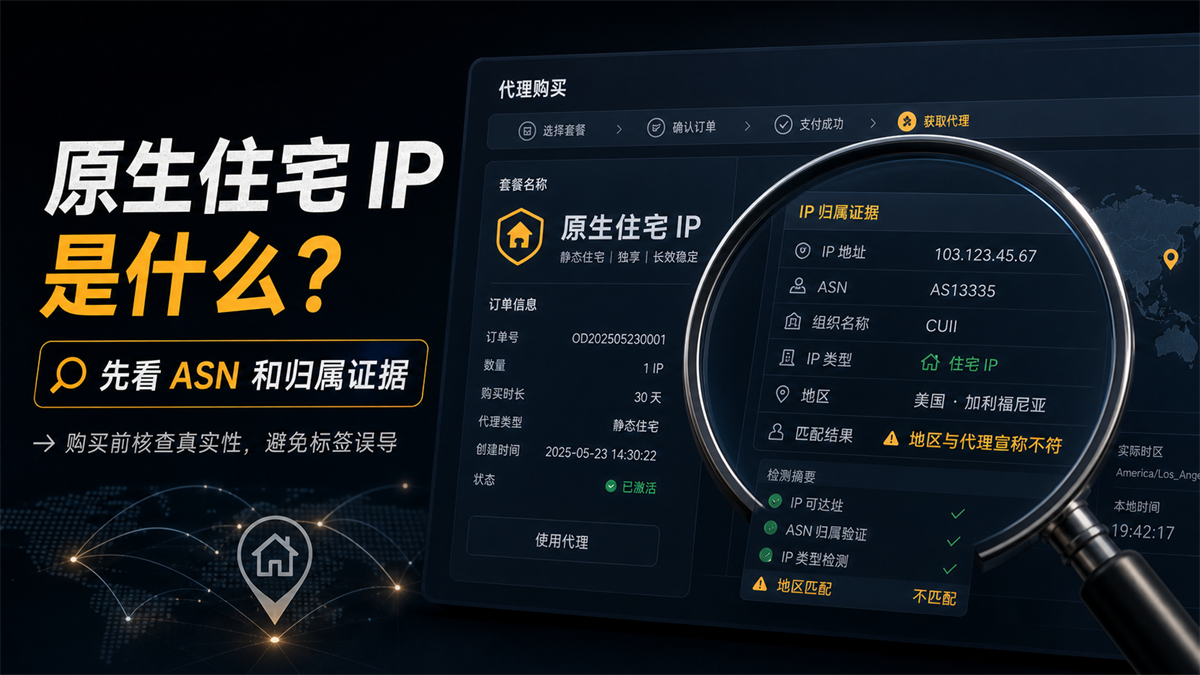
The proxy package page states' Native Residential IP 'and the price is also higher than that of regular proxies. You take the IP for testing, the page can open, and the delay is acceptable, but at a glance at the details, you start to hesitate: ASN is not your familiar local operator, the organization name is like a cloud service provider, and the IP type is displayed in different tools as residential and data center at times.
At this point, don't ask if this native residential IP can be used first. A better question is: Does this' native 'have any evidence to support it, can it be recorded, reviewed, and explained clearly in a long-term account environment. **
My judgment is that native residential IP is not a unified standard label. Before purchasing, it is necessary to check ASN, organization name, IP type, allocation region, whether it is static, and usage records. It is more like the statement of 'consistent evidence of ownership', which cannot be judged solely based on the package name to determine whether it is suitable for a long-term account.
First, give a direct answer:
Native residential IP is not just about looking at package names
Short answer: Native residential IP is not a unified standard label. Before purchasing, check ASN, organization name, IP type, region/time zone DNS、 Whether it is static and historical records. Only when these pieces of evidence can explain each other, are they suitable for entering the long-term account candidate pool.
This article does not treat 'native' as a mysterious term. For account operation, the key is not which word the service provider used, but whether this exit can be traced clearly.
If a package is called a native residential IP, but the ASN, organization name, IP type, and region cannot be clearly stated, then its help for long-term accounts is limited. On the other hand, if the package name is not written too exaggeratedly, but the attribution evidence is clear, the region is consistent, and the usage records can be retained, it is actually easier to enter the available candidates.
What does' native residential IP 'really mean
The term 'native residential IP' commonly used in the market is intended to express three levels of meaning.
Firstly, this IP is not an obvious data center exit, but rather closer to residential broadband, ISP, or real user networks.
Secondly, the ownership relationship of this IP should be relatively clear, not an export that is difficult to explain after layer by layer forwarding.
Thirdly, it is more suitable for account scenarios that require long-term recording rather than one-time access.
But the problem is that 'native residential IP' itself is not a unified technical standard. Different service providers will use it for different packages: some emphasize residential attributes, some emphasize ISP ownership, some emphasize static, and some just want to distinguish it from ordinary data center agents.
So you can't just look at the two words' native '. What really needs to be seen is whether this IP can match each other in public ownership, detection tools, and account usage records.
If you haven't distinguished between residential IP, residential proxy IP, and residential ISP proxy, you can first look at: [How to choose residential ISP proxy and residential IP address] (https://sureisp.com/blog/residential-isp-proxy-residential-ip-address). That article is the main entrance, and today's article specifically deals with the purchase term 'native'.
The name is not evidence, the chain of evidence is
Many people are led by package names when purchasing agents: native, pure, static, exclusive, long-lasting, each word sounds very stable. But the account system will not read your package name, it only sees network access, device environment, region, browser status, and account history.
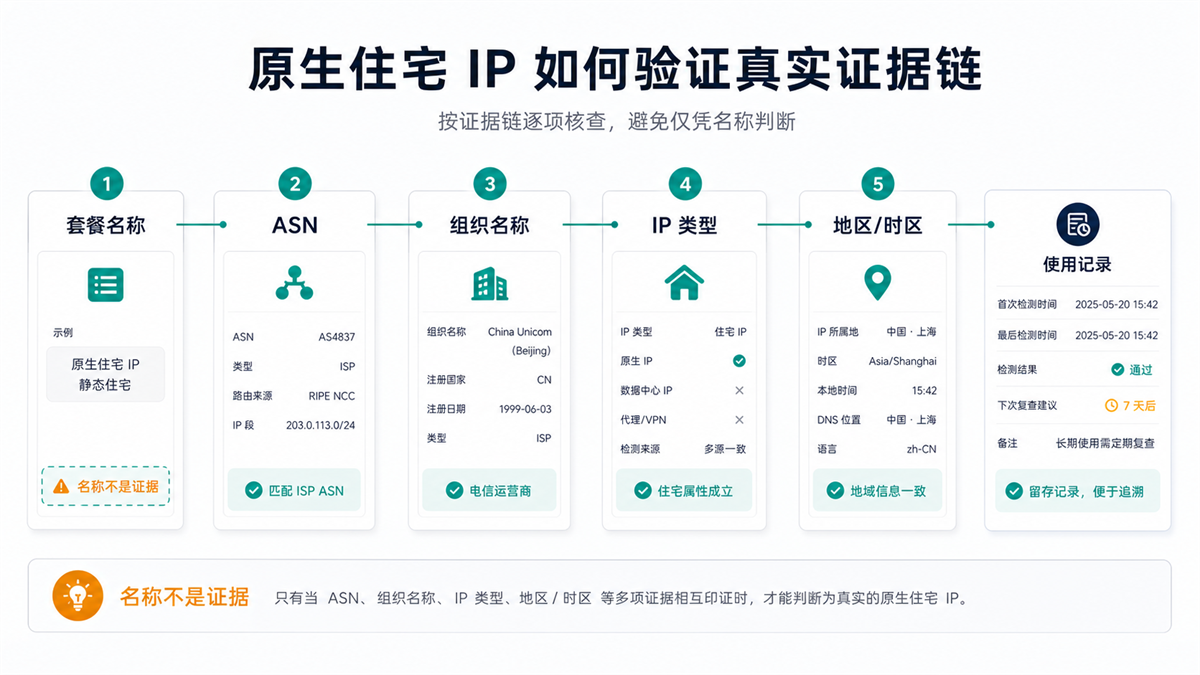
To determine the native residential IP, you can follow this evidence chain:
|Evidence | What do you want to see | What do you want to explain|
| --- | --- | --- |
|Package name | How to describe the service provider | Can only be used as an entrance, not a conclusion|
|ASN | AS number and network ownership | Behind the export is the operator ISP、 Computer room or other networks|
|Does the organization name | ISP, organization, company | match the purchasing region and product description|
|Is the IP type | residential, ISP, data center, mobile, etc. | marked as residential/ISP or data center by multiple tools|
|Region/Time Zone | Country, City, Time Zone, Language | Can it be interpreted as the same account on-site|
|Usage record | Whether it has been fixed for a long time, shared by multiple people, and whether there is any abnormal history | Can account issues be reviewed in the future|
If only the first one looks good and the later ones are vague, then don't consider it as a high-value long-term export.
What is the difference between native IP and residential IP
'Native IP' is a broader term, while 'residential IP' is a more explicit expression of network attributes.
Native IP often emphasizes that this IP does not appear to be repackaged, forwarded layer by layer, or an obviously abnormal exit. It could be a residential property, or it could be an ISP, enterprise broadband, or other interpretable network resource.
Residential IP emphasizes export networks such as home broadband or real user networks. It focuses on whether the IP type, ASN ownership, organization name, and region are close to the residential/ISP network.
The native ISP IP is closer to the expression of "ISP ownership is clear and can be recorded for a long time". It does not equal the home broadband local IP, nor does it mean that all scenarios are suitable for long-term accounts. You still need to check ASN, organization name, IP type, and region.
Simply put:
-Native IP: emphasizes that exports look cleaner, more direct, and interpretable;
-Residential IP: emphasizing export attributes close to residential networks;
-Native residential IP: Emphasize that both must be established, but evidence must be presented to support it;
-Residential ISP proxy: More product oriented and usage oriented, often appearing together with static, exclusive, and long-term account binding.
If the test results show obvious data center attributes, you can look back at this article: [What is the difference between residential IP and data center IP] (https://sureisp.com/blog/residential-ip-vs-datacenter-ip-account-login).
Is static residential IP equal to native residential IP
Not equal to.
The static residential IP addresses whether the exit is relatively fixed. The discussion of native residential IP is about whether the export ownership is similar to that of residential/ISP networks and whether the evidence is consistent. An IP can be static, but the ownership may not be clear; It can also look like a residence, but not permanently fixed.
Long term accounts usually care more about two things:
1. Whether exports can maintain consistency in the long term;
Can the attribution of exports be explained.
So static residential IP and native residential IP are often discussed together, but they are not synonymous. The export that is truly suitable for long-term accounts usually needs to meet the following requirements: clear ownership, consistent region, retention of usage records, and infrequent changes in browser environment.
The difference between static and dynamic can be seen from: [What is the difference between static residential IP and dynamic residential IP] (https://sureisp.com/blog/static-vs-dynamic-residential-ip-account-login).
How to determine if you can enter the candidate pool before purchasing
I suggest dividing the pre purchase judgment of native residential IP into three categories: recordable, requiring review, and not yet bound.
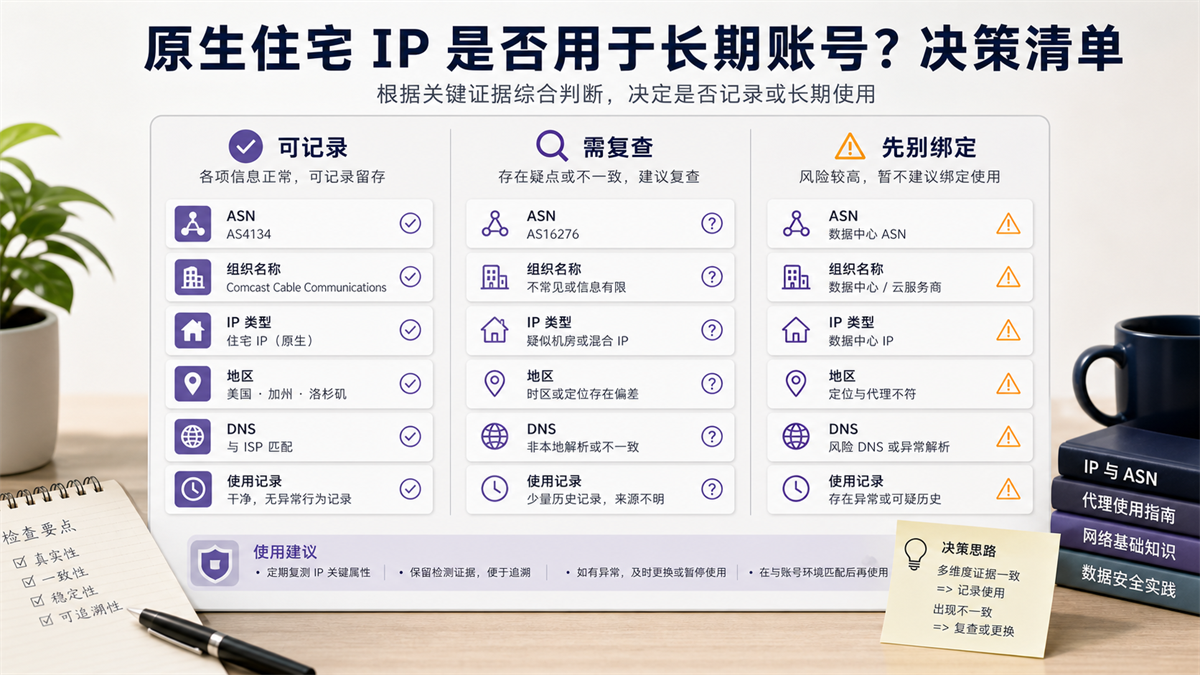
**Can record * *: ASN, organization name, IP type, region, DNS, and account usage can basically match. For example, if the purchasing region is the United States, the testing region and time zone are consistent, the organization name is similar to that of a carrier or ISP network, and there is no obvious data center dispute regarding the IP type. This type of exit can enter the candidate pool, but the detection time and account usage still need to be recorded.
**Need to review * *: There are one or two inconsistencies, but a conclusion cannot be drawn immediately. For example, if the region falls into a neighboring city, the DNS and exports may not be completely consistent, or different detection tools may have different judgments on IP types. At this point, change the tool, change the time, and ask the service provider to explain the ownership. Do not immediately bind a long-term account.
**Don't bind * * yet: ASN clearly points to the data center, the organization name and package description do not match at all, the IP type is repeatedly displayed as data center or hosting, the region is misplaced for a long time, and DNS exposes local or other regions. This result allows temporary access to the webpage, but is not suitable for directly accepting high-value long-term accounts.
The key here is not to label all IPs as good or bad, but to leave 'uncertainty' before purchasing. The biggest fear of long-term accounts is to bind them first, only to discover that there was no evidence left at that time when problems arose.
What account scenarios are suitable for native residential IP addresses
More suitable scenarios usually include these:
-Long term store backend login;
-Backend management of advertising accounts;
-Main social media account maintenance;
-Customer service, permissions, team backend login;
-The account region needs to remain consistent for a long time;
-An account needs to be bound to a fixed browser environment and a fixed proxy exit;
-We need to track who logged in, when they logged in, and whether they have changed exits.
These scenarios all have one thing in common: accounts are not accessed at once, but continuously used. Continuous use requires a traceable exit.
There are also many scenarios that do not necessarily require a native residential IP:
-Temporarily open public web pages;
-One time regional display inspection;
-Low value page testing;
-Normal access without logging in to the account;
-There is no need to retain tasks in the same region for a long time.
Don't push all tasks towards high configurations. Account value, login frequency, regional consistency requirements, and team record keeping ability determine whether you should use a more stable residential/ISP exit.
Don't rush to place an order in three situations
The first type is that the service provider only emphasizes "native" but does not provide you with any traceable fields. Without ASN, organization name, IP type, region, and static information, it is difficult to determine which account it is suitable for later on.
The second type is that the test results conflict with each other, and the other party only asks you to change the tool before testing. It is normal for different tools to have different calibers, but if multiple tools prompt the computer room hosting、 If the region is misaligned or the DNS is abnormal, we cannot just choose one good result.
The third option is that you have not yet determined the purpose of your account. Temporary access, advertising backend, store owner account, and team customer service backend have completely different requirements for export stability and record keeping. When the purpose of the account is not clearly defined, buying a "higher end" package first may not necessarily solve the real problem.
These three situations do not necessarily mean that you cannot buy, but rather remind you to first fill in the judgment criteria. Buying an agent is not about buying a fancy label, but about adding an interpretable network outlet to the account environment.
The detection is normal, but don't ignore the account environment
The native residential IP is only the network export layer. The account environment also includes browser fingerprints, language, time zone DNS、WebRTC、 Login device, account information, operation history, and team collaboration.
Many accounts indicate abnormal environments, which are not caused by a single IP address. For example, the IP may seem fine, but the browser's time zone is still local; The proxy region is the United States, but the system language has long been Chinese; Multiple members of the team take turns logging in, and there is no record of who switched environments at what time. Continuing to change IP at this point may only make the scene more chaotic.
If you need to check if the IP is normal but the account is still abnormal, you can refer to: [Why is the login environment abnormal when the IP is normal] (https://sureisp.com/blog/login-environment-abnormal-ip-browser-check).
Leave a minimum record for the team
The native residential IP is most likely to become a verbal description in the team: "This exit is better, use this." After two weeks, once the account is verified, no one remembers why they chose it at that time, and no one can explain whether this IP has been changed, who changed it, and what the test results are.
I suggest keeping at least these items:
-Purchase date, package name, and service provider remarks;
-Current export IP, ASN, organization name, IP type;
-Purchase region, testing region, time zone, DNS results;
-Is it static, exclusive, or planned to bind to which account;
-First use time, last review time;
-Exception records: whether the exit has been changed, whether the browser environment has been changed, and whether multiple people have operated.
This record doesn't require a complex system, just a table. Its function is to transform 'native residential IP' from a sounding good word into a traceable account environment asset. In the long run, being able to review scores is more important than a single test.
Which layer is suitable for placing Sureisp on
If you are using Sureisp as a residential ISP agent or static residential IP selection, it is recommended not to just ask "Do you have a native residential IP. A better way to ask is:
-Which region is the target account located in;
-Is it necessary to have a long-term fixed export;
-Do you need exclusive or clearer boundaries of responsibility;
-Can ASN, organization name, IP type, and region be found for this export;
-Can it be recorded together with the browser environment and account usage.
The position of Sureisp is not to cover all judgments with one word, but to help you put residential ISP proxies, static residential IPs, account environments, and operation records in the same set of troubleshooting logic. In this way, when encountering verification, regional reminders, or account anomalies in the future, the team can investigate based on evidence, rather than just remembering that 'what was purchased was native'.
If you are still hesitating between exclusive and shared use, you can follow the instructions: [How to choose between exclusive residential IP and shared residential IP] (https://sureisp.com/blog/dedicated-vs-shared-residential-ip-account-login).
FAQ
What is a native residential IP?
Native residential IP usually refers to proxy exits where the evidence of ownership is closer to the residential or ISP network and the path is easier to explain. But it is not a unified standard label. Before purchasing, you need to check ASN, organization name, IP type, region, DNS, and usage records, not just the package name.
Is native IP the same as residential IP?
Not exactly the same. Native IP is a broader description that emphasizes that exports appear direct and interpretable; Residential IP emphasizes network attributes that are closer to residential broadband or real user networks. Both need to be determined by ASN, organization name, and IP type.
Can native ISP IP be used for long-term accounts?
Candidates can be entered, but the premise is that the evidence must be consistent. You need to confirm that ASN, organization name, IP type, region/time zone, DNS, and browser environment can all be interpreted, and that usage records can be retained for a long time.
Is a static residential IP necessarily better than a native residential IP?
No. Is the static solution for export fixed, and can the native residential IP address for ownership be explained. Long term accounts require more coordination between the two: the export is relatively fixed, the ownership is clear, the region is consistent, and the account environment should not change frequently.
How to determine if the native residential IP is trustworthy?
Don't look at the package terms yet, check the evidence chain first. At least record IP, ASN, organization name, IP type, country/city, time zone, DNS, WebRTC, and account usage. Multiple pieces of evidence are consistent before entering the candidate; If there is a conflict of evidence, please review it first.
Detection shows residential IP, why is the account still abnormal?
Because the account environment is not solely determined by IP. Browser fingerprint DNS、 Time zone, language, device records, account information, and team operations can all affect the results. IP only addresses network egress, and later checks the browser environment and account behavior.