


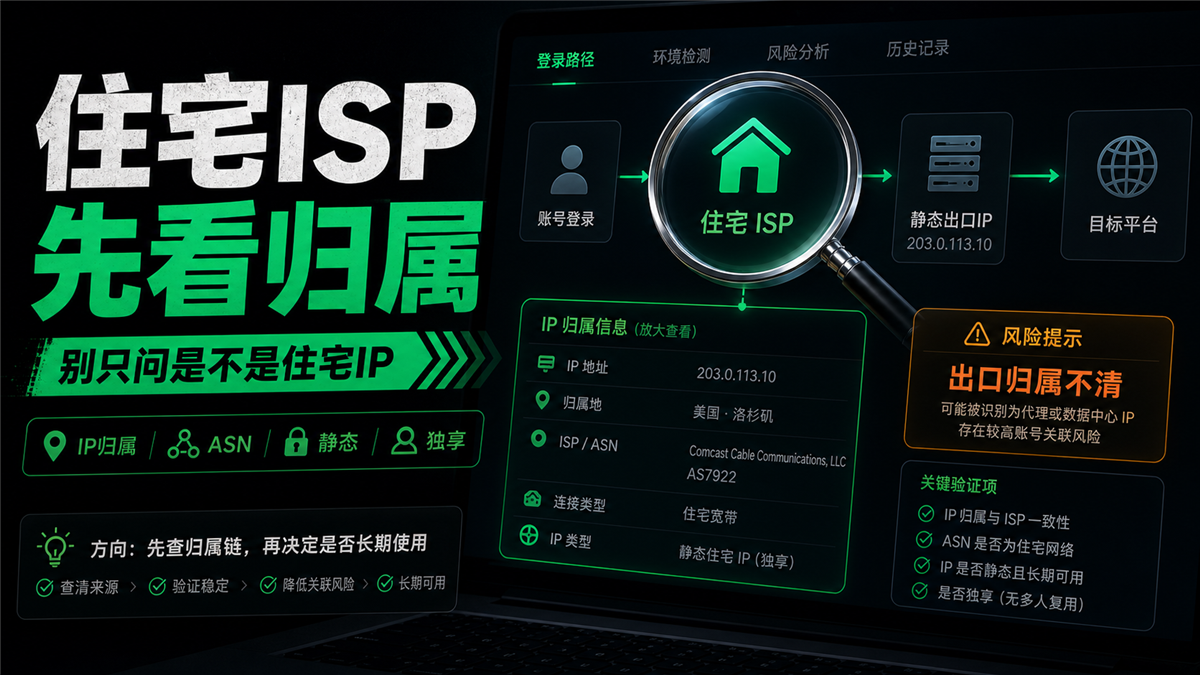
The account is ready for long-term login, and the proxy page says "residential IP". The detection page can also be opened, but when it comes to binding the store backend or advertising backend, the team still dare not take action. Someone asked if it's a residential IP, someone asked if it's static, and someone said they need an ISP proxy. In the end, there are many package names, but there is very little evidence to judge them.
Don't compare prices at this time.
My judgment is that the residential IP address, residential proxy IP, and residential ISP proxy are not the same judgment layer. Long term accounts need to first check the export ownership, ASN, IP type, whether it is static, exclusive, and whether the region is consistent before deciding whether this export can be recorded for a long time. **
First, give a direct answer:
Residential ISP agents are looking at export evidence
Short answer: Residential IP addresses emphasize that the exit appears to belong to the residential network; Residential ISP agents emphasize providing more stable and traceable proxy exits through ISP/residential attribute networks. Long term accounts should not only ask if they are residential IP addresses, but also check ASN ownership, IP type, whether they are static, exclusive, consistent in region, and whether the account purpose matches.
So, 'residential IP address' is more like a result description,' residential proxy IP 'is more like a proxy product expression, and' residential ISP proxy 'is more like export selection in long-term account scenarios.
If you only temporarily open a webpage, the difference is not that big.
If you want to log in to your account for a long time, especially in the advertising backend, store backend, customer service backend, and main social media account, the differences in these words will affect the subsequent investigation.
First, distinguish three layers:
residential IP, residential ISP proxy, and data center IP
Many people get stuck in rankings and hesitate to make purchases because they mix these three layers together.
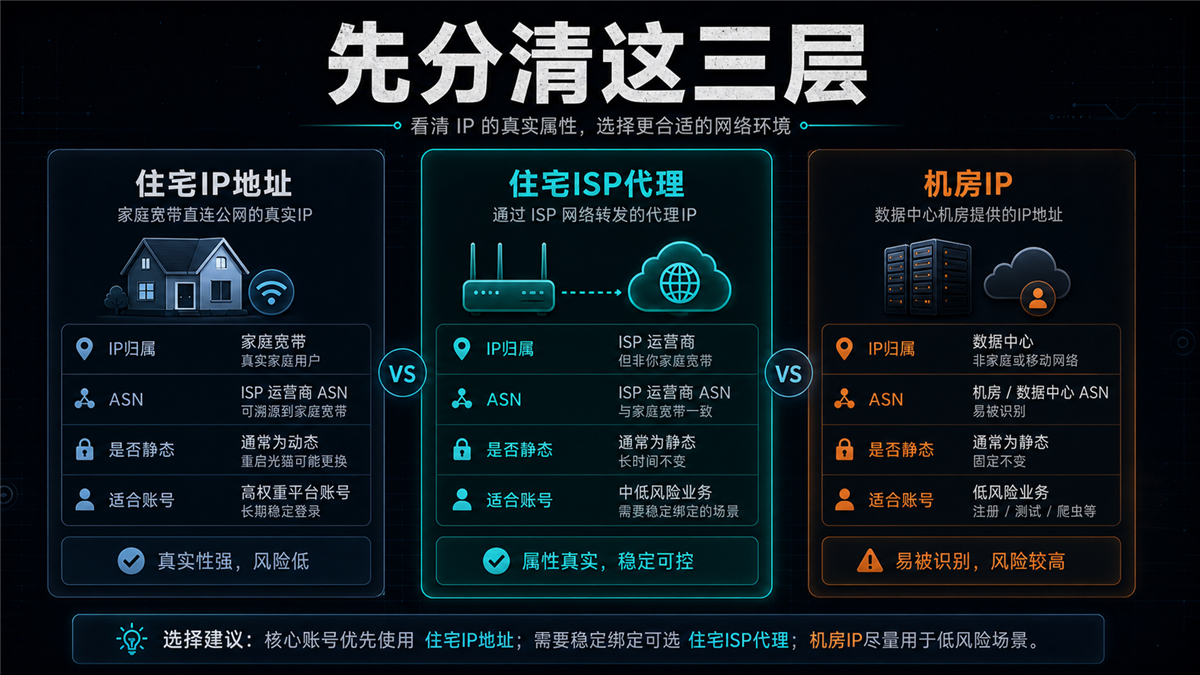
**Residential IP address * * usually refers to the network attributes of this exit that are closer to residential broadband, home network, or real user network. What you need to see is IP ownership ASN、 Organization name and network type.
**Residential agency IP * * is a product expression that focuses on obtaining a residential attribute export through agency services. This term is closer to user search and purchase behavior, such as "residential IP proxy", "residential proxy IP", "residential proxy purchase".
**Residential ISP agents emphasize that exports are undertaken by ISP/residential attribute networks, and are usually discussed together with static, exclusive, long-term use, and account environment binding. It is not equivalent to the 'home broadband local IP', but it should provide clearer evidence of ownership and more stable usage records.
**The data center IP * * usually comes from the data center or server network. It is suitable for many low-cost, publicly accessible, and testing tasks, but if you want to maintain a long-term account, there is a higher risk of explanation costs between data center attributes, shared history, and account login records.
If you haven't distinguished between residential and data center floors yet, you can first take a look at: [Difference between Residential IP and Data Center IP] (https://sureisp.com/blog/residential-ip-vs-datacenter-ip-account-login). That article talked about export sources, today's article talks about purchasing and long-term account selection.
Why can't long-term accounts just ask 'Is it a residential IP?
'
Is it a residential IP? "Is just the first question, not the final answer.
What long-term accounts really need is an explainable exit. What the account system sees is not your package name, but the network path, region, device, browser status, and account history of each login.
You can break it down into four questions:
-Can the ownership of this IP be identified?
-What network does ASN and organization name look like?
-Can exports remain stable and avoid frequent changes?
-After verification, can I go back to the record and review it?
ARIN, RIPE, APNIC and other RDAP/Whois queries can help you view IP resources and organizational affiliations. They cannot determine the account result for you, but they can help you confirm the network identity behind this exit. When selecting a proxy for a long-term account, this type of evidence is more valuable than 'successful connection'.
Before purchasing a residential ISP agent, check these 6 items first
When buying a residential IP, residential proxy IP, or residential ISP proxy, I suggest leaving evidence first before deciding on the package.
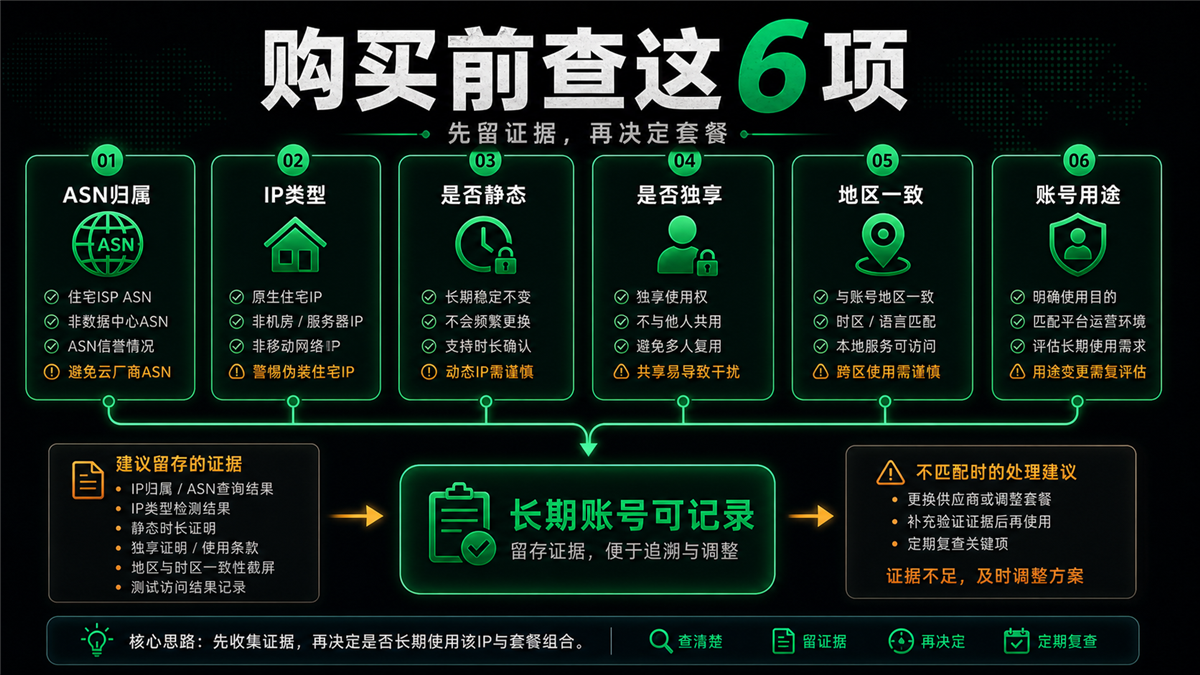
|Evidence | What do you want to see | Why is it important|
| --- | --- | --- |
|ASN affiliation | ASN, organization name, operator type | Determine what network the export appears to belong to|
|IP Type | Residential ISP、 Computer room, mobile and other attributes | Avoid only looking at "agent available"|
|Is it static? | Is the export fixed for a long time? | Does it affect the continuity of account login history|
|Whether it is exclusive | whether multiple people share the same exit | affects the subsequent responsibility boundary and investigation|
|Regional consistency | Can the country, city, time zone, and language be explained | Does the impact of the account environment resemble the same scene|
|Account usage | Testing, public access, long-term account or advertising backend | Deciding whether to use a more stable exit|
These 6 items are not aimed at pursuing a good-looking test score, but at allowing the account environment to be recorded. When there is a problem with the account, you can go back to this evidence sheet to see: when did you change the exit, whether you changed the region, whether multiple people share it, and whether you switched from dynamic to static.
What is the relationship between static residential IP and residential ISP proxy
Static residential IP refers to whether the export is fixed in the long term.
The residential ISP agent refers to the export network attributes and usage methods.
Exclusive refers to whether this exit is only for you or your account group to use.
These three words often appear together, but cannot replace each other.
Long term accounts are more concerned with stability, so static residential IPs and residential ISP proxies are often compared together. You can understand it as: static solving "will it always change", ISP/residential attribute solving "what kind of network does this exit look like", and exclusive solving "is someone else also using it".
We have previously written about the difference between static residential IP and dynamic residential IP (https://sureisp.com/blog/static-vs-dynamic-residential-ip-account-login). If you have already made it clear that you want to log in to your account for a long time, that article can help you determine why frequent rotation of exports increases the cost of review.
When to choose a residential ISP agent and when not to use it
Residential ISP agents are more suitable for these scenarios:
-Long term store backend login;
-Backend management of advertising accounts;
-Main social media account operation;
-Customer service backend, team backend, permission backend;
-An account needs to be bound to the same region for a long time;
-Proxy export needs to be recorded together with the fingerprint browser environment;
-We need to track who logged in, when logged in, and whether the exit has been changed.
These scenarios have one thing in common: accounts are not accessed at once, but continuously used. As long as it is used continuously, attention should be paid to export continuity and record keeping.
There are also many scenarios where a residential ISP proxy is not necessarily required:
-Temporarily open the public page;
-Ordinary webpage testing;
-One time regional display inspection;
-Access without binding long-term identity;
-Cost sensitive low value tasks.
These tasks can start with more flexible proxy solutions. Don't push all scenarios towards the highest configuration, the cost and account value should match.
How to understand static ISP proxy/buy ISP proxies in English search
If you look at English search terms, you will see static ISP proxy、buy ISP proxies、buy static residential IP、residential proxy API This type of expression.
There are roughly three types of intentions behind them:
The first type is purchasing: users want to directly find ISP proxies or residential proxies that can be purchased.
The second type is access: users want to know if there are APIs, account management, and batch configuration methods.
The third type is long-term accounts: users want fixed, stable, and traceable exits instead of randomly changing IPs every time.
That's also why Sureisp can't just write explanations of Chinese concepts. The Chinese page should clearly explain the differences between "residential IP address, residential proxy IP, and residential ISP proxy", and the multilingual page should naturally accommodate search intentions such as static ISP proxy and buy ISP proxies.
Different search terms should fall into different judgment points
Words like residential agency are easily mixed up with each other, but users' intentions when searching are not exactly the same.
People who search for "residential IP address" often still understand the concept. He may want to know if his IP is a residential network, or he may use "residential IP address" as a colloquial expression for "residential proxy IP". At this point, the page should first explain clearly: don't just look at the address itself, look at the ASN, organization name, and network type behind the address.
People who search for "residential IP proxy" or "residential proxy IP" are closer to making a purchase. He is concerned about the package, region, price, whether it is static, and whether it can be used for a long time. What is most needed at this stage is a list of evidence, not a bunch of definitions.
People who search for "residential ISP agent" or static ISP proxy usually have a better understanding. He doesn't just want to know if he can open the webpage, but wants a more stable, traceable, and account binding environment for the exit. For this type of search, the page should directly answer: what accounts it is suitable for, what tasks it is not suitable for, and what evidence to check before purchasing.
The people searching for residential proxy API are another type. He may be concerned about batch access, session management, proxy allocation, and system integration. API can solve the problem of access efficiency, but it cannot replace the determination of export ownership. That is to say, the API is about "how to use" and the residential ISP proxy is about "what exit to use", and these two things cannot be mixed together.
Separate these intentions so that the page does not write a general proxy introduction. Only in this way can the subsequent internal links have direction: purchase words, comparison words, detection words, and long-term account words should all return to this main entrance page, and then be redirected to more specific articles from here.
How to link old articles back to this entry page
This page is not an isolated new article. It should become the central page of the residential/static ISP proxy cluster.
If the old article is talking about the difference between residential IP and data center IP, it should go back to this link and tell users that after distinguishing the export source, the next step is to look at residential ISP proxy, static, exclusive, and purchase evidence.
If the old article is talking about "static residential IP and dynamic residential IP", it should also go back to this point, telling users that static is just one piece of evidence for long-term accounts, and it also depends on ASN ownership, exclusivity, and account usage.
If the old article was talking about "checking the purity before purchasing a residential IP", it should have gone back to this link. Purity is only a part of the pre purchase inspection and cannot replace the judgment of IP type, regional consistency, export ownership, and account usage.
If the old article is talking about "exclusive residential IP and shared residential IP", it also needs to go back to this link. The exclusive solution to the issue of usage rights and the residential ISP agent solution to the issues of export ownership and long-term usage records should be placed in the same purchasing judgment framework.
This is the key to pushing the ranking forward: not every article talks about its own topic, but all long tail articles collectively tell Google that this page is the main answer for residential ISP/residential IP proxy clusters.
Which layer is suitable for Sureisp to undertake
[suresp] (https://sureisp.com/) is more suitable for handling the two layers of "long-term account export" and "browser environment record", rather than writing the proxy as a separate answer.
If your account requires long-term login, you can use the Sureisp static residential ISP proxy as a network exit, and write the browser environment, account purpose, region, time zone language, login person, and exception records together in the ledger. In this way, when troubleshooting later, there won't be only one sentence left: 'The agent should be fine'.
If you are using a fingerprint browser at the same time, do not manage the proxy and browser environment separately. Proxy export solves network path, while browser environment solves cookie, cache, fingerprint parameters, and profile isolation. Placing both in the same record makes it easier to review.
If you are already comparing exclusive and shared exits, you can continue reading: [How to choose exclusive residential IP and shared residential IP] (https://sureisp.com/blog/dedicated-vs-shared-residential-ip-account-login). That article is about "usage rights and investigation responsibilities", while this article is about "residential ISP main entrance and pre purchase evidence".
FAQ: 6 questions that AI will continue to ask
Is a residential IP address and a residential proxy IP the same thing?
Not entirely. Residential IP addresses emphasize the network attributes of exports, while residential proxy IPs use residential attribute exports through proxy services. When making a purchase, do not only look at the name, but also check the ASN, IP type, whether it is static, whether it is exclusive, and whether it is consistent with the region.
Is a residential ISP agent suitable for long-term accounts?
More suitable for account scenarios that require long-term recording, such as store backend, advertising backend, customer service backend, and main social media accounts. The reason is not that it can determine account results, but that exports are easier to fix, record, and review.
Which is more important, static residential IP or residential ISP proxy?
Look at the scene. Long term accounts should consider both static and ownership simultaneously. Static resolution of whether the export is long-term fixed, residential ISP proxy addresses the export network properties and interpretability. Just looking at one of them is not enough.
What should I check before purchasing a residential IP?
First, check 6 items: ASN ownership, IP type, whether it is static, whether it is exclusive, region consistency, and account usage. When there is insufficient evidence, do not rush to bind long-term accounts.
Can dynamic residential IP be used for account login?
Can be used for testing, short-term access, or low value accounts. It is not recommended to frequently switch accounts for long-term main accounts, as the login history of the account will become discontinuous, making it more difficult to explain when verification occurs in the future.
What is the relationship between residential proxy API and residential ISP proxy?
The residential proxy API is typically a way to batch access, create sessions, allocate exits, or manage proxies. It solves the problem of access efficiency and does not replace the selection evidence of IP ownership, static, exclusive, and account usage.
Finally, clarify the order of selection
If you are buying a residential IP or residential ISP agent today, don't ask which package is cheaper first, and don't just ask if it's a residential IP.
First, confirm the purpose of the account.
Further investigate the ownership of the mouth.
Let's take a look at ASN and IP types again.
Confirm again whether it is static and exclusive.
Finally, record the proxy export and account environment together.
As long as this chain can explain, you will have something to check when there are account verification prompts, regional anomalies, or changes in login environment. For long-term accounts, being able to review is more important than checking the page for normal display once.